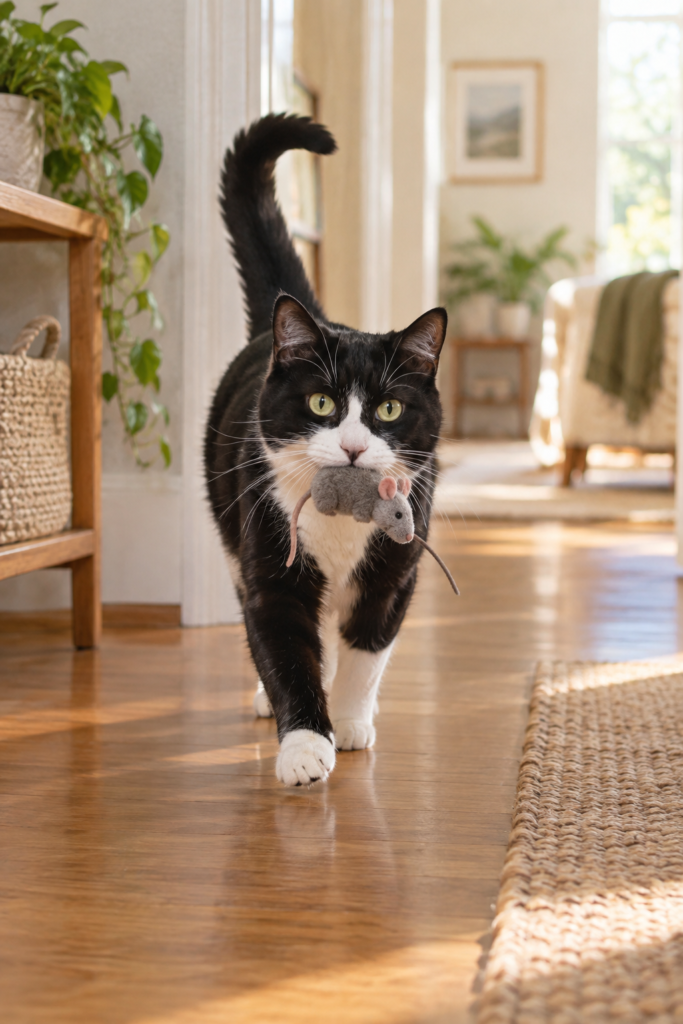
If your cat has ever marched into the room carrying a toy mouse, a sock, or something that absolutely should not be in its mouth, congratulations: you may have just received a present. It may not be wrapped, and it may smell faintly of carpet, but in cat language it can mean quite a lot.
So, why does your cat bring you gifts? Usually, it is a normal mix of instinct, play, attention-seeking and social bonding. Your cat is not necessarily trying to start a tiny household gift shop. It may simply be sharing an activity, showing off a successful “hunt,” or inviting you into its world.
Why does my cat bring me gifts?
Cats are natural hunters, even when their biggest daily challenge is reaching the food bowl before you do. Hunting behaviour often follows a sequence: notice, stalk, chase, catch and carry. Indoor cats still have those instincts, but instead of a mouse or bird, the target may be a feather toy, a plush ball, a hair tie or one of your socks.
When your cat carries the object to you, it may be completing that sequence in the safest place it knows: home, with its favourite person nearby. In other words, you may have been promoted to head of the household’s tiny hunting department.
Five common reasons cats bring objects to their owners
1. Your cat is sharing a successful “hunt”
A toy can stand in for prey. Bringing it to you may be your cat’s way of presenting the result of a successful chase. Some cats drop the toy at your feet, while others carry it around proudly before placing it somewhere highly visible. The message is often less “please admire my craftsmanship” and more “look what I managed to catch.”
This behaviour is especially common in cats who enjoy interactive toys that move like prey. Wand toys, small balls and soft mice can all trigger the same instincts as outdoor hunting, without the risks of traffic, fights or parasites.
2. Your cat has learned that gifts get attention
Cats are excellent observers. If you laugh, talk, pet them or throw the toy whenever they deliver an object, they quickly learn that carrying something to you is a reliable way to start a conversation.
That does not make the behaviour fake. It simply means your cat has discovered a successful social routine. Cats repeat what works, and “bring object, receive attention” is a very reasonable business model from their point of view.
3. It is an invitation to play
Sometimes the gift is not really a gift at all. It is a request. Your cat may be saying, “Please activate the fun machine.” This is common when the object is a favourite toy and your cat looks alert, waits for you to move, or carries it back after you throw it.
A few short play sessions each day can help satisfy this need. Let your cat stalk, chase and pounce rather than waving the toy randomly in its face. Finish with a successful catch, then allow a quiet cool-down. Cats appreciate a proper ending to the story.
4. Your cat is reinforcing your social bond
Cats do not always show affection in obvious ways. Some sit beside you rather than on you; others follow you from room to room or blink slowly when you look at them. Bringing an object can be another form of social connection.
Your cat may be including you in an activity it finds important. It may also feel safer carrying the object near you, especially if you are a calm and predictable presence. The delivery is not proof that your cat thinks you are another cat, but it can show that you are part of its trusted social environment.
If your cat also rubs against your legs, pauses for gentle contact or settles nearby, you can read the whole pattern together. Learn more about that behaviour in why cats rub against their owners.
5. The object smells interesting
Cats experience the world through scent. A sock, tea towel or piece of packaging can be fascinating because it carries smells from you, other animals, food or unfamiliar places. Your cat may carry it because it is interesting, not because it has assigned the object a sentimental value.
This is one reason you should be cautious with hair ties, string, ribbons and small plastic items. They are exciting to some cats but can be dangerous if swallowed.
Why does my cat bring me gifts at night?
Night-time deliveries are common because cats are naturally most active around dawn and dusk. Indoor lighting and household routines can shift that rhythm, but many cats still feel ready for action when the house becomes quiet.
If your cat brings toys at 2 a.m., it may be trying to start a hunting game while you are trying to sleep. A play session before bed, followed by a meal or puzzle feeder, can help create a calmer routine. Avoid rewarding midnight deliveries with an exciting game every time, or your cat may decide that night shift is now a permanent position.
If night vocalisation is part of the same pattern, see why cats meow at night for more practical ideas.
Should you take the “gift” away?
That depends on the object. If it is a safe toy, you can acknowledge the delivery and use it for a short play session. A calm “thank you” followed by gentle interaction is enough. You do not need to perform a dramatic award ceremony, although your cat may believe one is deserved.
If the object is unsafe, remove it quietly and replace it with an appropriate toy. Avoid chasing your cat or turning the removal into a thrilling game. If the item is string, ribbon, thread, a hair tie, a small plastic object or anything sharp, take the risk seriously. Swallowing these items can cause an intestinal blockage.
When could this behaviour signal a problem?
Bringing toys or harmless household objects is usually normal. Pay closer attention if the behaviour appears suddenly alongside other changes, such as appetite loss, vomiting, hiding, confusion, unusual aggression, excessive crying or difficulty walking.
Also contact your veterinarian if your cat repeatedly chews or swallows non-food items. This can be related to stress, boredom, nutritional problems or a condition called pica. A veterinary check is the right way to work out what is happening rather than guessing from one unusual delivery.
How to respond when your cat brings you something
- Check the object first. Remove anything that could be swallowed, splintered or become tangled.
- Acknowledge your cat calmly. A soft voice or brief stroke can show that you noticed.
- Offer a safe alternative. Swap socks and hair ties for a suitable toy.
- Use the moment for enrichment. A short chase or fetch game can meet the instinct behind the behaviour.
- Keep a routine. Regular play, food puzzles and calm attention reduce boredom-driven mischief.
If the “gift” is a favourite toy, rotate it with a few others so it stays interesting. If your cat brings the same object repeatedly, that is useful information: it may be the texture, smell or movement that makes it special.
What kind of “gift” is your cat bringing?
The object can give you a clue about what your cat is trying to do. A soft mouse or feather toy usually points to play and hunting practice. A sock or small piece of clothing may be attractive because it smells like you. A crinkly wrapper may simply be irresistible because it moves and makes an interesting noise. Cats are not known for choosing the most convenient souvenirs; they choose the ones that switch on their curiosity.
Does bringing gifts mean my cat thinks I am its kitten?
You may hear that cats bring objects home because they are trying to teach their owners to hunt, as a mother cat might teach kittens. It is a charming idea, but it is too definite to apply to every cat. We cannot know that a cat is assigning you a specific role in its family group simply because it carries a toy.
A safer explanation is that several behaviours overlap. Cats have a strong motivation to stalk and catch moving objects, and many also enjoy sharing space and activities with people they trust. Your cat may be combining those instincts in a way that looks wonderfully personal. That still makes the moment special without requiring a story that cannot be confirmed.
How to read your cat’s body language during a delivery
Body language can help you work out whether the object is an invitation, a display or a request for space.
- Relaxed ears, a loose body and a normal tail: your cat is probably comfortable and may be ready for gentle attention or play.
- Wide pupils, crouching and quick movements: the hunting sequence may still be active. Move the toy rather than your hands and let your cat chase from a safe distance.
- Vocalising, staring at you or dropping the toy repeatedly: your cat may be asking you to interact.
- Hissing, growling or guarding the object: give your cat room. Do not grab the item from its mouth, especially if it may have caught live prey.
A cat can also bring an object and then walk away. That does not mean the gift was rejected. Some cats simply enjoy carrying things and leaving them in a familiar place. The delivery may be the entire activity.
What if your cat brings live prey?
Outdoor cats may occasionally bring insects, lizards, birds or small mammals indoors. This can be upsetting, but chasing your cat or shouting can make the situation more chaotic. Keep children and other pets away, close internal doors if possible, and give yourself a clear route to a safe exit or container.
If the animal is alive and you can do so safely, contact a local wildlife rescue service for advice. Avoid handling wild animals with bare hands. If your cat has been bitten or scratched, or if you are unsure whether it has eaten part of the animal, contact your veterinarian. Outdoor cats should also have preventive healthcare appropriate to their location and lifestyle.
How to encourage safe “gift” behaviour
You do not need to discourage a harmless habit. You can shape it so that your cat has safe objects to carry and a predictable way to use its energy.
- Create a small toy collection. Offer several toy types, including a soft toy, a ball and a wand toy used only under supervision.
- Rotate rather than display everything. Keep a few toys out and put the rest away for a day or two. Novelty can make familiar toys interesting again.
- Play at likely delivery times. If your cat becomes active at dawn, dusk or just before bed, schedule a short interactive session before the behaviour escalates into midnight athletics.
- Let the cat catch the toy. A chase that never ends can be frustrating. Allow regular pounces and finish with a successful catch.
- Offer food enrichment. Puzzle feeders and simple scatter feeding can give indoor cats a safe way to search and work for part of their normal food.
- Keep fingers and toes out of the game. Use toys that create distance between your hands and your cat’s teeth and claws.
Start with easy enrichment and watch how your cat responds. A puzzle that is too difficult can create frustration rather than satisfaction. The aim is not to make your cat solve an escape-room challenge before breakfast; it is to add a little safe, rewarding activity to the day.
When a gift becomes a safety concern
The biggest risk is not the delivery itself but what happens if your cat chews or swallows the object. String, thread, ribbon, dental floss, elastic bands, hair ties and small pieces of plastic can become lodged in the digestive tract. Sharp objects can cause even more serious injury.
Put away craft supplies, sewing materials, rubber bands and small children’s toys. Inspect cat toys regularly and throw away anything that is shedding pieces or has loose parts. Do not leave fishing-rod toys, string toys or toys with feathers attached unattended. Cats Protection recommends supervising these toys because a cat can become tangled or swallow part of the toy.
If you see string hanging from your cat’s mouth, do not pull it. Pulling can damage tissues if the string is caught farther inside. Contact a veterinarian promptly for instructions. Seek urgent veterinary advice for repeated vomiting, loss of appetite, marked lethargy, abdominal pain, straining to pass stool or a sudden change in behaviour after possible ingestion. VCA notes that non-food items can cause gastrointestinal obstruction and that string-like objects can be particularly dangerous.
Is the behaviour linked to boredom?
Sometimes a cat starts bringing objects more often because it has discovered a reliable way to create activity. That is not a diagnosis of boredom, but it is a useful prompt to review the daily routine. Does your cat have opportunities to climb, hide, scratch, chase and search for food? Does it spend long stretches alone with nothing changing in the environment?
For indoor cats, small changes can help: move a perch near a window, hide a few pieces of normal food for supervised searching, rotate toys and add short play sessions. If your cat already has plenty of enrichment, the deliveries may simply be a favourite hobby.
If the behaviour is accompanied by destructive chewing, repetitive licking, weight change, anxiety or other unusual habits, make a veterinary appointment. Behavioural changes can have many causes, and a professional assessment is more useful than trying to label the behaviour from a single sign.
Does every cat enjoy a game of fetch?
No. Some cats naturally carry toys back and forth, while others prefer to chase a toy once and then watch you retrieve it. A few will stare at the ball as if you have personally disappointed them. Respect the individual cat.
If you want to encourage fetching, use a lightweight toy your cat already likes. Toss it only a short distance, wait for your cat to investigate and reward interest with calm praise or another gentle throw. Never force the toy into your cat’s mouth or turn the game into a competition. The goal is shared play, not athletic performance.
Frequently asked questions
Why does my cat bring me socks?
Socks carry your scent and are easy for a cat to grip and carry. Your cat may also enjoy their texture or the game of finding them. Keep socks clean and out of reach if your cat chews fabric, and offer a safe soft toy instead.
Why does my cat bring toys to my bed?
Your bed is familiar, smells like you and may be part of your cat’s safe territory. The timing may also reflect natural activity around dawn or dusk. A short play session before bedtime can help, but do not reward every overnight delivery with an exciting game.
Should I praise my cat for bringing a gift?
A calm acknowledgement is fine. You can thank your cat, offer a brief play session or swap an unsafe object for a safe toy. There is no need to make a loud celebration, especially if the item was live prey or your cat is guarding it.
When should I call the vet?
Call your veterinarian if your cat may have swallowed string, plastic, fabric or another non-food item, or if the behaviour comes with vomiting, pain, appetite loss, lethargy or a noticeable change from normal. A sudden behaviour change deserves attention even when the object itself seems harmless.
The simple explanation
Most cats bring gifts because hunting, play, curiosity and social connection overlap. Your cat may be presenting a successful catch, inviting you to play, carrying an interesting scent or bringing an object into a trusted space. The habit can be affectionate without having one single universal meaning.
Enjoy the safe deliveries, redirect risky objects and pay attention to the wider pattern of behaviour. With a few supervised toys, regular enrichment and sensible safety checks, your cat can keep running the household’s gift department without turning it into an emergency room.