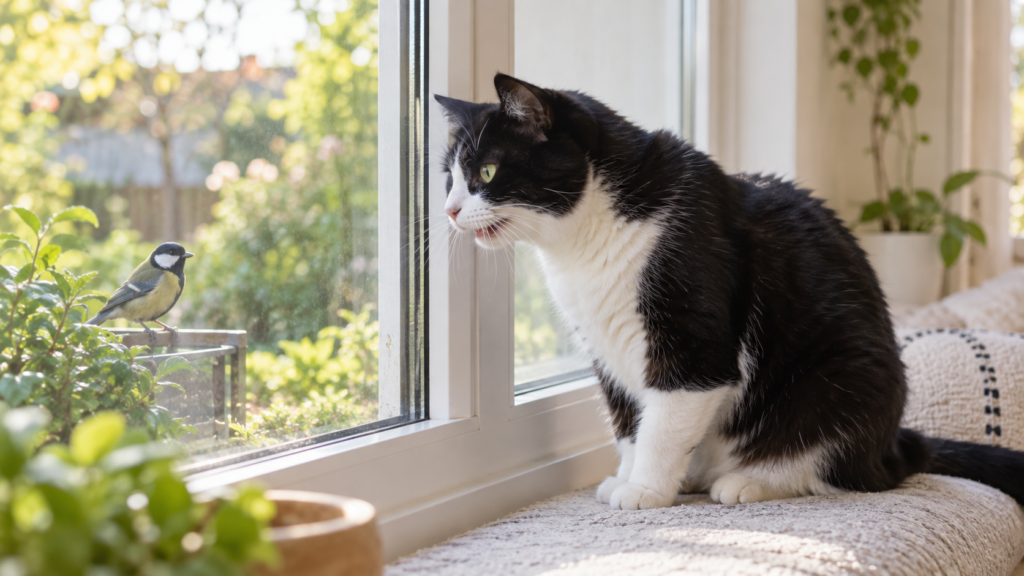
If your cat sits at the window, spots a bird and suddenly makes a tiny series of clicks, squeaks or excited chirps, you are not imagining things. Your cat has not become a miniature bird impersonator overnight. Chattering and chirping are common feline sounds, especially when a cat is watching prey it cannot reach.
So, why does your cat chirp at birds? The honest answer is that there is no single explanation for every cat. The sound may appear when a cat is excited, frustrated, highly focused or responding to a familiar hunting trigger. Some cats also chirp when greeting people or asking you to follow them. Context matters more than the noise by itself.
What does cat chirping or chattering sound like?
People use several words for similar noises: chirping, chattering, chittering, twittering and trilling. One cat may produce a high-pitched “ek-ek-ek” sound, while another makes a fast clicking noise with the jaw. Some cats open and close their mouths quickly as they stare through the window. Others keep their mouths nearly closed and make a short, bird-like series of sounds.
These sounds are different from an ordinary meow, hiss or growl, but cats do not follow a dictionary. The same cat can use slightly different noises in different situations. A soft chirrup when you come home may be a friendly greeting, while rapid chattering at a bird usually comes with intense visual attention.
Why do cats chirp at birds?
When a cat watches a bird outside, several possible explanations can overlap. Behaviour experts generally describe the behaviour in terms of excitement, frustration, predatory arousal and communication. We can observe what happens before and after the sound, but we cannot ask a cat to explain which feeling came first.
Excitement and high arousal
A moving bird is an attention-grabbing sight. It flaps, changes direction and disappears behind leaves, which makes it especially interesting to a predator built to notice small movements. Your cat may chirp because its nervous system is highly activated by the sight. Wide eyes, forward-facing ears, a crouched body and a twitching tail often appear at the same time.
High arousal does not automatically mean your cat is distressed. It can simply mean the situation is very stimulating. Think of the difference between calmly looking at a television and watching the final minute of a close match. Your cat is not necessarily upset; it may just be completely absorbed in the action.
Frustration caused by the window
A window creates a barrier between your cat and the bird. Your cat can see the prey, hear it and sometimes smell it, but cannot complete the chase. That mismatch can produce frustration. Chattering may be one outward sign of a cat whose hunting sequence has started but cannot move to the next step.
This is sometimes called barrier frustration. It does not mean your cat needs to be let outside. Outdoor access carries its own risks, and many cats can enjoy a rich indoor life. It does mean that play and enrichment can be useful ways to give the hunting instinct a safe outlet.
A predatory response
Cats are predators even when they are well fed. Hunger and hunting are related to survival, but they are not identical drives. A cat can finish a meal and still stalk a toy, pounce on a moving shadow or chatter at a bird on the other side of the glass.
The sound may occur as part of a wider predatory sequence: watching, crouching, tracking, pouncing and biting. Because the bird is out of reach, the sequence stops at watching and vocalising. This is one reason the behaviour is often seen in indoor cats who spend time looking through windows.
Possible imitation, but not a proven translation
You may have read that cats chirp to imitate birds and trick them into coming closer. It is an interesting theory, and the sound can sometimes resemble a bird or rodent. However, it has not been established as a universal explanation for domestic cats.
It is better to describe imitation as one possibility rather than a fact. Your cat may be producing a sound that happens to resemble its target, or the sound may simply be an involuntary expression of excitement. Either way, the behaviour does not need a dramatic explanation to be normal.
Why does my cat chirp at me?
Not every chirp is aimed at wildlife. Some cats chirp or trill when they see their person, approach the food area or want someone to follow them. These sounds are often shorter and softer than window chattering. Your cat may walk toward you, look back over its shoulder and chirp as if it has just remembered an important appointment.
A greeting chirp usually makes sense alongside relaxed body language. Your cat may hold its tail upright, rub against your legs or pause for a gentle touch. If it wants you to follow, it may lead you toward a toy, a food bowl or a favourite room. Watch the whole interaction rather than translating one sound in isolation.
Some friendly chirps may be learned through the relationship between a cat and its owner. If you respond by talking, following or offering attention, your cat may use that sound more often because it works. That does not make the communication meaningless. It shows that your cat has learned a reliable way to start an interaction with you.
What body language should I look for?
Sound is only one part of feline communication. Before deciding whether your cat is enjoying the moment or becoming overwhelmed, check the rest of its body.
- Forward ears and a steady stare: your cat is focused on something interesting.
- Crouching with weight shifted forward: your cat may be preparing to chase or pounce.
- Rapid tail twitching: arousal is high. This can accompany excitement, frustration or irritation.
- Loose posture and soft eyes: your cat is more likely to be comfortable.
- Flattened ears, hissing, growling or a tense body: your cat wants space and the situation should be interrupted calmly.
Body language is individual, so compare the moment with your cat’s normal behaviour. A tail that swishes slowly may mean something different from a fast, sharp flick. If you are unsure, reduce the stimulation by closing the curtain or inviting your cat to move away, then see whether it settles.
Is chirping a sign that my cat is unhappy?
Usually, no. A cat that chirps occasionally at a bird and then returns to normal activities is generally showing a normal response to an interesting sight. The sound alone is not a reliable measure of happiness or stress.
It deserves more attention when it is new, unusually frequent or part of a larger change. For example, contact your veterinarian if unusual vocalising appears with appetite loss, hiding, changes in litter-box use, pain, lethargy, confusion or a marked change in social behaviour. Cats can vocalise for many reasons, and medical problems cannot be diagnosed from one sound.
If your cat is making repeated clicking noises while eating, breathing or resting, do not assume it is the same as playful window chattering. Record a short video if possible and show it to your veterinarian. The timing, body posture and surrounding circumstances can help them decide what should be checked.
How should I respond when my cat chirps at birds?
You do not need to stop a normal, occasional sound. Instead, decide whether your cat is calm and whether the window is creating too much frustration.
- Observe first. Note what your cat is looking at, how long the episode lasts and whether it settles afterwards.
- Keep the window safe. Make sure screens, balconies and high windows are secure. A focused cat can make a surprising leap.
- Offer a suitable outlet. Use a wand toy, soft mouse or another toy that lets your cat stalk, chase and catch at a safe distance from your hands.
- Let your cat catch the toy. A game that never ends can add frustration. Give your cat regular successful pounces.
- Reduce the view if needed. If your cat becomes tense or cannot disengage, close the curtain or use an opaque window film on the lower section of the glass.
- End calmly. Once your cat has moved away, allow it to rest. There is no need to scold, clap or spray water.
Interactive play is most useful when it resembles the movements of prey. Move the toy along the floor, pause behind furniture and allow your cat to decide when to pounce. Short, regular sessions are often easier for cats than one exhausting marathon.
Should I let my cat chase birds outside?
That depends on your location, your cat’s health and your household safety plan, but the sound itself is not a reason to open the door. Free-roaming cats can face traffic, fights, parasites, toxins and other hazards. They can also hunt wildlife.
Many cats can express hunting behaviour indoors through play, food puzzles, climbing opportunities and safe window watching. If you provide outdoor access, discuss appropriate preventive care and local wildlife considerations with your veterinarian. A secure catio or supervised outdoor space may offer stimulation with fewer risks than unrestricted roaming.
If the birds outside are regular visitors, place feeders where cats cannot easily ambush them, and keep the window experience calm. Cats Protection recommends enrichment and appropriate play as ways to support natural behaviour while helping reduce hunting pressure on wildlife.
Can I stop my cat from chattering?
You may be able to reduce it, but stopping every chirp is not necessary. The aim should be to manage distress or frustration, not to erase a harmless part of your cat’s communication.
Start by identifying the trigger. Does the sound happen only when a particular bird visits? Does it stop when the curtain closes? Does your cat become more settled after play? These observations tell you whether the window, the wildlife or the lack of an alternative activity is the main factor.
Try rotating toys, adding a puzzle feeder and scheduling short play sessions around the times your cat is most active. If the behaviour is reinforced by being let outside immediately, pause and offer another activity first. Avoid punishment, which can increase fear and may make your cat less willing to communicate with you.
What if my cat chatters at nothing?
A cat may appear to chatter at an empty wall or a window where you cannot see anything. Cats hear and notice details that humans miss, including small movements, insects and distant sounds. Check the environment before assuming the behaviour has no trigger.
If episodes are brief and your cat remains otherwise normal, make a note and keep observing. If the sound is new, persistent or accompanied by other changes, arrange a veterinary check. A video recorded at home can be more useful than trying to reproduce the sound in a clinic.
How chirping fits with other cat sounds
Cats use a broad range of sounds, and the same cat may have a different “conversation” with a person than with another animal. A chirp or trill toward you may be social. A rapid chatter at a bird may be linked to predatory arousal. A hiss is a warning to back off, while a growl usually signals that your cat wants more distance.
Do not build a translation guide from one sound alone. Consider the trigger, the body language and what happens next. If your cat chirps, looks at you and walks toward a toy, interaction is likely. If it chirps at the window, crouches and cannot disengage, a play session or a temporary visual barrier may help.
If your cat also wakes you with vocalising, you can read our guide to why cats meow at night. For a wider look at feline communication, our article on what different purrs mean explains why sounds need to be interpreted alongside body language.
Frequently asked questions
Why does my cat make clicking noises at birds?
Clicking or chattering often appears when a cat is highly focused on prey it can see but cannot reach. Excitement and frustration are common explanations, but the exact cause varies between cats.
Is cat chirping the same as trilling?
People use these words inconsistently. A soft trill toward a person may be a social greeting, while a sharper chatter at a bird is more closely linked with hunting interest. Context and body language help separate the situations.
Should I distract my cat from birds?
If your cat is calm, occasional window watching is usually fine. If it becomes tense, frantic or unable to settle, close the curtain and redirect the cat to a supervised toy or food puzzle.
When is chirping a veterinary concern?
Arrange a veterinary appointment if the sound is a sudden change, happens repeatedly without an obvious trigger or appears with breathing difficulty, eating problems, pain, appetite loss, hiding or other unusual behaviour.
Do age and personality make a difference?
Yes. Kittens often experiment with new sounds as they practise movement and communication, while adult cats may develop a predictable routine around a favourite window. Some cats are naturally more vocal, and others prefer to communicate with posture, scent and quiet proximity. A quiet cat is not missing a required line in the feline script.
Your cat may also chirp more during seasons when birds are especially active outside. That does not prove the season caused the behaviour, but it can change how often the visual trigger appears. Keep the observation practical: note the time, the trigger and how quickly your cat returns to normal.
A simple window-watching routine
Give your cat a stable perch with a clear view, then provide an easy way to move away. Keep breakable objects and unsecured screens out of reach. After a short viewing period, offer a toy or scatter a small portion of the cat’s normal food nearby. This lets your cat switch from watching to searching without being forced.
The routine should feel like an invitation, not a test. If your cat ignores the toy, let it rest. Cats are perfectly capable of deciding that your carefully planned enrichment activity is less interesting than a patch of sunlight.
The simple explanation
When cats chirp at birds, they are usually reacting to a fascinating moving target on the other side of a barrier. Excitement, frustration and predatory focus can overlap, and the sound does not have one universal translation. Some cats also chirp at people as a greeting or invitation.
Watch the full picture, offer safe opportunities to stalk and catch, and reduce the view if your cat becomes overwhelmed. Your cat may never explain the noise in plain English, but its ears, eyes, tail and next move usually provide useful clues.