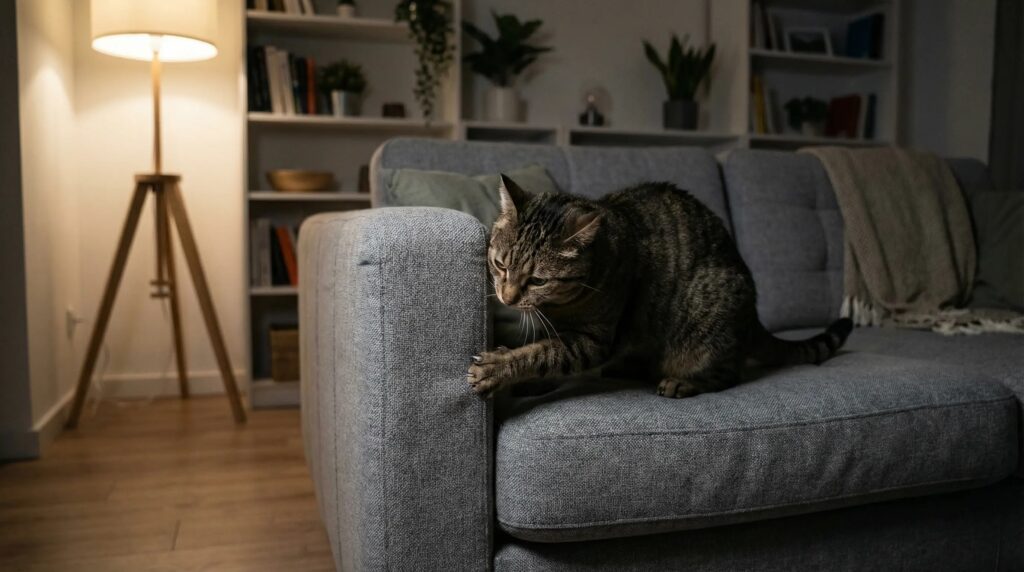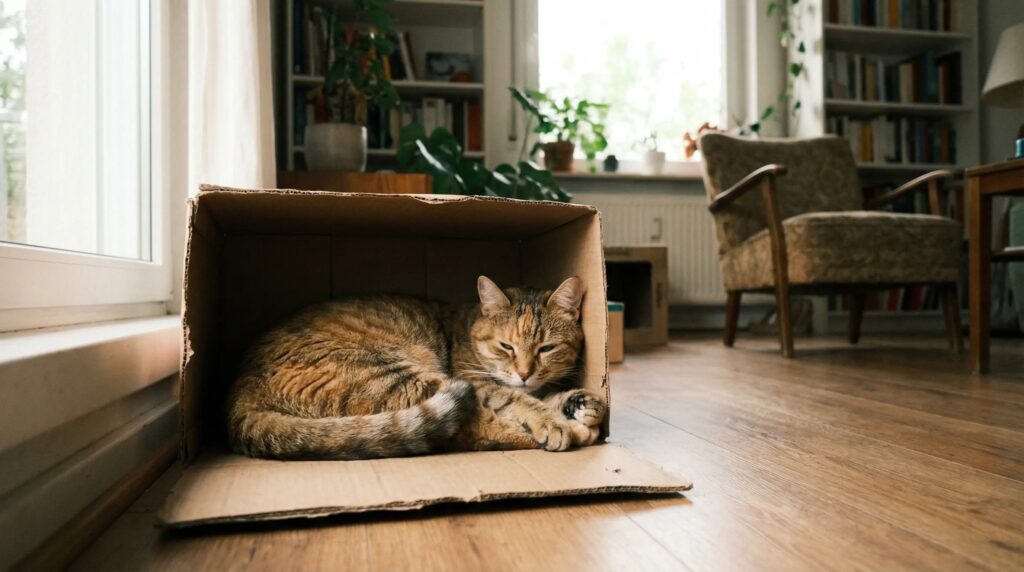
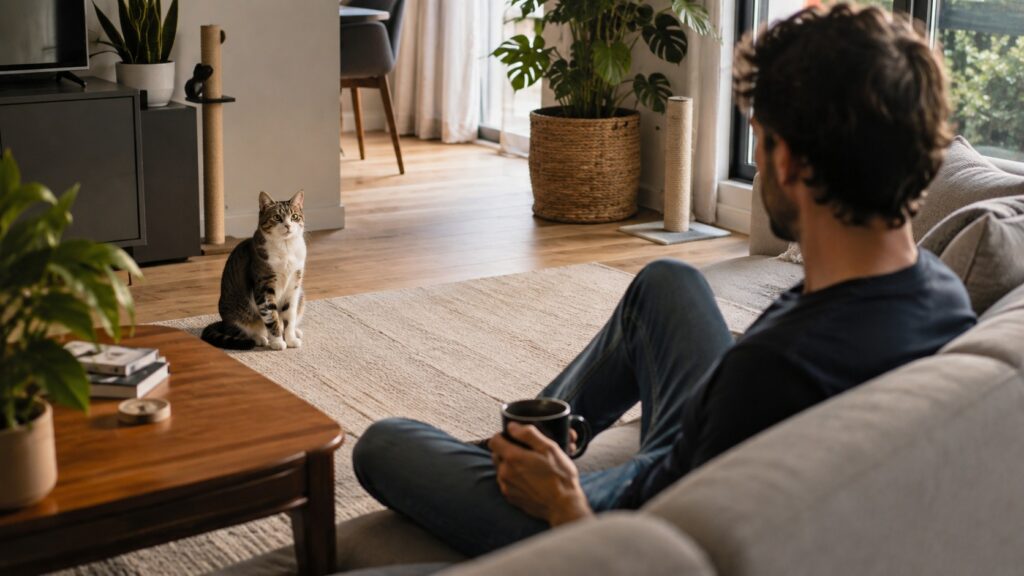
If you’re wondering why does my cat stare at me, the first thing to know is that staring by itself doesn’t have one universal meaning.
Your cat might be waiting for dinner, watching what you’re doing, asking for attention, or simply relaxing nearby. In other situations, a fixed stare can be part of tense or fearful body language.
That’s why trying to interpret a cat’s eyes without looking at the rest of their body can be misleading.
The good news is that staring is usually nothing to worry about. Once you learn to look at your cat’s ears, pupils, tail, posture, and the situation around them, that mysterious stare becomes much easier to understand.
Why Do Cats Stare at People?
Cats pay close attention to their environment, and that includes the humans living with them.
Your movements matter to your cat. You are the person who may open a door, pick up a toy, prepare dinner, sit down for cuddles, or suddenly leave the room.
Watching you gives your cat information.
But cats can also learn that looking directly at us produces results.
Imagine your cat staring at you near dinner time. You notice, assume they’re hungry, and fill the bowl.
Your cat has just learned something useful:
staring at you can make food appear.
The same process can happen with petting, play, opening doors, or other forms of attention.
So sometimes the answer to “Why is my cat staring at me?” is surprisingly simple: because you’ve taught them that it works.
1. Your Cat Wants Something
This is probably one of the easiest stares to recognize.
Your cat sits a few feet away and looks directly at you.
Then perhaps they look toward:
- Their food bowl
- A closed door
- A toy
- The kitchen
- You again
In this situation, the stare is often part of a request.
Cats learn our routines extremely well. If dinner normally happens at 6 PM, your cat doesn’t need to understand a clock to recognize all the events that happen before dinner.
If staring has previously resulted in you getting up and giving them something, there’s even more reason to repeat it.
Pay attention to what happens immediately after the stare. That often tells you more than the stare itself.
2. Your Cat Is Watching What You’re Doing
Sometimes your cat isn’t asking for anything.
They’re just watching you.
Humans do a lot of strange things from a cat’s perspective. We move around the house, carry objects, open cupboards, prepare food, change clothes, clean rooms, and repeatedly disappear through doors.
Your cat may simply be monitoring all that activity.
This is especially likely when their body looks relaxed:
- Comfortable posture
- Relaxed ears
- No obvious tension
- No agitated tail movements
If your cat frequently moves from room to room with you as well, the staring may be part of a broader pattern of staying close and keeping track of you.
Related: why your cat follows you everywhere
3. Your Cat Is Waiting for Your Attention
Some cats discover that eye contact is an excellent way to start an interaction.
They stare.
You notice.
You say their name.
They come over.
You pet them.
From the cat’s perspective, the strategy was successful.
Over time, this can become a reliable way to ask for attention without making a sound.
Other cats are much more vocal about what they want. If staring is regularly followed by persistent meowing, there may be more going on than simple observation.
Related: why your cat is meowing so much
4. Your Cat Feels Comfortable Around You
A cat choosing to spend time near you and calmly observe you can also fit into a healthy social bond.
The important word here is calmly.
A relaxed cat looking in your direction is very different from a tense cat holding a hard stare.
Look at the whole picture.
If your cat is sitting comfortably, their ears and whiskers look relaxed, and they occasionally look away or partially close their eyes, there is little reason to interpret the stare negatively.
Some cats are simply much more interested in their humans than others.
If yours seems particularly focused on you throughout the day, this may be part of a stronger attachment pattern.
Related: why your cat is so attached to you
5. Your Cat Has Learned Your Routine
Cats are extremely good at recognizing patterns.
Your cat may know that after you:
- Wake up, breakfast appears
- Put your shoes on, you leave
- Sit on the sofa, petting becomes available
- Walk toward a particular cupboard, treats might appear
- Go to bed, the house becomes quiet
That makes you worth watching.
Sometimes your cat is staring because they’re waiting to see what happens next.
You may notice this more strongly around predictable events such as feeding time.
If your cat seems permanently focused on food rather than occasionally anticipating a meal, that’s a slightly different question.
Related: why your cat is always hungry
6. Your Cat Is Bored
Imagine spending most of the day inside the same home with very little changing.
Eventually, the person walking through the room becomes entertainment.
Cats need opportunities to explore, climb, play, hunt, scratch, and interact with their environment. When those opportunities are limited, they may focus much more heavily on their owners.
You might notice your cat:
- Watching everything you do
- Following you constantly
- Interrupting you for attention
- Becoming more active when you move
- Repeatedly asking for play
Staring alone doesn’t prove boredom. But if it appears alongside a general lack of independent activity, enrichment is worth considering.
Related: why your cat is bored
7. Your Cat Is Curious
Sometimes there really isn’t a deeper emotional explanation.
Something about you is interesting.
Maybe you’re eating something unfamiliar. Maybe you’re making a strange noise. Maybe you’re unpacking a box. Maybe you’re doing an exercise your cat has never seen before.
Cats often observe before deciding whether to approach.
Curiosity tends to look different from fear. A curious cat may orient toward whatever has caught their attention while remaining willing to investigate.
Again, context matters more than the eyes alone.
What Does It Mean When Your Cat Stares and Slowly Blinks?
This is one of the most misunderstood parts of feline body language.
You’ll often hear that a slow blink literally means “I love you.”
That’s a nice interpretation, but it’s too absolute.
Slow blinking is commonly associated with relaxed, non-threatening interactions between cats and humans, and research has found evidence that slow-blink interactions can facilitate positive cat-human communication. However, animal behavior organizations also caution that context still matters; blinking shouldn’t be interpreted in isolation.
So instead of translating a slow blink into a human sentence, look at the whole cat.
A cat with:
- A loose body
- Relaxed ears
- Soft eyes
- Relaxed whiskers
who slowly closes and reopens their eyes is probably comfortable in that moment.
You can try slowly blinking back without maintaining an intense stare.
What Do Dilated Pupils Mean When a Cat Stares?
Large pupils are another cue people frequently misinterpret.
Dilated pupils do not automatically mean aggression.
A cat’s pupils change size partly in response to light. They can also become larger when the cat is aroused, excited, frightened, stressed, or engaged in hunting or play.
That means this:
big pupils = angry cat
is not a reliable rule.
Instead, look at everything else.
Large pupils during energetic play are very different from large pupils combined with:
- Flattened ears
- A tense or crouched body
- Hissing
- Growling
- Rapid tail movement
The second situation is telling you to give the cat space.
When a Stare Means “Leave Me Alone”
This is where reading body language becomes particularly useful.
A tense, fixed stare can be part of a defensive or aggressive interaction.
Warning signs can include:
- Ears turned sideways or flattened back
- A stiff posture
- Tail lashing or rapid movement
- Hissing or growling
- Swatting
- A body positioned as though the cat is ready to escape or strike
If you see that combination, don’t move closer to investigate the stare.
Give your cat space.
And don’t stare back.
Direct, prolonged eye contact can be perceived as threatening in feline communication, particularly when the cat is already uncomfortable.
Why Does My Cat Stare at Me From Across the Room?
Distance doesn’t necessarily change the basic explanations.
Your cat may be:
- Resting while keeping track of you
- Waiting for you to do something
- Watching movement
- Looking for attention
- Monitoring a familiar routine
Look at what happens next.
If your cat remains relaxed and eventually goes back to sleep, there probably wasn’t an urgent message behind the stare.
If they immediately run toward the kitchen when you stand up, you’ve probably discovered what they were waiting for.
Why Does My Cat Stare at Me and Meow?
Staring plus vocalization makes an attention-seeking explanation more likely.
Your cat may be trying to get you to:
- Feed them
- Play
- Open something
- Follow them
- Provide attention
But don’t assume every increase in vocalization is simply demanding behavior.
A major or unexplained change in how much your cat meows deserves more attention, particularly if there are changes in appetite, drinking, litter-box habits, activity, or general behavior.
Related: why your cat is meowing so much
Why Does My Cat Stare at Me While I Eat?
Food is a powerful explanation.
Cats learn which human behaviors predict access to food, and watching you eat may be especially interesting if they have ever received food from your plate.
Giving them something every time they stare can strengthen that pattern.
If you don’t want a cat watching and begging throughout every meal, avoid turning staring into a reliable way of getting table scraps.
And if your cat seems unusually hungry throughout the day rather than simply interested in your dinner, look at the broader pattern.
Related: why your cat is always hungry
Why Does My Cat Stare at Me While I’m Sleeping?
This can feel much stranger because you may wake up to two eyes already fixed on you.
But the basic explanations remain fairly ordinary.
Your cat may be awake while you’re asleep, waiting for you to get up, observing small movements, or anticipating the morning routine.
The nighttime version deserves its own explanation because feline activity patterns and learned morning routines can play a role.
Related: why your cat watches you sleep
Should You Stare Back at Your Cat?
Generally, there’s no benefit to turning it into a staring contest.
Humans often use sustained eye contact positively, but cats don’t necessarily interpret it the same way.
If your cat looks comfortable, you can:
- Keep your expression relaxed
- Avoid looming over them
- Briefly look away
- Try a gentle slow blink
If your cat looks tense, don’t test their reaction.
Give them space.
Respecting those small signals is much more useful for your relationship than trying to establish who “wins” the stare.
When Should You Worry About Your Cat Staring?
Most staring is normal.
What matters is change and context.
A cat that has looked at you this way for years and otherwise behaves normally is very different from a cat that suddenly develops prolonged staring alongside other unusual behaviors.
Pay more attention if the staring is new and accompanied by things such as:
- Apparent confusion
- Changes in vision or navigation
- Unusual vocalization
- Appetite or drinking changes
- Litter-box changes
- Hiding
- Restlessness
- Sudden aggression
- Other major personality changes
In older cats, new staring or apparent disorientation deserves particular attention because sensory or medical changes can affect behavior.
If you’re concerned, don’t try to diagnose the cause from the stare itself. A veterinarian can assess the whole picture.
For broader behavioral changes, see: common cat behavior problems and causes
Could Stress Cause More Staring?
It can be part of the picture, but staring alone isn’t enough to say a cat is stressed.
Stress is better identified from a cluster of behavioral and physical signals.
A stressed or anxious cat may also show changes such as hiding more, becoming unusually vigilant, altering normal social behavior, overgrooming, or changing how they eat or use their environment.
If the stare comes with other changes, look at the wider pattern rather than treating the eyes as a diagnosis.
Related: signs of stress in cats and what actually helps
How to Respond When Your Cat Stares at You
You don’t necessarily need to do anything.
First, check the context.
Ask yourself:
What happened immediately before the stare?
Then look at your cat’s body.
If they look relaxed, you can interact normally.
If they seem to be requesting something, decide whether you actually want to reinforce that request.
If they look tense, give them space.
And if the behavior has suddenly changed, monitor what else is different rather than focusing only on the stare.
That simple approach is much more reliable than trying to translate every look into one specific emotion.
Frequently Asked Questions
Why does my cat stare at me for no reason?
There is usually some context even if the reason isn’t obvious to you. Your cat may be observing you, anticipating something, asking for attention, or simply resting while looking in your direction.
Does my cat stare at me because they love me?
A relaxed cat may look at you as part of a comfortable social relationship, but staring alone doesn’t prove affection. Look for relaxed body language and other signs of a positive bond.
What does it mean when my cat stares and slow blinks?
In a relaxed context, slow blinking is generally associated with comfortable, non-threatening interaction. Avoid treating it as a literal translation of “I love you”; the cat’s overall body language still matters.
Why does my cat stare at me with huge pupils?
Pupils can dilate because of low light, excitement, play, hunting arousal, fear, or stress. You need the rest of the cat’s body language and the environment to understand what is happening.
Is staring a sign of aggression in cats?
It can be part of an aggressive or defensive interaction, but staring alone isn’t enough. A hard stare combined with a stiff body, flattened ears, tail agitation, growling, hissing, or swatting is much more concerning.
Should I be worried if my cat suddenly starts staring at me?
A new behavior deserves attention, especially if your cat is older or you also notice confusion, vision problems, appetite changes, unusual vocalization, aggression, or other changes. In those circumstances, speak with your veterinarian.
The Bottom Line
If you’re asking why does my cat stare at me, don’t try to interpret the eyes alone.
Your cat might want dinner. They might be waiting for attention. They might be watching what you’re doing. Or they may simply feel comfortable sitting nearby and keeping an eye on you.
The best clue is everything happening around the stare.
Soft eyes, relaxed ears, and a loose posture tell a very different story from a rigid body, flattened ears, and a rapidly moving tail.
Most staring is perfectly normal.
What deserves attention is a stare accompanied by tension, distress, or a sudden change in your cat’s normal behavior.
Learn to read the whole cat, not just the eyes, and those mysterious staring sessions become much easier to understand.