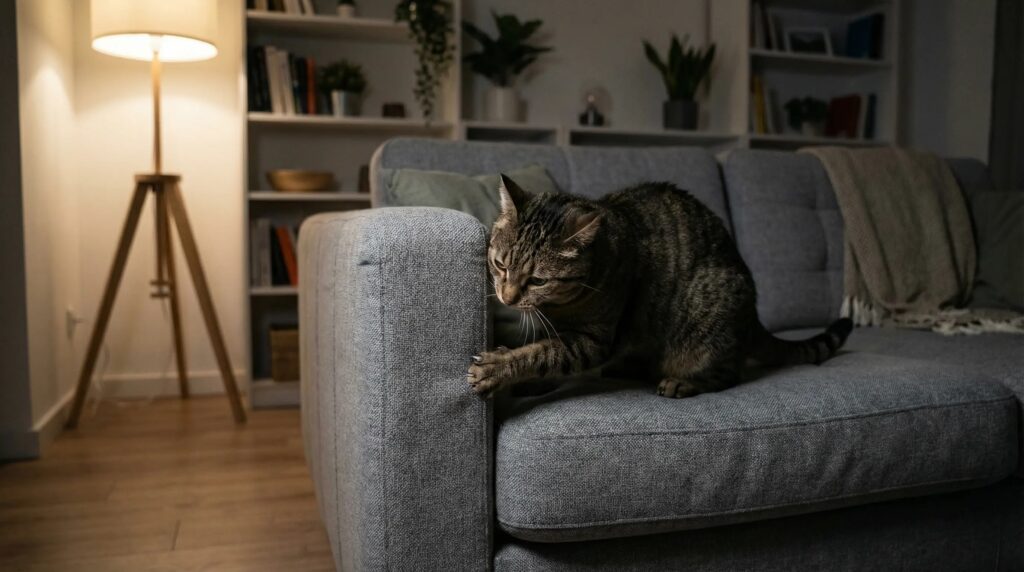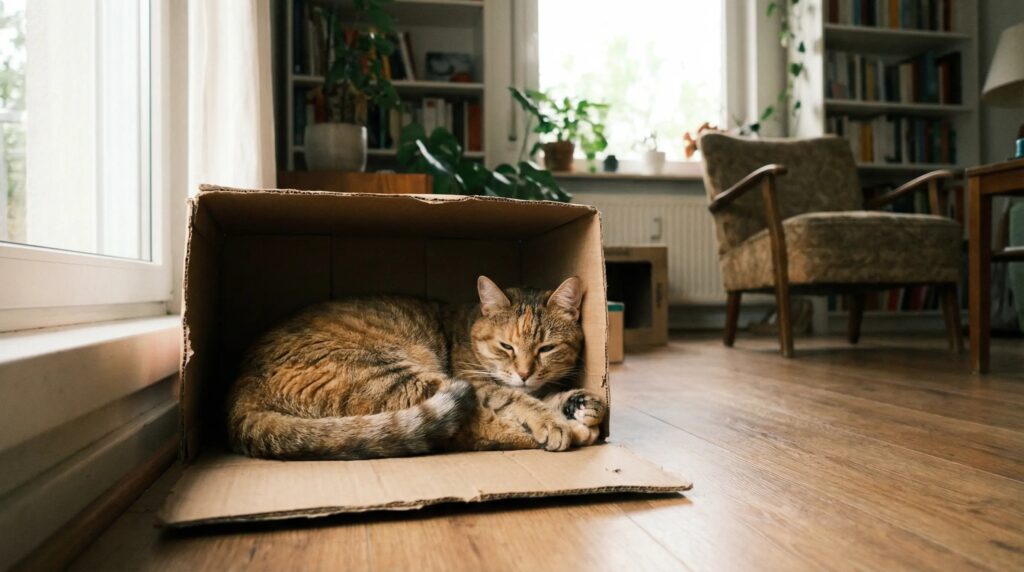

Your cat may enjoy your company without enjoying lap time. Sitting beside you lets them share your space while keeping control over physical contact. Their choice can reflect handling preferences, the comfort of the seat, or what is happening around them—not a verdict on how much they like you.
If you are asking, “Why does my cat sit next to me but not on my lap?”, start with two questions: do they look comfortable, and is this normal for them? A relaxed cat who has always chosen the next cushion is different from a former lap cat who suddenly avoids touch.
Your lap is an invitation, not an assigned seat. Here is how to understand the difference and respond without making the sofa a negotiation table.
What Sitting Beside You Can—and Cannot—Tell You
Being close and wanting to be touched are separate things. A cat can approach a person, settle nearby, and still prefer that the person keeps their hands to themselves. Veterinary behavior guidance describes this distinction: company does not automatically mean a request for stroking.
The useful question is not whether the gap between you is three inches or three feet. It is what happens before, during, and after your cat settles there. Do they choose the spot freely? Can they leave? Do they relax, or keep shifting away whenever you reach over?
Imagine two cats on the same sofa. One stretches out beside a person and stays there while they read. The other sits stiffly, watches an approaching hand, and moves away when touched. The location is similar; the interaction is not. Treating both as a clear declaration of affection would miss that difference.
You also cannot measure the whole relationship from one resting position. Consider ordinary life together: comfortable shared time, play your cat chooses to join, and whether your responses suit their preferences. Lap sitting is one possible interaction, not an entry requirement for being a good companion.
When the same question comes up at bedtime, our guide to sleeping close without touching explores that situation separately.
Why Your Cat May Prefer the Seat Next to You
They want company without extra handling
A lap can come with an expectation: the cat arrives, the hands get busy. A nearby cushion offers a different arrangement. They can stay in the room without being stroked, held, or repositioned.
That explanation is especially worth considering if your cat settles happily until you start touching them. It does not prove you have done anything wrong, and it does not establish a medical cause. It tells you that the next useful step is to separate quiet company from contact.
Try leaving the interaction alone on one occasion. Read your book, watch your programme, or carry on with whatever you were doing. Notice whether your cat stays comfortably beside you without the usual reaching and adjusting. This is an observation, not a test they need to pass.
If they routinely bite during stroking, take that seriously rather than treating it as a quirky complaint. Our guide to cats biting when you pet them discusses that problem in more detail.
The cushion may simply be a better resting place
Warmth and soft surfaces can influence where cats rest. A blanket beside you may offer both, while your lap changes shape when you cross your legs or reach for a drink. The nearby spot might also have a view your cat finds interesting.
Consider the setting before giving the choice an emotional explanation. Are you balancing a laptop? Does your chair move? Is the favourite cushion beside a window? These are things you can actually check, unlike a confident guess about what your cat thinks of you.
Suppose your cat consistently chooses the same blanket whether you are on the sofa or not. That makes the blanket itself a plausible part of the explanation. If they follow you to another seat and settle nearby again, your presence may matter too. Neither observation tells the whole story, but both are more useful than assuming rejection.
You do not need to remove their preferred resting place to make your lap more competitive. Offer comfortable options and let the cat keep the one that works for them.
Their experience with touch may differ from your expectations
Cats vary in how they respond to handling. Previous experiences and early socialisation can contribute to those differences, but you may not know the history of an adopted cat. Avoid filling that gap with an invented story about mistreatment.
A cat who enjoys a brief cheek rub may not enjoy being lifted. One who climbs onto a person may still dislike long strokes down the body. Rather than putting them in a permanent category—affectionate or unfriendly—notice which interactions they currently choose.
Cats Protection’s advice on petting emphasises individual preferences and letting the cat approach. For everyday sofa time, that gives you a practical starting point without needing to explain their entire personality.
The room may be affecting the interaction
Noise, visitors, changes at home, and other animals can affect a cat’s comfort. If the sitting pattern changes in a busy setting, look at the surroundings as well as your own behaviour.
For example, a cat may leave the sofa when a dog approaches or when visitors gather around them. The sensible response is to offer space and a quiet retreat, not to pick them up for reassurance they have not requested.
Check whether another pet blocks a doorway or regularly takes over resting places. Provide alternatives rather than expecting the cats to sort out access themselves. Environmental-care guidance recommends separate resources in multi-cat homes and safe places to withdraw.
These possibilities are not proof that a cat sitting beside you is stressed. A peaceful-looking preference is not automatically a problem. Investigate the environment when there is a reason to, especially a noticeable change or repeated signs of discomfort.
Read the Interaction, Not Just the Distance
Look at the whole cat. Relaxed posture, comfortable ears, and soft or partly closed eyes can fit a settled interaction. A tense body, ears moving back, freezing, or shifting away as your hand approaches suggests you should pause.
Context matters. Watching something at the window is not the same as watching your hand, and one tail movement does not explain the entire mood. Notice patterns rather than trying to translate every flick into a sentence.
Purring is not a reliable all-clear signal on its own. Cats can also purr in stressful situations or when uncomfortable. Likewise, remaining still does not necessarily mean they enjoy being touched. Give more weight to the overall response than to the absence of a dramatic protest.
A helpful comparison is what changes when you stop. Does your cat move toward your hand or rub against it again? Do they turn away, settle without touching you, or leave? You are looking for an invitation to continue, not trying to persuade them to tolerate more.
Consider this everyday example: your cat accepts a couple of cheek strokes, then looks toward your hand and becomes still. You pause. They turn away and resume resting. Let that be the end of the petting for now; there is no need to wait for a hiss to make the message official.
Keep the observation simple. You do not need a body-language scorecard beside the remote control. Learning a few repeatable signals from your own cat is more practical than trying to decode every movement at once.
How to Offer Contact Without Forcing Lap Time
Start with an ordinary, low-pressure moment
Choose a time when your cat is awake and not hiding, eating, or absorbed in play. Sit comfortably and leave a clear route away. Do not bring them over, hold them in position, or block their exit with your arms.
You can place a familiar blanket on your lap if you want to offer another surface. Keep an equally comfortable option beside you. The point is to make a choice available, not to confiscate the alternatives until the cat accepts yours.
Offer your hand and wait
Let your cat decide whether to make contact. An approach to your hand can be an opportunity to observe; a sniff followed by a turn away is not an instruction to start stroking.
Research on cat-friendly interaction supports giving cats control, watching their responses, and being thoughtful about touch. The study of practical handling guidelines involved shelter cats interacting with unfamiliar people. It supports considerate handling, but does not promise that your cat will become a lap cat.
If your cat rubs against your hand and looks comfortable, offer a brief gentle stroke around a preferred area such as the cheeks or chin. Do less than your automatic instinct suggests, then pause.
Make stopping part of the interaction
When you pause, allow your cat to ask for more—or not. If they lean in or make contact again, you can consider another brief stroke. If they turn away, become tense, or leave, finish the interaction.
Do not follow them across the sofa to deliver the last stroke. It may feel unfinished to you, but there is no minimum cuddle length your cat owes the household.
If they do climb onto your lap, resist immediately rearranging them into a more photogenic position. Keep your hands relaxed and let them settle. A lap visit can also be quiet time without petting.
Change one thing at a time
If you want to understand what helps, keep the comparison manageable. On one occasion, sit still and do not reach over. On another, offer your hand briefly. Avoid changing the chair, blanket, room, and interaction all at once.
Write a short note if a pattern is easy to forget: where they sat, whether they initiated contact, and what made them leave. Notes are useful for noticing behaviour, not for diagnosing your cat from home.
Success might be a cat who rests peacefully beside you rather than one who climbs onto you. Choose comfort as the goal, and you can recognise progress without turning a preferred resting place into a problem.
Agree on the same approach at home
Make the arrangement clear to everyone who shares the sofa. One person leaving the cat alone while another keeps lifting them onto a lap makes it harder to understand which situation the cat is responding to.
Give visitors a specific instruction rather than “be nice to the cat”: let them approach, do not pick them up for a cuddle, and stop if they turn away. For children, an adult can help keep the interaction calm and prevent grabbing or following. Nobody needs to prove that the cat secretly enjoys more contact.
Picture a cat settling beside a visitor who immediately starts stroking from head to tail. When the cat moves off, the visitor calls them unfriendly. A better response is to explain the household rule before the next approach: quiet company is welcome, but touching is optional. That avoids asking the cat to deliver the explanation with their claws.
This is also a useful way to compare observations. If someone reports that the cat “never sits with them,” ask what happens after the cat arrives, not just whether the visit ends on a lap.
Look for Changes Rather Than Comparing Cats
The neighbour’s cat may spend every evening on someone’s knees. That does not set a standard your cat should meet. A more useful comparison is your own cat’s previous behaviour in a similar situation.
Think about a cat who has always sat on the arm of the sofa, enjoys their usual activities, and declines handling without any new change. Quiet shared time may be the arrangement to respect. Now consider a cat who used to approach for contact but has recently started avoiding it. That second situation calls for closer attention.
Do not assume ageing alone explains a new reluctance to get onto furniture or accept touch. Medical and behavioural factors can overlap, and a veterinary assessment may be needed to distinguish them.
A short record can help you describe a change clearly. Instead of “my cat does not love me anymore,” note “they have stopped climbing onto the sofa, move away when I touch their back, and ate less today.” The second description gives your vet something concrete to work with.
If following you around is another part of the pattern, our guide to why cats follow their people looks beyond sofa time. The aim is to understand the situation without relying on a single affectionate-or-independent label.
When to Speak to Your Veterinarian
A preference for the next cushion is not, by itself, evidence of illness. However, a sudden change in handling tolerance or normal interaction deserves attention, especially with other changes.
Contact your veterinarian if you notice:
- Reduced appetite or a new change in eating.
- More hiding or less interaction than usual.
- Stiffness, limping, or reluctance to jump.
- A new reaction to touch, such as moving away, crying out, or biting.
- Changes in grooming or toileting alongside the behaviour change.
International Cat Care’s guide to recognising pain describes changes like these. They do not establish a diagnosis or identify one particular condition. They are reasons to ask for an assessment rather than repeatedly touching an area to see whether it still hurts.
Do not use lap training as a way to work through suspected pain. Tell the clinic what changed and when, and follow its advice about the urgency of a visit. If a medical concern is ruled out but interactions remain difficult, ask about suitable behavioural support.
Our article on signs of stress in cats can help you notice environmental patterns, but a website cannot determine whether your own cat is in pain.
Questions About Lap Sitting
Why does my cat sit on someone else but not me?
Compare the situations before assuming a favourite person. One person may sit still, offer a different surface, or touch the cat less. Observe what differs without removing the cat from someone else’s lap to make a comparison. A preference in that moment is not a ranking of everyone in the home.
Should I get another cat to make mine more affectionate?
No: do not add another cat as a strategy for changing lap behaviour. A new animal brings its own needs and may add tension. Choose an interaction that suits the cat you already have rather than expecting another pet to change their preferences.
Does kneading beside me mean they want to climb onto me?
Not necessarily. Notice what your cat does next instead of moving them yourself. If they settle on the blanket, leave them there. Our guide to why cats knead explores that behaviour without making lap sitting the expected next step.
Let the Comfortable Spot Count
Offer a calm place, pay attention to your cat’s response, and leave room for a genuine choice. You can enjoy their company without converting every visit into a cuddle. If their usual behaviour changes, take that change seriously. Otherwise, the cat on the next cushion does not need to be upgraded to a lap cat for sofa time to be worthwhile.