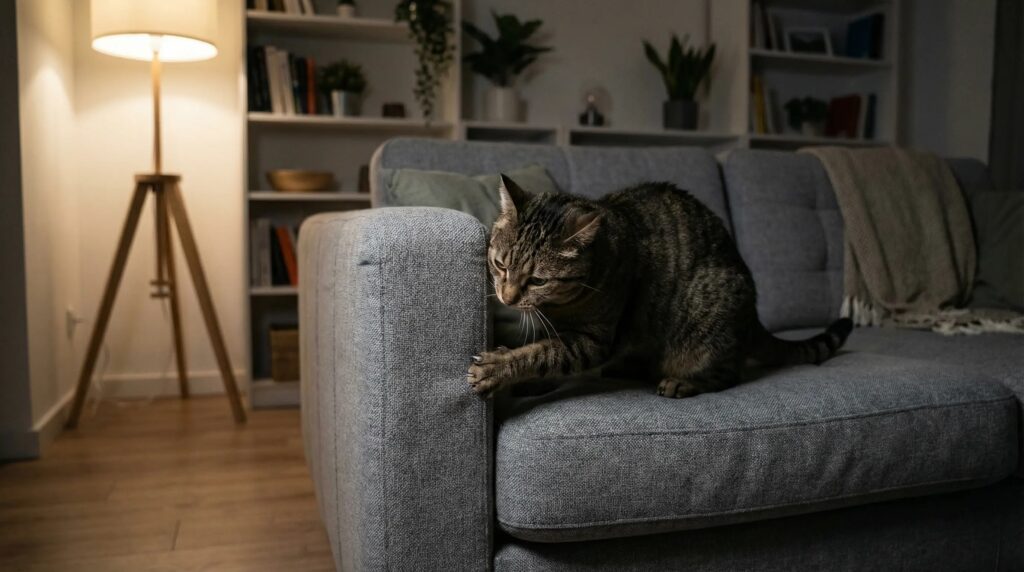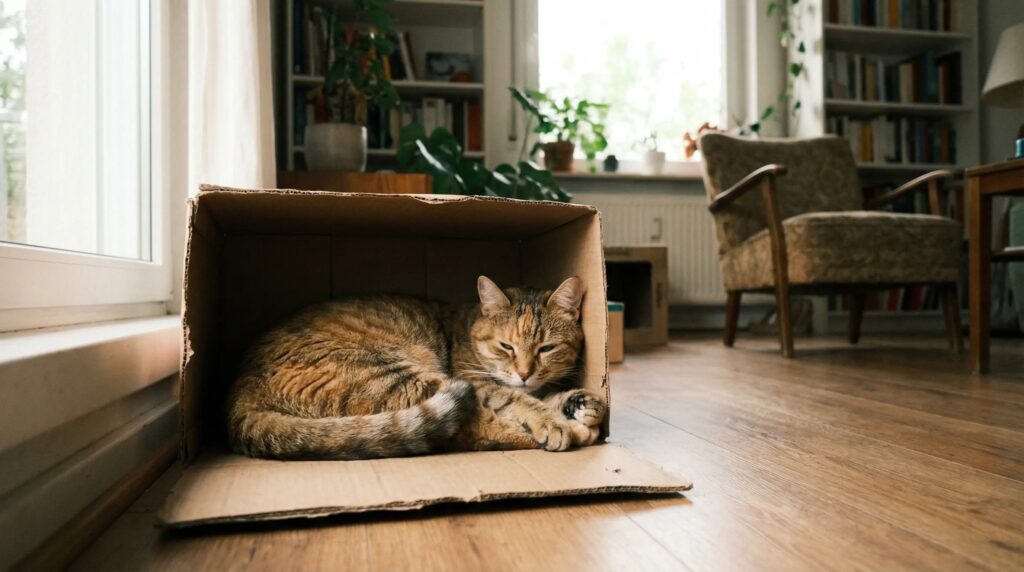

Your cat may enjoy your company, associate you with familiar routines, and choose to spend time close to you. Cats can form bonds with people, but following you or sitting on your lap does not tell you everything about that relationship. A longstanding preference for company is different from a sudden change or visible distress.
If you are asking, “Why is my cat so attached to me?”, start by describing what your cat actually does. Do they quietly share your room, ask for contact, or become unsettled when you leave? Those are different situations, even if all three get called “clingy.”
The aim is not to make an affectionate cat less affectionate. It is to give them a comfortable life that includes company, choice, and things to do besides supervising your every movement. The bathroom can probably manage without a feline project manager.
What Do You Mean by “Attached”?
“Attached” is an everyday description, not a diagnosis. You might use it for a cat who sleeps beside your desk or one who repeatedly interrupts you. Before looking for an explanation, separate those observations from the meaning you have given them.
For example, “lies on the spare chair while I work” is specific. “Cannot cope without me” assumes something you may not have observed. If you have only seen your cat while you are home, you do not yet know what happens during your absence.
Company does not have to involve touching
A cat can choose to share a space without wanting to be picked up or stroked. Cats Protection’s petting guidance describes considerable individual variation: some cats enjoy contact, while others prefer proximity without handling. Let that preference shape your response.
Imagine your cat settles at the other end of the sofa. You reach over, and they move away. That does not cancel the fact that they chose the sofa. It tells you not to keep reaching after them.
You can enjoy the company without turning it into a test. Leave room for them to stay, move, or return. A successful evening together does not require a photograph of a cat in your arms.
One habit cannot measure the whole bond
Lap sitting, following, and resting nearby are observations, not scores on a relationship scale. Avoid comparing your cat with an online video or another person’s pet. Their behavior, circumstances, and willingness to be handled may differ.
If room-to-room following is your main question, our guide to cats following their owners focuses on that specific habit. Here, the broader question is how to understand closeness and make everyday interaction work.
Cats Can Bond With People—Without Fitting a Stereotype
Research from Oregon State University found attachment behavior toward caregivers in a structured test involving kittens and adult cats. That is evidence against treating cats as incapable of social bonds with people. It is not a home test you can reproduce by closing a door.
The study assessed behavior in a particular setting with trained evaluation. You cannot label your cat’s attachment style because they follow you, sit on your lap, or prefer a different room. Nor should a quiet cat be written off as uncaring.
The AAHA/AAFP feline life-stage guidelines also describe social relationships alongside independent daily activity. Company and time apart do not need to be opposites. Look at the actual cat rather than choosing between “aloof” and “obsessed.”
Why your routine matters
Consider what your presence is connected with in your home. You may provide meals, open a favorite room, bring out a toy, or settle in a comfortable place. Those details give you useful context without proving that every approach has the same motive.
Suppose your cat approaches while you prepare dinner, then later rests beside you after everyone has eaten. Record those as separate situations. There is no need to decide that the first is “only food” and the second is “real affection.”
If you want to understand a pattern, note what happened before and after it. You can be curious without claiming to translate your cat’s thoughts. “Came over when I opened the cupboard” is enough information to start with.
Why one person may get more attention
Compare how household members interact rather than turning a preference into a competition. Who waits for the cat to approach? Who reaches first? Does anyone follow the cat after they move away? These are practical differences you can observe.
A person receiving less contact can offer calm opportunities without copying another person’s handling. If the cat enjoys a game, try that while they are awake and interested. If they keep their distance, let the encounter end there.
Avoid withholding care to make someone else more appealing. Share necessary tasks reliably, not as leverage. The household does not need an election for Favorite Human, particularly one involving an unreliable breakfast service.
Look for Comfort and Choice, Not Constant Contact
The AAHA/AAFP guidelines describe relaxed muscles and comfortably held ears and whiskers as useful body-language observations. Tension, crouching, avoidance, or defensive vocalizations deserve respect. Interpret the whole situation rather than treating one movement as a verdict.
A cat remaining beside you is not automatically enjoying everything you are doing. During handling, look for changes and give them a way to leave. Stillness alone is not a reliable invitation to continue.
Make a brief interaction genuinely optional
If your cat approaches willingly, offer the kind of contact they have previously accepted. Keep it gentle and stop when they move away or appear uncomfortable. Do not hold them in place to finish a cuddle.
For example, your cat may approach your hand and accept a brief cheek stroke, then turn away. You can stop there rather than extending the session until they object more strongly. The end of contact does not need to become an argument.
If they remain nearby afterward, you can leave them nearby. Do not repeatedly restart touching because they have not left the room. Being within arm’s reach is not a standing booking for petting.
Use observations you can explain
Instead of “looked needy,” write “approached three times during my call, then rested on the chair.” Instead of “was angry with me,” describe the movement or sound. These examples keep your notes useful without assigning an emotion you cannot confirm.
Notice whether handling, noise, a visitor, or access to a room changed at the same time. That helps you describe circumstances. It does not establish a cause or exclude a medical issue when behavior is new.
When Closeness Has Changed
Contact your veterinarian about a sudden or significant change in behavior. Cats Protection’s behavior guidance recommends checking health before assuming that an out-of-character pattern is a training problem. Do not wait for a second symptom to justify asking.
Mention changes in eating, drinking, toileting, movement, grooming, or sleep, if present. Describe when you first noticed the difference and ask the clinic how urgently your cat should be seen. This article cannot diagnose the cause.
Our article about a sudden increase in clinginess considers that change-specific question separately. Use it for additional context, not as a reason to postpone veterinary advice.
Keep the timeline straightforward
You might have started a new work schedule in the same week your cat began seeking more contact. Tell the vet both facts, but do not assume one explains the other. Events happening together are not proof of a cause.
Ask other caregivers what they noticed. Someone else may have seen a change at breakfast while you noticed one during the evening. You do not need everyone to agree on an explanation before sharing the observations.
Do not perform your own stress test
Do not deliberately leave a distressed cat alone, shut them away, or repeat uncomfortable handling to see what happens. An observation is useful; manufacturing an upsetting situation is not. Ask for individual guidance if you are concerned.
A short recording of naturally occurring behavior may help show what you mean. Make it only if you can do so without disturbing your cat or delaying care. Missing the perfect clip is preferable to prolonging an uncomfortable situation.
Does Being Attached Mean Separation Anxiety?
No. Enjoying your company does not establish separation anxiety. Cats Protection distinguishes behavior associated with being left alone from intense distress specifically linked to an attached person’s departure. Professional assessment is needed rather than a label based on following or greeting.
A meow as you leave and an energetic welcome are not, by themselves, proof of distress throughout your absence. Consider what you actually know, what you have not seen, and whether behavior has changed more generally.
If you have evidence of intense distress around departures, seek veterinary advice and a suitably qualified cat behaviorist. Avoid using a universal time limit, an internet checklist, or a breed stereotype to diagnose your cat.
Check the circumstances around time apart
Before interpreting an event, note whether usual resources remained accessible. Was a door shut that normally stays open? Was a planned meal missed? Did another person or animal enter the space? These are details to report, not explanations to assume.
If you only know that something was disturbed when you returned, say so. You may not know when it happened or what preceded it. Do not use the result to infer that your cat spent the whole absence feeling one particular way.
Ask a professional what information would be helpful before investing in equipment or trying repeated departures. A tailored plan should fit the actual problem. Affection alone is not a reason to begin separation training.
Make information useful for another caregiver
If someone else will care for your cat, leave practical notes rather than saying “they are very attached to me.” Explain the ordinary meal arrangements, where resources are located, which rooms should remain accessible, and how your cat usually chooses to interact.
Include what the caregiver should do if they notice a change, with your veterinarian’s contact details and any instructions already provided by the clinic. Do not expect them to interpret an unfamiliar behavior from a description of your bond.
For example, “usually rests on the spare chair and does not like being lifted” tells a visitor more than “needs lots of love.” It also avoids encouraging unwanted handling. Show them where your cat can retreat, and agree that they will not reach into that space for a cuddle.
This is useful preparation whether or not time apart is a concern. Clear care instructions are not evidence of an attachment problem; they simply help another person look after the individual cat in front of them.
Build a Day That Includes More Than You
Your company matters, but your cat also needs access to suitable resources. The AAFP/ISFM environmental-needs guidance recommends safe resting places, separated resources, play opportunities, and interaction the cat can choose. Those provisions are ordinary care, not a cure guaranteed to reduce attachment.
Review the space before buying anything
Look at where food, water, litter, scratching areas, and resting places are located. Check actual access rather than counting objects. A resource behind a closed door is not available simply because you bought it.
In a multi-cat home, consider whether each cat can reach resources without being blocked by another. If you notice avoidance or conflict, discuss it with your veterinarian. Do not assume that adding another cat will solve a need for company.
Start with a concrete household check: walk through the usual day and note which rooms are open. An appealing resting option beside your workspace may be worth offering, but leave other suitable places available too.
Offer play without demanding a performance
Cats Protection recommends short games, suitable toys, and opportunities to catch the toy during interactive play. Keep fingers and toes out of the game. Put away string or wand toys afterward and inspect toys for damage.
Offer a game while your cat is awake and interested rather than waking them to meet a schedule. Their response can guide whether to continue or stop. A quiet afternoon does not need to become a compulsory exercise class.
If one toy is ignored, you can try a different suitable option another time. Do not use frustration as evidence that your cat needs more vigorous handling. Keep the opportunity safe and voluntary.
Protect undisturbed rest
Cats Protection advises leaving sleeping cats undisturbed. A cat choosing to nap near you does not need ongoing stroking, and a cat napping elsewhere does not need to be brought back for company.
Explain that rule to visitors and children. A resting place should be somewhere the cat can actually rest, not a convenient location for everyone to reach into. Make the household expectation clear before an interaction becomes uncomfortable.
Make Human Boundaries Work Without Punishment
You can need space and still care well for your cat. Choose a practical goal such as keeping the keyboard clear or preventing a trip hazard. “Stop being attached” is too vague to guide a workable change.
Cats Protection advises against punishment for behavior concerns. Do not shout, spray water, or frighten your cat away. If a problem persists, seek advice about its cause rather than escalating restrictions.
For a cat joining your workday
Imagine your cat repeatedly climbs onto your desk. First decide what needs changing: access to hot equipment, interference with typing, or your uncertainty about their needs. Each calls for a different practical response.
Offer an alternative resting place safely away from equipment. Keep normal care and interaction in the day, and note whether the alternative is used. You are offering a choice, not proving that the cat was bored or promising a behavior fix.
If the behavior is new, unusually intense, or accompanied by other changes, return to the health question. Do not keep rearranging the desk indefinitely while dismissing a changed pattern as stubbornness.
For a household with different expectations
Agree on a few shared rules: no forced cuddles, no following a cat who moves away, no disturbing sleep, and clear responsibility for ordinary care. Put the emphasis on what people will do rather than on how affectionate the cat must become.
One person can enjoy brief contact while another prefers sharing the room without handling. Consistency does not require identical personalities. It requires that both respect the cat’s response and do not undermine necessary care.
What a Useful Improvement Looks Like
Judge changes against a specific concern, not an idealized independent cat. If the concern was unsafe desk access, note whether that happens less. If it was uncomfortable handling, notice whether people now stop sooner.
Do not use a reduction in contact alone as proof that everything is better. Keep the rest of your cat’s behavior in view, and seek veterinary advice about a new change. More distance is not automatically the right outcome.
Your cat does not need to become someone else’s version of sociable. Offer predictable care, respect their limits, and make room for company that suits both of you. A chair shared peacefully can be a perfectly good arrangement—even if your cat has taken the better half.