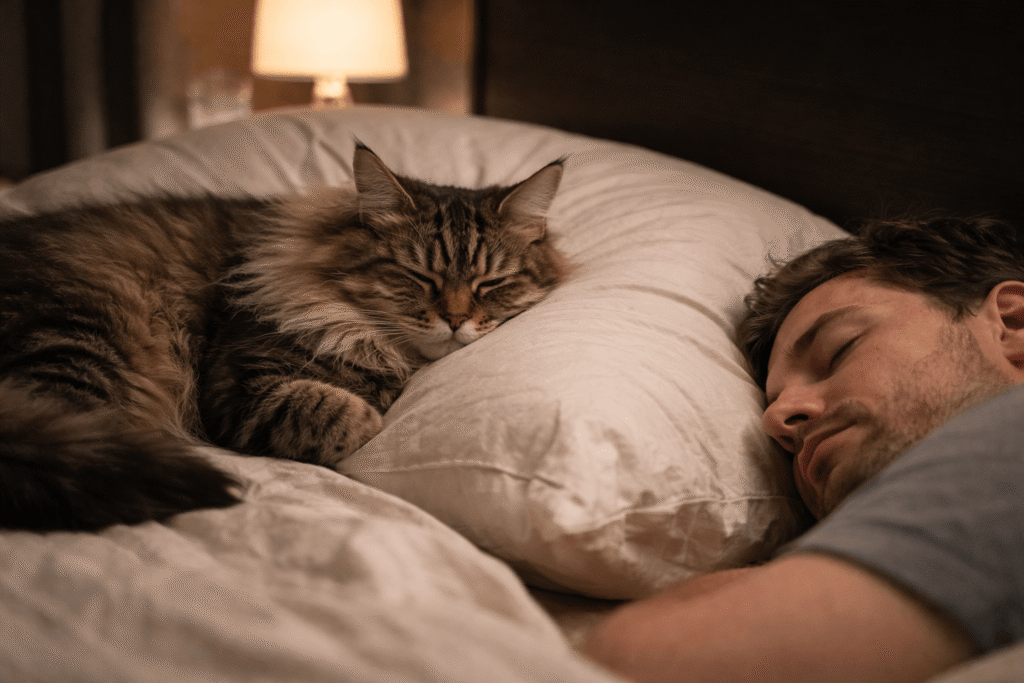
If you’ve ever gone to bed and found your cat already curled up on your pillow — or woken up with fur next to your face — you’re not alone.
This is one of the most common sleeping behaviors in indoor cats.
And while it might feel inconvenient (or even a bit annoying), for your cat, it makes perfect sense.
If you’re wondering why does my cat sleep on my pillow, the answer usually comes down to scent, warmth, comfort, and attachment.
Understanding this behavior helps you decide whether to accept it… or gently change it.
Why Cats Are So Selective About Where They Sleep
Cats don’t sleep just anywhere.
They carefully choose spots based on:
- Safety
- Warmth
- Familiar scent
- Comfort
- Positioning
Your pillow happens to combine all of these factors in one place.
From your cat’s perspective, it’s one of the best sleeping spots available.
Why Your Cat Sleeps on Your Pillow
There isn’t just one reason.
In most cases, several factors are working together.
Why Nighttime Makes Your Pillow More Attractive
At night, your environment changes in ways that make your pillow especially appealing.
During these hours:
- The room is quiet
- You are still
- Your scent is concentrated on the pillow
- Your breathing is steady
- Your body heat spreads through the bed
Your pillow becomes a strong scent zone, which is very important for cats.
The pillow also carries familiar smells from everyday use. That may be part of its appeal, but we cannot tell which smell or feature your cat is choosing.
This is why many cats choose the pillow instead of other parts of the bed.
It also explains why this behavior often appears alongside others like watching you or staying near your head. If your cat does that too, it connects closely with: Why Does My Cat Watch Me Sleep?
1. Your Cat Is Attracted to Your Scent
A pillow you use regularly carries your familiar scent.
Cats rely heavily on scent to feel safe and comfortable.
Your scent tells your cat:
- This place is safe
- This is familiar
- This belongs to someone I trust
Sleeping on your pillow allows your cat to stay close to that scent.
For many cats, this is one of the main reasons they choose that spot.
2. Your Cat Feels Safe Near Your Head
Cats often choose sleeping positions that maximize their sense of security.
Your head area provides:
- Stability (less movement than your legs)
- Strong scent
- Proximity to you
- A calm, predictable zone
This makes it an ideal place for your cat to rest deeply.
Cats only sleep deeply where they feel safe, so this behavior is often a sign of trust.
3. Your Cat Is Bonding With You
Sleeping close is one of the strongest forms of bonding in cats.
By choosing your pillow, your cat is:
- Staying close to you
- Sharing space
- Reinforcing connection
This is similar to other attachment behaviors like following you around during the day. If that sounds familiar, you’ll likely relate to: Why Does My Cat Follow Me Everywhere?
For many cats, this is simply their way of being close to you.
4. Your Cat Likes the Warmth
Cats naturally seek warm places.
A recently used pillow may retain some body warmth. That is one possible attraction, not evidence that it is always the warmest part of the bed.
This warmth, combined with softness, creates a very comfortable sleeping spot.
Even a small temperature difference can make a big difference for a cat.
5. Your Cat Wants to Be Near Your Face
Your face is one of the most important areas for your cat.
It carries:
- Strong scent
- Movement (breathing, facial muscles)
- Sound (breathing, subtle noises)
This makes it a focal point for interaction.
That’s why many cats don’t just sleep on the pillow — they position themselves very close to your face.
This behavior often overlaps with other nighttime interactions like touching or licking your face. If your cat does that, it relates to: Why Does My Cat Touch My Face While I Sleep?
6. Your Cat Is Creating a Habit
Once your cat discovers that your pillow is comfortable, it can quickly become a routine.
Cats are creatures of habit.
If something feels good and safe, they will repeat it.
Over time, sleeping on your pillow becomes part of their nightly routine.
7. Your Cat Is Avoiding Disturbance
Your pillow area tends to be one of the least disturbed parts of your body during sleep.
Compared to:
- Legs (which move more)
- Arms (which shift position)
your head remains relatively stable.
Cats prefer places where they are less likely to be disturbed, and your pillow provides that.
Why Some Cats Prefer Pillows Over Other Spots
Cats choose different sleeping spots, and the same cat may change places. A pillow, the foot of the bed and a separate bed can all be comfortable choices. Where your cat sleeps is not a ranking of how much they love you. Look at their wider pattern of relaxed interaction rather than treating one resting place as a personality test.
Is It Safe for Your Cat to Sleep on Your Pillow?
In most cases, yes.
However, there are a few things to consider.
Hygiene
Cats can carry dirt, fur, and bacteria from their paws and fur.
Sleeping on your pillow increases contact with:
- Hair
- Skin
- Face
If hygiene is a concern, you may want to limit the behavior.
Allergies
If you are sensitive to allergens, this behaviour can make symptoms worse. If you have a cat allergy or asthma symptoms around cats, discuss bedroom access with your clinician. Keeping a cat off the pillow is not the same as making the bedroom free of cat allergens.
Sleep Disruption
Some cats:
- Move frequently
- Lick
- Purr loudly
- Wake you up
If that happens, it may affect your sleep quality.
How to Stop Your Cat From Sleeping on Your Pillow
If you don’t mind it, there’s no need to stop it.
But if it bothers you, there are ways to reduce it.
1. Provide a Better Alternative
Give your cat a spot that competes with your pillow:
- A soft bed
- A blanket near you
- A raised sleeping area
Cats usually choose the most comfortable option available.
2. Wash Your Pillow Regularly
Reducing your scent on the pillow can make it less attractive.
3. Redirect Gently
Instead of pushing your cat away, guide them to another spot.
4. Increase Play Before Bed
A tired cat is less likely to move around during the night.
Add:
- 15–20 minutes of play
- Interactive toys
- Short bursts of activity
5. Stay Consistent
If you allow it sometimes but not others, your cat will keep trying.
Consistency is key.
When You Should Pay Attention
Most of the time, this behavior is normal.
But pay attention if:
- It starts suddenly
- Your cat becomes unusually clingy
- It’s paired with stress or anxiety
If this sleeping habit is new and comes with changes in appetite, movement or litter-box use, ask your veterinarian for advice rather than assuming it is simply affection.
Frequently Asked Questions
Why does my cat sleep on my pillow every night?
Because your pillow combines scent, warmth, and comfort, making it one of the most attractive sleeping spots for your cat.
Is my cat showing affection by sleeping on my pillow?
Resting close to you can be part of a friendly relationship, but comfort and a familiar sleeping spot may also matter. It does not prove a particular level of attachment.
Why does my cat prefer my pillow over their bed?
Your pillow smells like you and provides warmth, which is often more appealing than a separate bed.
Should I stop my cat from sleeping on my pillow?
Only if it affects your comfort, hygiene, or sleep. Otherwise, it’s a normal behavior.
Why does my cat sleep near my head specifically?
Your head may move less than your feet, and the pillow may offer warmth, softness and familiar scent. Those are plausible reasons; the sleeping position alone cannot tell us exactly why your cat chose it.
If your cat also spends time watching you closely, why your cat stares at you explains the most common reasons.