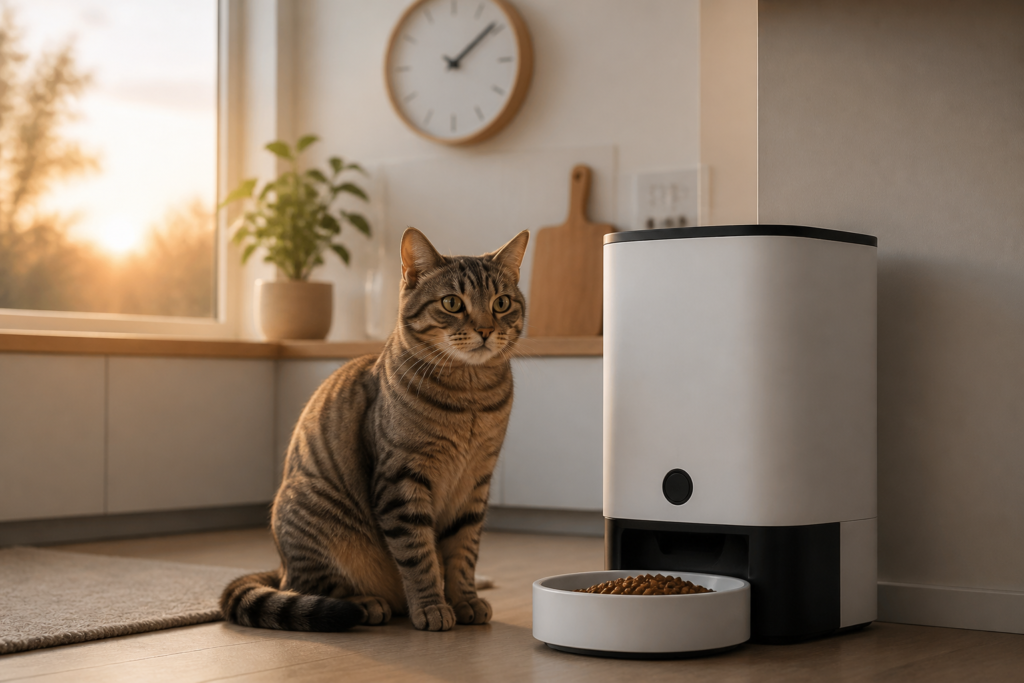
If your cat treats 4 AM as breakfast time, an automatic feeder can make a surprisingly big difference.
Disclosure: This article contains affiliate links. If you buy through them, we may earn a commission at no extra cost to you. As an Amazon Associate I earn from qualifying purchases.
It is not a magic solution for every early-morning wake-up call. Cats may wake their people because they are hungry, bored, stressed, or simply used to getting a response. But when food is part of the pattern, a timed feeder can help remove you from the equation.
Instead of learning, “If I meow at my person long enough, breakfast happens,” your cat can learn, “Breakfast comes from the feeder at the same time every morning.” That consistency is the real value of an automatic feeder.
For a complete plan to change the routine behind early wake-ups, read Why Does My Cat Wake Me Up at 4 AM?.
Can an automatic feeder stop a cat waking you up early?
It can help a lot when your cat wakes you because they expect food from you. Many cats quickly notice the pattern: they meow, you get up, and breakfast appears. Even giving in occasionally can keep that habit going.
A feeder changes the routine in two useful ways. Food arrives at a predictable time, and you are no longer the person delivering it. Over time, this can reduce the reason your cat has to wake you specifically.
It will not solve every case. If your cat is suddenly much hungrier than usual, losing weight, drinking more, vomiting, or changing behaviour, speak to a vet rather than simply adding more meals. These guides can also help: Why Is My Cat Always Hungry?, Why Is My Cat Meowing at Night?, and Why Is My Cat Bored?.
What makes a good automatic feeder for cats?
Reliable schedules
The basic job is simple: the feeder should release food when you set it to. Look for a model that lets you schedule several meals per day and adjust portions. For many cats, several small meals work better than one large breakfast.
Before relying on a new feeder overnight, test it while you are at home. Make sure it dispenses reliably, the amount is correct, and your cat can eat comfortably from the bowl.
Portion control you can measure
Every feeder defines a “portion” differently. Start with your cat’s usual daily amount of food, divide it between the meals you want to offer, then test the machine with a kitchen scale or measuring cup.
More frequent meals should not automatically mean more food. The total daily amount still needs to suit your cat’s age, size, activity, body condition, and veterinary guidance.
A secure hopper and easy cleaning
Cats can be surprisingly inventive around food. Choose a feeder with a stable base, a secure lid, and a design that makes it difficult for paws to reach the stored kibble. A removable bowl and accessible food path also make regular cleaning much easier.
Backup power
A feeder with battery backup can keep the routine going during a power cut. It is still important to check batteries, refill the hopper, and clean the unit regularly, but backup power is reassuring when your cat relies on an early meal.
App control: helpful, not essential
Wi-Fi feeders can let you adjust schedules remotely, receive notifications, or offer an extra snack. Those features are useful for some homes, but a simple programmable feeder is often enough if your only goal is a reliable breakfast schedule.
The best feeder type for your situation
Our shortlist is based on manufacturer specifications and customer-review research, not hands-on testing. We looked for useful features, a substantial review history, and complaints that matter when a machine is responsible for breakfast. Amazon ratings can combine different versions, so a large total does not mean every review describes the exact model linked here. None of these feeders is guaranteed to prevent missed meals.
For a simple single-cat routine, our budget pick is also our research-based choice. There is no reason to spend more just to give breakfast a better marketing department.
Our budget-friendly pick for one cat: VOLUAS 4L
The VOLUAS 4L automatic feeder is a straightforward option if your cat eats dry food and needs no more than four scheduled meals a day. You programme it using its LCD controls rather than an app, and it supports plug-in power and battery backup.
That makes it worth considering for a regular early breakfast without paying for remote monitoring. Its Amazon listing has a substantial ratings history, and the positive reviews we examined often described simple setup. But some reviews of the 4L version reported jams, inconsistent portions, or meals that were not dispensed. Those reports are reasons to check it carefully, not a measured failure rate.
Choose it for a basic single-cat schedule, not for more than four daily meals or remote checks. Before using it overnight, test your cat’s actual kibble and measure what comes out over several scheduled feeds. Keep the food path clean and check the backup batteries.
A two-bowl option: oneisall 5L standard feeder
The oneisall 5L automatic feeder for two cats is worth comparing when two cats eat compatible dry food and can share a feeding area calmly. This is the standard timed version, not the Wi-Fi model. It has two bowls, local controls, battery backup, and up to six scheduled meals a day.
Its listing combines a positive overall rating with several thousand ratings. The reviews we examined included praise for setup and scheduling, alongside reports of inconsistent portions, missed feeds, and control problems. Check the stated kibble size and test both outlets with the food you actually use.
Two bowls do not mean two protected meals. The feeder does not identify which cat is eating, and a determined cat can still visit both bowls. Skip this option if your cats need different diets or one regularly steals the other’s food. The access-controlled category below is more relevant in that situation.
A camera-equipped upgrade: PETKIT YumShare Dual-Hopper
The PETKIT YumShare Dual-Hopper with Camera is an option if you genuinely want camera monitoring, app control, and two separate food compartments. The P591 model uses 2.4 GHz Wi-Fi. Its camera lets you check the feeding area, but it does not keep one cat away from another cat’s meal.
Its Amazon listing has a positive overall rating, although substantially fewer ratings than the VOLUAS and oneisall listings we checked. Reviews included praise for the camera and setup, but also concerns about connection problems and subscriptions. PETKIT confirms that replaying recorded footage requires a Care+ subscription after the trial. Check which features are included before buying.
Choose this upgrade for the monitoring features, not because a camera proves the dispensing mechanism is more reliable. A basic timer may be all you need for breakfast. Neither a camera nor a full hopper replaces someone checking on your cat when you travel.
Best for cats who steal each other’s food: an access-controlled feeder
In multi-cat homes, a normal timed feeder can create a new problem: one cat may eat both portions. If one cat needs a special diet, gains weight easily, or steals food, consider an access-controlled feeder.
Some products use an RFID collar tag while others use microchip recognition. These are different systems, so check how a feeder identifies the cat before buying. PETLIBRO One RFID is an example of a collar-tag option.
What about wet food?
Most hopper-style automatic feeders are designed for dry food only. Do not put wet, damp, or fresh food into a dry-food feeder unless the manufacturer clearly says it is designed for that purpose. Wet food can spoil, block the mechanism, and create a hygiene problem.
For wet food, look for a feeder specifically designed to keep meals cool or covered until serving time. These are normally tray-based rather than dry-food hoppers and need careful cleaning, especially in warm weather.
Compare the features before choosing
These models solve different problems. Compare the layout and controls first, rather than treating the most expensive option as the automatic winner.
| Model | Storage and bowls | Controls | Best fit |
|---|---|---|---|
| VOLUAS 4L | One 4L hopper, one bowl | LCD; up to four scheduled meals daily | A simple dry-food breakfast for one cat |
| oneisall 5L standard | One 5L hopper, two bowls | Local dial; up to six scheduled meals daily | Two cats sharing the same suitable food calmly |
| PETKIT YumShare Dual-Hopper P591 | Two compartments totalling 5L, one feeding bowl | App, camera and 2.4 GHz Wi-Fi | Owners who want remote monitoring and separate food storage |
The PETKIT’s two hoppers are not two protected feeding stations. They store food separately but dispense into a shared bowl. Likewise, the oneisall’s two bowls do not stop either cat crossing over. If keeping diets apart is essential, neither layout replaces selective access.
A larger hopper also is not permission to leave a cat unattended for longer. Capacity tells you how much the container holds, not how long food stays suitable or how long your cat can go without someone checking their welfare.
Set up and test the feeder before the first overnight meal
Make the first trial a daytime job, when you can see what happens. A feeder deserves a small audition before becoming the breakfast department.
Measure what the machine actually dispenses
Use the food your cat will normally eat, after checking its size against the model’s instructions. Put an empty bowl on a kitchen scale, zero it, and weigh several feeds separately at the same setting. Write down the setting and each result. This is a practical consistency check, not a laboratory reliability test.
A numbered portion setting is not a universal weight. Repeat the check when changing kibble, and do not assume that a setting copied from another owner suits your food. For the two-bowl oneisall, weigh each bowl separately as well as the combined amount. You need to know what each cat can reach, not just what left the hopper.
Count these test servings within the day’s food allowance if your cat eats them. Adjust the schedule around their established feeding plan; use veterinary advice if you are unsure about the amount.
Test a scheduled meal, not only the feed button
A manual feed confirms that food can come out. It does not confirm that you entered the correct breakfast time. Check the device’s clock, the selected meal time, and the portion setting, then watch an actual scheduled feed. Check AM and PM if the display uses them, and remove temporary test meals afterwards.
Let your cat investigate without forcing them towards the bowl. Watch their reaction to the motor and the food dropping. If they retreat or avoid eating, slow down the introduction rather than removing their familiar feeding option immediately.
Check backup power without assuming every feature survives
Install the battery type specified in the manual and check its orientation and condition. Following the manufacturer’s instructions, test a scheduled feed on backup power while you are present. Confirm that the meal is actually dispensed and check the clock and schedule again afterwards.
PETKIT states that this model retains scheduled feeding offline and on battery backup. That does not mean every connected feature behaves identically during an outage. Treat feeding, camera access and notifications as separate things to check, rather than relying on an app screen alone.
Retest after cleaning or moving the feeder
Follow the exact model’s cleaning instructions; do not assume all parts are dishwasher-safe. PETKIT’s manual requires the washed removable parts to dry completely before reassembly and says not to immerse the main unit.
Once everything is correctly reassembled, check the lid, bowl and food path and observe another feed. If a meal is missed, give your cat their planned food separately, record the settings and any error message, and troubleshoot using the manual or manufacturer support. Do not simply add a larger portion setting and hope the next breakfast works.
How to use a feeder to stop the 4 AM routine
Start close to your cat’s current breakfast time
If your cat currently wakes you at 4 AM, do not expect them to wait until 8 AM on the first night. Set the feeder for a time close to when they usually ask for food. Once they are eating calmly from it, move the meal later by ten to fifteen minutes every few days.
Feed the last evening meal later
A small early breakfast works better when your cat has had an appropriate evening meal and activity before bed. Try a short interactive play session, then offer the final meal afterwards. This can support a more natural hunt-eat-rest pattern.
Keep your response boring and consistent
The first nights may still be noisy because your cat has learned an old habit. As long as your cat is healthy and has food, water, and litter access, avoid getting up to offer another breakfast. If you do, your cat may learn that waking you still works.
Keep the feeder outside the bedroom so the dispensing sound does not become the new thing that wakes you.
Common mistakes to avoid
Adding extra food instead of dividing the daily amount
The feeder should divide your cat’s food, not automatically add more. Include wet food, treats, and puzzle-feeder snacks when thinking about the total daily intake.
Using the feeder as a substitute for enrichment
A feeder can handle breakfast, but it cannot replace play, attention, a suitable environment, or veterinary care. If your cat is noisy at night because they are bored, add enrichment and play to the plan too.
Forgetting to check the machine
Even good feeders need regular checks. Refill food before it runs low, clean the bowl, test the schedule after changing settings, and inspect the food chute for crumbs or blockage.
Frequently asked questions
Will an automatic feeder make my cat eat too much?
Not if you measure and programme it carefully. Start with your cat’s normal total daily amount, then divide it into scheduled meals.
Can I put wet food in an automatic dry-food feeder?
No. Only use food that the specific feeder is designed to handle. Most hopper-style feeders are for dry kibble only.
Is a feeder enough to stop night meowing?
It can help when food is the main reason for the meowing. If your cat still cries at night, consider boredom, routine, stress, litter-tray access, outside triggers, and possible health concerns too.
Do I need a camera feeder?
Usually not. A camera is useful if remote monitoring matters to you, but a basic timed feeder can solve the breakfast-routine problem perfectly well.
The bottom line
The best automatic feeder is the one that fits your cat’s food, your household, and the routine you want to improve. For most cats that wake their people early for breakfast, a secure dry-food feeder with reliable scheduling and backup power is enough.
Start simple, measure portions carefully, and use the feeder to make food predictable without making you part of the 4 AM routine. A camera can help with monitoring; an access-controlled feeder serves a different purpose by restricting which cat can reach the food. Choose the feature your household actually needs.