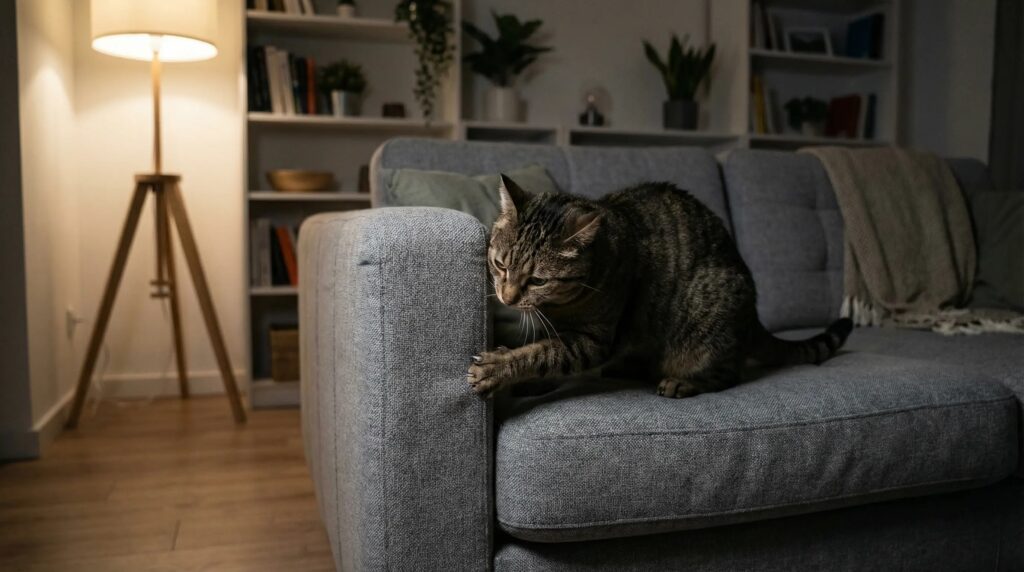
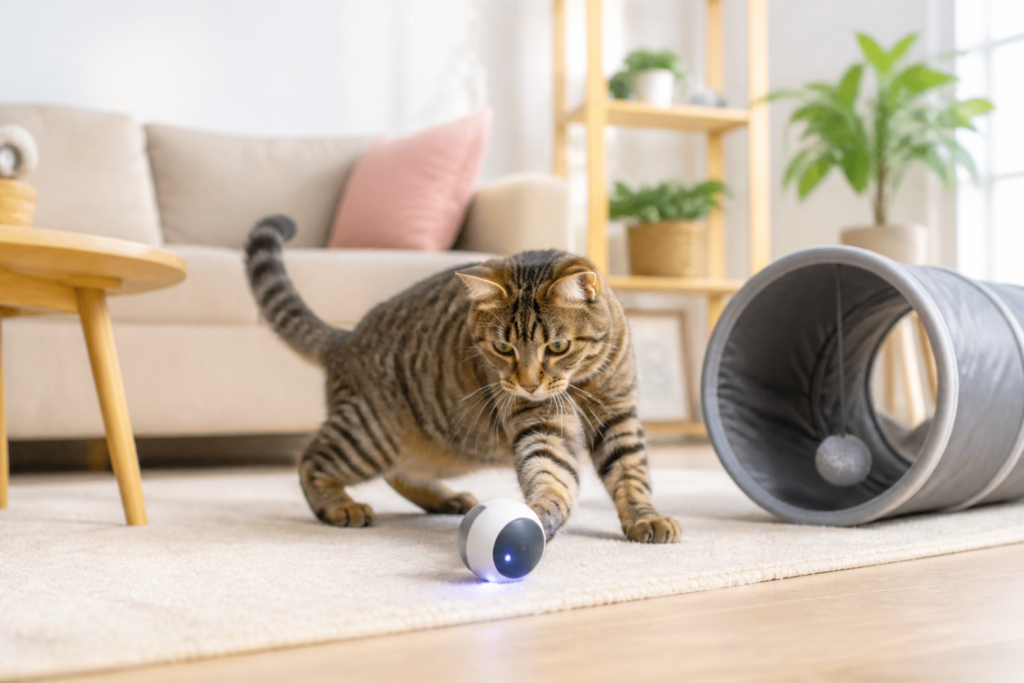
The best interactive toys for bored indoor cats are the ones that match how your cat likes to play. A wand suits a cat who enjoys stalking with you. A food puzzle gives a snack enthusiast something to investigate. A ball track may interest a dedicated paw-swatting specialist. Buying the loudest gadget is not a shortcut to finding the right match.
Start with your cat’s preferences, a manageable routine, and a safety check. This guide explains the main options, one food puzzle worth considering, and when it makes more sense to change the game than buy another toy.
This guide contains an affiliate link. As an Amazon Associate I earn from qualifying purchases. We have not personally tested the featured product; our recommendation is based on manufacturer information and customer feedback, including critical reviews.
Before shopping, check what your cat actually needs
Sleeping, watching the window, or following you around does not prove that a cat is bored. Look at the whole situation. Has your cat always done this, or is it new? Do they have opportunities to explore and interact, or does every day consist of the same bowl, sofa, and closed door?
Our guide to possible signs of boredom in cats explains the wider picture. Here, the useful question is narrower: which activity would give this particular cat an enjoyable choice?
Try a small observation session before opening your shopping basket. Roll a familiar toy, move a lure slowly, then offer a simple food-search activity. Note what attracts attention: following with the eyes, approaching, reaching with a paw, or chasing. Watching can be part of participation; an instant leap is not the only response worth noticing.
A sudden loss of interest in play deserves a different approach. If your cat also seems stiff, hides unusually, eats differently, or reacts painfully to handling, contact your veterinarian. Do not assume a new toy will fix a change you cannot explain.
Choose a play style, not just a product
Think of toys as tools for different jobs. Some create a chase, some offer a problem to solve, and some provide a place to hide. There is no reason to expect one item to cover all three.
A useful starting selection could be one toy for playing together and one different activity your cat already enjoys. That might mean a wand and a food puzzle, or a familiar ball and a cardboard hideaway. It need not mean three purchases.
Before buying, write down what the toy needs to do in your home. If your cat dislikes mechanical noise, quiet operation matters more than flashing lights. If storage is tight, dimensions matter. If food puzzles get washed daily, accessible surfaces matter. These are practical selection criteria, not glamorous ones, which is probably why they are so often overlooked.
Wand toys: a flexible starting point for shared play
A wand gives you control over the game’s pace and direction. You can offer a slow ground-level chase or a brief movement around a corner, rather than asking your cat to keep up with a fixed motor setting.
Choose a lure that your cat can grip without easily tearing off pieces. Inspect the connector, string, and attachment before each session. A reassuring brand name does not cancel out a loose part.
Keep the lure away from your hands and move it through clear floor space. Pause occasionally and allow successful catches. If your cat starts chewing the attachment rather than playing, stop and reassess the toy. Put the entire wand away afterward, somewhere your cat cannot retrieve it.
Wands are for supervised interaction, not decoration left dangling from a chair. Cats can swallow string or become tangled. For that reason, we are not naming a specific wand as an automatic best buy here: the attachment and your cat’s chewing habits matter too much to ignore.
Food puzzles: for cats who enjoy investigating a reward
A food puzzle asks your cat to manipulate an object to reach something edible. It offers a different activity from chasing, and the difficulty needs to suit the cat using it. Veterinary literature supports introducing puzzles gradually, while acknowledging that evidence for particular health outcomes is limited.
Start with an easy setup and familiar food. Keep your cat’s usual feeding arrangement available while they learn rather than making an unfamiliar puzzle their only route to a meal. If they struggle, simplify the task; hunger is not a teaching tool.
For a dry-food puzzle, allocate a small amount from the day’s planned food rather than continually adding bonus snacks. Follow any feeding instructions your veterinarian has given, especially for a prescribed diet. The goal here is enrichment, not an unsupervised weight-loss plan.
Our conditional pick: Catit Senses 2.0 Digger
The Catit Senses 2.0 Digger has five removable cups in two sizes, held in a broad base. Cats reach in with a paw to retrieve dry food or treats. It is stationary: there is no rolling chase or moving target.
That makes it worth considering for a cat who already enjoys fishing food out of accessible spaces. The removable parts also allow you to take it apart for cleaning. Check the measurements against the place you intend to use it; the footprint is not especially compact.
There are limitations. Buyers report cups being lifted out, a mat that does not always fit neatly, and food scattered around the setup. Some cats find reaching into the cups difficult or show no interest. Those reports do not establish a defect rate, but they are good reasons to avoid calling it suitable for every cat.
Inspect the assembled fit, supervise initial use, and follow the manufacturer’s cleaning guidance. Do not glue the cups in place or improvise fixes from customer comments. If it is awkward for your cat, choose an easier puzzle instead.
Check the Catit Senses 2.0 Digger on Amazon.
Ball tracks: a different game from chasing across the room
A track keeps a rolling ball within a defined route, so the activity is mainly watching and batting. That can be a useful format to compare if your cat already paws at moving objects but rarely follows them across the floor.
Check how easily the ball moves, whether the track has sharp or distorted edges, and whether pieces can come loose. Do not assume that a contained ball is permanently secured. Use the supervision instructions for the exact product.
We are not recommending Tower of Tracks as our main purchase at present. Although its Amazon listing has a large positive rating history, several recent critical reviews we checked described bent tracks or balls that stopped moving. This is customer feedback, not an independently confirmed manufacturing finding.
There is also a version issue: the manufacturer and Amazon information we reviewed described different ball counts. Before buying any track, confirm the exact version and included parts rather than relying on a photo from another listing.
Automatic toys: convenience without a supervision shortcut
Automatic balls and moving toys can introduce a different kind of motion, but they are not essential. A cat may enjoy one, ignore it, or avoid the sound. More settings do not guarantee more fun.
Read the exact model’s instructions before deciding where it fits into your routine. If supervision is required, it remains required even when the toy has rest cycles or an automatic shutoff. Hands-off movement and unattended use are different things.
For an initial trial, clear a small area and observe the toy and your cat together. Does it repeatedly lodge under furniture? Is the noise intrusive? Does your cat approach willingly, or keep trying to escape the activity? Those observations are more useful than leaving it running and hoping for the best.
We are not selecting Cheerble Wicked Ball M3 as a featured purchase here. Its manufacturer requires supervision, and customer feedback we reviewed included reports of the attached bell coming loose. The reports are not independent proof that every unit has a problem, but they do not justify presenting it as a carefree solution for time alone.
Tunnels and boxes: useful places to set up a game
A tunnel or box creates a location for exploration and hiding. You can use it as part of a supervised game without expecting the object itself to entertain your cat indefinitely.
With a commercial tunnel, inspect the fabric, seams, and any frame or exposed wire. Check that the openings are comfortable for your cat and that the tunnel stays in a usable position. Remove damaged items rather than covering exposed components with a quick patch.
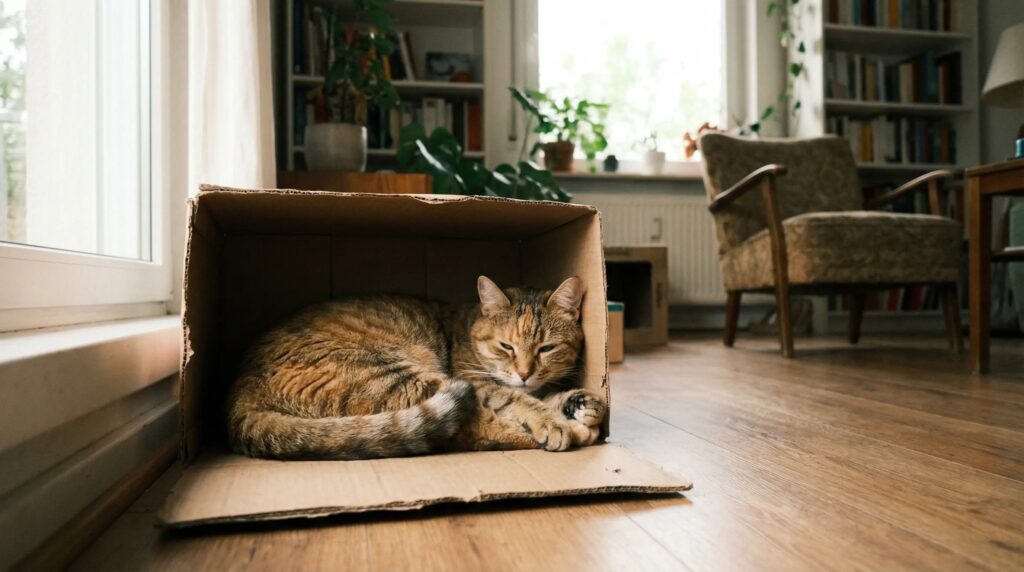
A clean, sturdy cardboard box is a reasonable no-purchase starting point. Remove staples, loose tape, and packing material, and leave an easy entrance and exit. Retire the box if your cat tears off and eats pieces. Simple is useful; simple does not mean exempt from inspection.
Try placing a familiar toy nearby and letting your cat decide whether to investigate. Do not reach into the hideaway to provoke a pounce at your fingers. The hiding place should remain an option, not a trap.
Laser play: optional, not a necessary upgrade
A laser creates movement without an object to grab. If you use one, avoid eyes and reflective surfaces, keep the activity controlled, and finish with a real toy or suitable food reward. Stop if the game seems to leave your cat unsettled rather than satisfied.
There is no need to purchase a laser just because a product list includes one. If your cat happily plays with a physical lure, that already gives you something tangible to offer at the end of the chase.
Make the setup work for your household
For a cautious cat
Choose a quiet location with room to move away. Introduce one unfamiliar item at a time rather than switching on a gadget beside a new tunnel and a puzzle. Let the cat approach; do not carry them over and hold them near the toy.
If stress seems to be part of the situation, our guide on helping a stressed cat feel more comfortable is a better starting point than a larger shopping list.
For an older cat or one with limited movement
Consider accessibility before speed. Can the activity stay at floor level? Can the cat reach the reward without an awkward position? Offer a gentle trial and do not require jumping just to participate.
Ask your veterinarian about an appropriate activity level if your cat has a mobility problem. A change in willingness to move is not something to test by increasing the intensity of the game.
For a home with several cats
Watch who actually gets a turn. A toy can look popular while one cat does all the playing and another waits behind the sofa. Separate sessions are worth trying when shared play leaves someone excluded.
Food-based activities especially need individual access. Do not make one puzzle the household’s shared gatekeeper to dinner. Provide space and separate opportunities, and avoid forcing cats together around a reward.
A realistic first-week trial
Rather than buying several toys at once, try the following observation plan with one suitable activity. This is a practical trial, not a behavior-treatment schedule or a promise that a week will resolve boredom.
On the first day, check the toy’s condition and instructions, set up a clear area, and offer a brief introduction. Record what happened without grading the cat: watched, approached, touched, chased, or walked away.
For the next few attempts, change only one detail. Try a quieter location, a gentler movement, or an easier food setup. Changing everything at once makes it difficult to tell which adjustment mattered.
Keep a short note of your cat’s response and any practical issue, such as scattered food or a loose component. Include whether cleaning and storage are manageable for you. A toy that works only when you have half an hour to assemble it may not suit an ordinary Tuesday.
At the end of the trial, decide whether to continue, simplify, or try a different format. If your cat enjoys the activity, there is no obligation to upgrade it. If they avoid it, do not keep escalating the noise or movement to force a reaction.
Build variety without buying a cupboard full of toys
Keep a modest selection and rotate some items rather than leaving every novelty available indefinitely. Store string toys securely between supervised sessions. Rotation should never mean removing a cat’s essential resting places or hiding options.
Make a simple household list: what you already own, what the cat uses, what needs repair or replacement, and what stays ignored. You may discover that the missing ingredient is time together rather than another object.
Give unused purchases a fair, safe introduction, but do not treat their price as a reason to persist. A costly toy your cat dislikes remains a toy your cat dislikes. The cat has not read the receipt.
For nighttime restlessness, plan play when your cat is willing to engage rather than promising that an exhausting session will guarantee sleep. If vocalizing continues, our article on why cats meow at night covers other possibilities. Toys are only one part of that question.
Check reviews more carefully than the star rating
A large rating total helps you find experiences to read, but it does not prove safety or suitability. Reviews may cover different colors, sizes, or versions. Look for comments about the exact setup you are considering.
Compare recent favorable reviews with critical ones. Distinguish a preference issue, such as a cat ignoring a toy, from a practical concern such as loose pieces, inaccessible food, or repeated charging trouble. Neither kind of comment proves what will happen in your home.
Check the seller, return terms, included parts, and current instructions before ordering. We do not attach fixed prices or permanent star ratings to our recommendation because those details can change. A product should earn its place through suitability, not through the size of an affiliate commission.
When to stop playing and get advice
End a session if the toy breaks, a component comes loose, or your cat starts ingesting material. Contact a veterinarian promptly if you suspect your cat has swallowed string or another toy part. Do not wait for a replacement toy to solve a possible ingestion problem.
Veterinary advice is also appropriate when a change in activity comes with reduced appetite, unusual hiding, apparent pain, or other signs of illness. Describe what changed and when rather than labeling it boredom.
For ongoing fear, conflict, or difficulty finding comfortable activities, ask your veterinarian whether a qualified feline behavior professional would help. The right next step may be a better assessment, not a better gadget.
Start with one good match
Choose an activity your cat can enjoy comfortably, introduce it without pressure, and watch what happens. A supervised wand session and an accessible food puzzle serve different purposes; neither needs a premium price tag to be useful.
The Catit Digger is a conditional option for food-search enthusiasts, not our universal winner. For everyone else, begin with the play style rather than the brand. Keep what works, put unsafe items away, and leave room for your cat to vote with their paws.