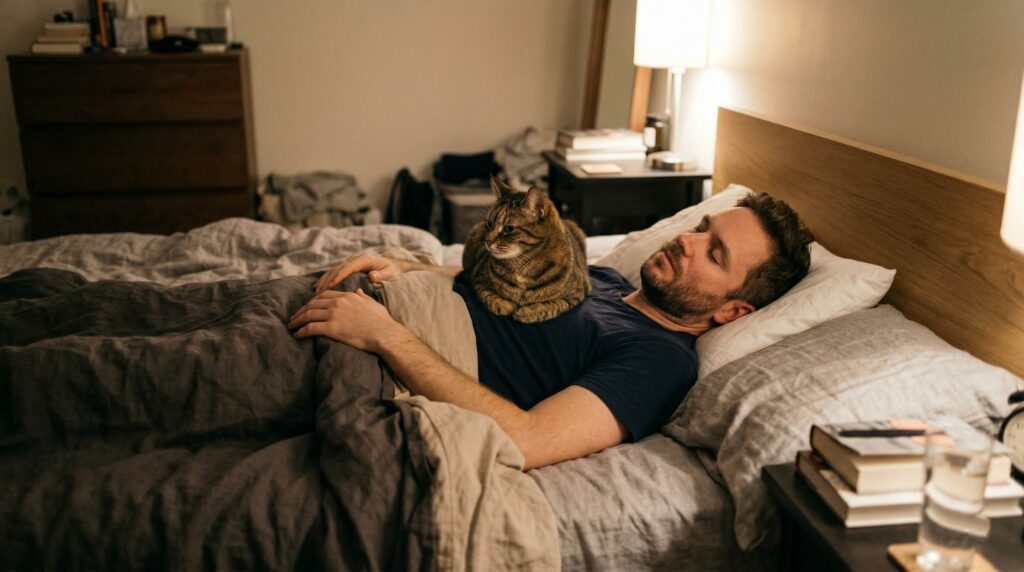
Your cat has chosen your chest as a sleeping spot, apparently without consulting you first. Warmth, comfort and closeness may explain the choice, but the position alone cannot tell you exactly what your cat wants.
If it interrupts your sleep or feels uncomfortable, you can gently move your cat. Difficulty breathing is different: do not assume your cat is the cause or try to sleep through it. The safety section below explains when to seek medical help.
Why Cats Choose Specific Sleeping Spots
A resting place can offer several things a cat enjoys: warmth, comfort, familiar surroundings and opportunities for close contact. Your chest may offer some of those things, but it is not necessarily your cat’s safest or favourite spot.
Rather than treating the location as a message with one translation, consider the situation. Does your cat settle quietly? Does the visit happen just before breakfast? Is this a familiar routine or something new? Those observations give you more useful context than the position alone.
Why Your Cat Might Choose Your Chest
Several explanations are possible, and more than one may apply. None can be confirmed from the sleeping position alone.
1. Sharing Your Warmth
Sharing your body heat may make this an appealing place to rest. That does not mean your chest is warmer or more comfortable than every other option. Some cats will choose a nearby blanket instead, and their preference may change.
2. Feeling Comfortable Around You
Choosing close contact can be consistent with feeling comfortable around you. It is not proof that your cat regards your chest as the safest place in the home.
If your cat also stays close during the day, our guide to why your cat follows you everywhere explores that separate pattern.
3. Enjoying Close Contact
Resting together can be part of a friendly relationship. Still, warmth and comfort may also play a role. A cat who prefers sleeping nearby rather than on you can be comfortable with you too. Chest-sleeping is not a compulsory feline declaration of love.
4. Being Awake Does Not Reveal a Specific Motive
An awake cat may look around or notice your movements. That does not demonstrate that they chose your chest to monitor your breathing or protect you.
If looking at you is a separate pattern you have noticed, read about why your cat watches you sleep. Watching and settling down are observations, not proof of a particular intention.
5. Learning That Contact Gets a Response
If you regularly get up, offer food or give attention after your cat climbs onto you, that response may encourage the pattern. This does not establish that your cat is deliberately trying to interfere with your breathing.
Keep your comfort and safety first. Notice what usually happens before and after the visit rather than assuming that every approach is a request for breakfast.
If the timing is your main concern, our guide to why your cat wakes you up at 4 AM addresses early-morning interruptions.
6. A Familiar Routine
Repeated visits may become part of a familiar routine. That possibility does not mean you caused the behavior or must tolerate it indefinitely. Decide what sleeping arrangement works for you, then respond consistently and gently.
Why the Timing Can Matter
Cats are generally more active around dawn and dusk, although individual routines vary. A visit near sunrise may fit that pattern; settling quietly on your chest does not necessarily mean your cat is in an active phase.
Compare what actually happens. A cat who climbs up, curls into a ball and stays there presents a different practical problem from one who keeps moving across you. You may want to redirect either one, but you do not have to assign them the same motive.
For that moving-around pattern, see why your cat walks on you while you sleep.
Why You Do Not Have to Put Up With It
You can enjoy your cat’s company without agreeing to be their mattress. If the position feels uncomfortable or keeps waking you, gently move your cat to another resting place. You do not need to wait until it becomes a serious problem before setting that boundary.
Sleeping nearby is an option, not a consolation prize. If you would rather keep your chest cat-free, that is a perfectly reasonable arrangement.
What Your Cat’s Position Can Tell You
Posture offers context, not a translation of your cat’s thoughts. Notice whether they settle quietly, remain alert or keep moving, and what happens next. A single paw touch or upright posture does not establish that they want you awake.
Avoid conclusions such as “they sat upright, so they must be guarding me.” You can describe what you saw without turning it into a claim about an intention you cannot verify.
Is Sleeping With a Cat on Your Chest Safe for You?
Sharing a bed and having a cat resting directly on your chest are not the same situation. There is no blanket reassurance that suits every person. Choose a different sleeping arrangement if the contact causes discomfort, worsens allergy symptoms or disrupts your sleep.
If you are short of breath, move the cat off your chest, but do not assume that explains the symptom. Get prompt medical advice for new or unexplained breathlessness. For severe difficulty breathing, a tight or heavy chest, blue or grey lips, or sudden confusion, call your local emergency number immediately.
Cats should be kept out of babies’ and young children’s bedrooms for safety. Advice about an adult sharing a bed with a cat should not be applied to them.
How to Stop Your Cat From Sitting on Your Chest at Night
Move Your Cat If You Need To
Gently move your cat if the position is uncomfortable. Never ignore breathing difficulty to avoid rewarding a behavior. Once you are comfortable, keep the response calm rather than turning the interruption into a game. Do not punish your cat.
Review Play and Feeding Routines
Offer play opportunities during the day and an evening session suited to your cat’s interest and ability. This can help meet their activity needs, but it does not guarantee an uninterrupted night. A fixed play duration is not a requirement for every cat.
If visits tend to happen around breakfast, consider whether meal timing plays a part. Smaller, more regular meals or a timed feeder may help some cats. Keep changes within your cat’s existing daily allowance, and check with your vet before changing a prescribed feeding plan.
Offer Another Sleeping Place
A soft bed or familiar blanket near you gives your cat another option. Offer a comfortable alternative and give them a choice. They may not switch immediately; several suitable resting places are more realistic than expecting one new bed to solve everything overnight.
Keep the Boundary Consistent
Decide whether you are comfortable with your cat sleeping beside you or would prefer a separate space. Use the same calm approach rather than alternating between encouraging chest-sleeping and reacting sharply to it.
Consistency does not mean ignoring distress or a new health concern. If the pattern changes, reconsider the cause rather than simply becoming stricter.
When to Ask Your Vet
A new nighttime pattern deserves attention, especially if your cat also seems restless or disorientated. Contact your vet rather than assuming the change is simply affection or a training problem. Do not punish nighttime behavior that could be connected with feeling unwell.
For broader context, our guide to common cat behavior problems and their causes looks beyond a single sleeping position.
Work Out Which Part of the Night Needs Changing
A useful plan starts with an observation you can act on. “My cat is too attached to me” is an interpretation. “I wake when they climb onto my chest, and they return after I move them” describes the problem more clearly.
You do not need to stay awake to collect evidence. Write down what you remember in the morning and be honest about the parts you missed. If you only noticed your cat after waking, you cannot know how long they were there or what they did beforehand.
When Your Cat Settles Quietly but the Position Bothers You
In this situation, changing meal times may be beside the point. The immediate issue is where the cat rests. Prepare another resting option before bed and decide whether sharing the mattress still works for you.
For example, you might be happy with a cat beside your legs but not on your chest. That is a clear boundary. It does not require a rule against all closeness, and it does not mean the cat must demonstrate a different kind of affection before being welcome.
If moving them a few inches does not solve the problem because they keep returning, consider a separate sleeping space. Do not spend the night repeatedly tolerating discomfort while waiting for a training exercise to work. A workable arrangement protects your sleep now as well as supporting a longer-term routine.
When the Visit Becomes a Breakfast Announcement
Notice whether your cat leaves the bed when you get up and heads towards the feeding area. That sequence may make food expectations worth considering, but it is not proof that hunger explains every chest visit.
Keep the question practical: is breakfast always delivered immediately after this contact? If so, plan the meal independently of the interruption. Agree on the plan with anyone else who feeds the cat so that the routine does not depend on which person wakes first.
Do not withhold needed food to prove a point. A feeding arrangement has to suit your cat’s health and nutritional needs. If you are unsure how to change the schedule, ask your veterinarian rather than copying another household’s timetable.
When the Pattern Is New
Separate “my cat has always done this” from “my cat suddenly started doing this and seems different.” The second deserves a wider look, not simply a more determined bedtime rule.
Record the change and anything else you have noticed. You can describe the timing, frequency and surrounding behavior without deciding whether the cause is medical, environmental or both. If your cat seems unwell, contact the vet rather than waiting to finish a home experiment.
Prepare the Alternative Before Lights-Out
It is much easier to choose a resting arrangement while awake than with a cat perched on you at three in the morning. Start with an existing bed or blanket your cat already uses. The first step does not have to involve buying anything.
Think about access as well as location. Can your cat reach the resting place and leave it freely? Will someone shut a door that cuts off their usual resources? Is the proposed spot actually available, or does another pet occupy it every evening?
Keep the arrangement simple enough to repeat. A bed that only appears after the cat wakes you is different from an option that is available before bedtime. Preparing it early also lets you see whether your cat investigates it without needing to interrupt their sleep.
If More Than One Person Shares the Bed
Agree on what you are comfortable with. One person may enjoy chest contact while the other finds it disruptive. There is no benefit in pretending the same sleeping arrangement works equally well for everyone.
Choose a calm response both people can use. If one person moves the cat away while the other immediately invites them back, your household has conflicting rules. That does not establish that the cat is stubborn; it means the arrangement needs a clearer decision.
You might agree that the cat can sleep beside the bed but not on either person. Or you might choose separate sleeping spaces. The useful outcome is a plan you can follow without arguing about it when everyone is tired.
If You Decide to Keep the Bedroom Cat-Free
Check the alternative space before closing the door. Your cat should still have access to their usual essentials and a suitable resting place. Removing access to you should not also remove access to water or the litter tray.
Do not use a carrier as an overnight solution to bedroom interruptions. If changing access causes persistent distress, seek individual veterinary or behavior advice rather than escalating confinement. You are changing a sleeping arrangement, not imposing a punishment.
Consider how the plan works when someone gets up during the night. Decide whether the door stays closed and where the cat can rest, rather than making a new rule at every bathroom visit. Practical consistency is easier when the setup has already been thought through.
Check Whether the Change Is Actually Helping
Choose an outcome you can observe: fewer awakenings, no chest contact, or comfortable use of another resting place. “My cat is less needy” is not a useful measure because it labels the animal rather than describing the result.
Make a brief note of the arrangement and what happened. For instance: “Bed available beside the bedroom; cat settled there at bedtime; woke once when they climbed onto the mattress.” That is more informative than deciding the whole plan failed because one visit still happened.
If safety is not at issue, change one practical feature at a time. Moving the bed, changing feeding times and removing bedroom access on the same night may produce a result without showing which change mattered. You do not need a perfect explanation, but knowing what you tried helps when asking for advice.
Compare reasonably similar nights. A quiet evening and a night with visitors are different situations. Note a changed work shift, a late bedtime or a closed door rather than assuming your cat’s feelings changed for no reason.
There is no guaranteed number of nights after which this should stop. If the arrangement remains uncomfortable, you can change it; you do not need to keep repeating a plan because an online timetable says it should work. Persistent problems are a reason to ask for tailored help, not to become harsher.
A Comfortable Arrangement for Both of You
Before changing the setup, decide what you will do if you wake with your cat on your chest again. Keep a suitable resting option available and make sure you can end contact comfortably. You do not need to assess your cat’s mood perfectly before moving them away.
If the plan is not workable, describe the obstacle rather than blaming yourself or the cat. Perhaps they return repeatedly, the alternative space is unsuitable, or another household member follows a different routine. Each observation points to something you can discuss and change.
Bring those details to your vet or a qualified behavior professional if you need help. A short description of what happens, what you have tried and whether anything else has changed gives them a better starting point than a list of assumed motives. Your goal is reliable rest, not winning a disagreement about who owns the mattress.
You do not need to decode your cat’s exact motive before deciding where they can sleep. Notice the pattern, offer another resting place and keep your own sleep and health in the picture.
If your cat also spends time looking at you when you are awake, why your cat stares at you covers that different situation. For tonight, the useful question is simpler: can you both rest comfortably? If not, it is time to change the arrangement.