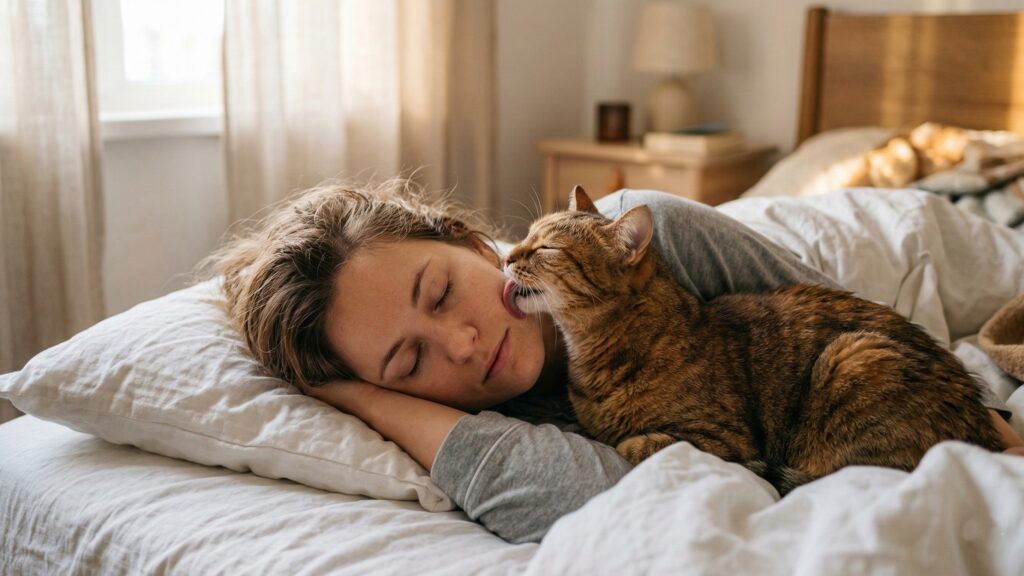
Your cat may lick your face while you sleep as part of social grooming, to seek interaction, or because the situation has become a familiar routine. The licking alone does not reveal one definite motive. You can respond kindly without letting it continue, especially around your eyes or mouth.
If you are asking, “Why does my cat lick my face while I sleep?”, the useful next step is to notice when it happens and what follows. A brief, familiar habit is different from a sudden change accompanied by other signs that your cat is uncomfortable.
And if the target is your eyelids, protect your eyes first. You do not need to lie still and endure it to avoid rewarding your cat. Your face is not a training exercise.
What Face Licking Can Mean—and What It Cannot Tell You
Social grooming is one possibility
Cats sometimes groom other cats in their social group, and licking can also occur during interaction with people. Cats Protection’s guide to cats licking their owners describes social bonding as a possible explanation.
That does not make every lick an unmistakable declaration of affection. Consider the situation around it. A cat who approaches freely during a quiet interaction is not in the same situation as one who starts licking while being held and trying to leave.
Nor does grooming mean your cat thinks you need a bath. It is tempting to supply a funny translation, but “you have failed the cleanliness inspection” is a joke, not an explanation we can establish.
Your response may become part of the routine
If licking repeatedly leads to breakfast or attention, that consequence may help maintain a nighttime habit. Veterinary behavior guidance discusses how owners can inadvertently reward activity that wakes them up.
For example, imagine a cat licking your cheek, you getting up, and breakfast appearing immediately afterward. Note the sequence without deciding hunger is definitely the original cause. An outcome can help keep a behavior going even when its starting point is unclear.
This is not evidence that your cat has carefully plotted your sleep deprivation. It is a reason to review the routine rather than blame either of you. A predictable feeding plan is more useful than arguing with a cat at dawn.
Context matters more than a list of seven “reasons”
Some cats are active when their owners are asleep, particularly around dawn or dusk. A cat near your head also has access to your face. Those observations help describe the setting; they do not prove your scent becomes stronger at night or that your cat is checking whether you are alive.
A different pattern needs a different response. Licking that starts during handling, becomes unusually persistent, or accompanies changes elsewhere should not automatically be filed under affection. You do not have to identify a precise emotion before you can give your cat space or ask for advice.
Why Does My Cat Lick My Eyelids While I Sleep?
Licking the eyelids may happen within the same interaction as licking the rest of your face. However, the guidance reviewed for this article does not establish one special, reliable reason cats choose eyelids. We cannot confidently say it is the taste of tears, eye movement, or an attempt to clean your eyes.
“They are near my pillow and can reach my face” describes access. “They are drawn to the salt in my tears” assigns a motive that would need evidence. Keeping that distinction clear avoids turning a plausible-sounding guess into advice.
You also do not need to investigate by letting it happen again. Stop access to the eye area calmly and choose a sleeping arrangement that prevents a repeat. Observing ordinary behavior should never require accepting unwanted contact.
A closed eyelid is not permission to continue
There is no useful reason to treat a closed eye as a safe target for licking. Avoid saliva contact around your eyes, mouth, and broken skin. That is a practical precaution, not a claim that one lick inevitably causes an infection.
If your cat keeps reaching your face from a shared pillow, reconsider that location rather than trying to supervise while asleep. Our guide to cats sleeping on pillows covers the resting-place preference. Here, the priority is preventing face licking.
If saliva gets into your eye
Stop further contact and avoid rubbing the eye. NHS eye-injury guidance recommends clean water to rinse something out of an eye. Do not put soap, disinfectant, or a pet-care product into your eye.
Get urgent medical help for severe pain, changes to your vision, or difficulty keeping the eye open. Seek advice if irritation continues or you are worried about what happened. Tell the clinician about the saliva contact or any scratch; do not assume discomfort is simply an allergy.
Is It Safe to Let a Cat Lick Your Face?
The sensible approach is to avoid face licking rather than encourage it. Cats can carry germs even when they look healthy and clean. The CDC’s guidance on staying healthy around cats recommends handwashing after contact with saliva and routine veterinary care.
Saliva should not contact wounds or sores. If you have a weakened immune system or a medical condition that changes your infection risk, ask your healthcare team for individual advice about contact with pets.
You can enjoy your cat’s company without choosing this particular form of contact. Sitting nearby, play, or gentle interaction your cat chooses are alternatives. Avoid framing a boundary as a test of whether you accept your cat’s affection.
For children, keep the rule straightforward: supervise interactions and do not allow pets to lick their face or mouth. That follows the CDC’s healthy-pets handout. A child should tell an adult about a bite or scratch, rather than decide for themselves whether it matters.
Remember what is on your skin
Face licking also raises a separate question: could your cat ingest something you applied? Human topical medication is not made for a cat to lick. Do not let them lick treated skin or assume a product is safe because it is sold without a prescription.
Minoxidil, found in some hair-loss products, is especially dangerous to cats. The ASPCA’s minoxidil safety guidance warns about contact with treated skin and residue on pillows, bedding, and other surfaces.
If you suspect exposure to minoxidil, seek veterinary help immediately rather than waiting for symptoms. For another product, contact your veterinarian or an animal poison service with the name and ingredients. Keep the packaging available. Do not change your own prescribed treatment without discussing it with the appropriate healthcare professional.
This is also why “maybe they like your lotion” is not a reassuring explanation. Whatever prompted the interest, preventing access to a potentially harmful product comes before interpreting the licking.
How to Stop Face Licking Without a Nightly Battle
Interrupt contact calmly
Move your face out of reach and disengage without shouting, spraying, or pushing your cat roughly. If contact around your eyes is continuing, change the arrangement rather than trying harder to ignore it. Protecting yourself is not a training failure.
There is a difference between ending contact and turning every wake-up into a long conversation, feeding session, or game. Keep the immediate response simple. Offer appropriate interaction at planned times when you are awake, not as the inevitable sequel to a lick.
Think through that response before bedtime. It is easier to follow a simple plan when you are tired than to invent an ideal one with a cat beside your nose. Agree with anyone sharing the bed so the household response does not change depending on who wakes first.
Prepare a resting option before lights-out
If your cat normally approaches from your pillow, offer an existing comfortable resting place elsewhere before you go to sleep. Start with a suitable bed or familiar blanket you already own; this is not automatically a shopping problem.
Choose a location your cat can reach and leave easily. Let them investigate while awake. Moving them repeatedly from one end of the mattress to the other during the night is not a useful way to assess whether the alternative works.
Sharing the bedroom may work for some households. If you cannot reliably prevent access to your face, consider keeping the sleeping spaces separate, with your cat’s usual resources accessible. Do not suddenly shut them somewhere unsuitable or keep them in a carrier overnight to solve the problem.
If a change in bedroom access leads to ongoing distress, consult your veterinarian and, where appropriate, a qualified cat behaviorist. The goal is a workable arrangement for both of you, not a contest over who can tolerate the loudest night.
Offer play when your cat is awake and interested
Plan regular opportunities for play rather than relying on one exhausting bedtime session. Cats Protection’s play guidance supports short games and toys that keep play away from fingers and toes.
Offer a suitable toy, let your cat engage, and stop when they lose interest. Put away string or fishing-rod toys afterward so they are not available unsupervised. An older cat or one with mobility concerns may need a different kind of game; ask your veterinarian if you are unsure.
Do not wake your cat through the day to force a quiet night. Cats Protection explicitly advises leaving sleeping cats undisturbed. A nap is not evidence that your plan has failed, and play is not a guarantee that face licking will disappear.
Separate meals from the moment you are licked
If your notes suggest the licking regularly happens just before breakfast, review how meals are delivered. Plan food around your cat’s nutritional needs rather than adding extra portions every time they wake you.
Discuss changes with your veterinarian if your cat has a prescribed diet or feeding requirements. A timed feeder may suit some routines, but it is not necessary for every cat and cannot explain a new behavior by itself.
For the wider early-waking problem, see our guide to cats waking their owners at 4 AM. Face licking deserves its own boundary even when breakfast timing is part of the bigger picture.
Keep a Useful Record, Not a Midnight Detective Project
A few notes can help you describe the pattern without setting an alarm to monitor your cat. Write down what you remember when you wake up. If you were asleep for most of the event, say so; you do not need to supply a motive or a missing beginning.
- Was it near bedtime, during the night, or shortly before your usual breakfast?
- Was your cat already sharing the pillow, or did you notice them arrive?
- Did you get up, feed them, pet them, or end the contact?
- Is the pattern familiar, or has it changed?
- Have you noticed changes in eating, movement, grooming, or interaction?
Use ordinary descriptions. “Licked my cheek at 5:30, then followed me to the kitchen” gives you something concrete to discuss. “Was jealous and desperate for attention” turns an interpretation into a fact before you have examined it.
Compare similar nights
Imagine one night when your cat has access to the pillow and another when you have prepared a separate resting area. Record where they settle and whether face contact occurs. You are comparing arrangements, not testing how much your cat loves you.
Do not change every part of the routine at once unless safety requires it. If you alter bedroom access, feeding time, and play on the same evening, you may get a useful result without knowing which adjustment helped.
That uncertainty is fine. A practical solution does not always need a perfect explanation. It matters more that the arrangement is comfortable, meets your cat’s needs, and lets you sleep without repeated face contact.
Include the rest of the household
If two people share the bed, compare what each of you actually does after being woken. One person may quietly end contact while the other gets up and offers breakfast. That difference is worth recording before concluding that your cat prefers one person’s face.
Write a simple plan you can both follow: where the cat can rest, who handles the planned meal, and what happens if face licking starts. It should be short enough to remember when neither of you feels especially articulate.
On nights with visitors, a later bedtime, or a different work shift, note those circumstances instead of treating them as comparable to every other night. You are looking for a manageable pattern in a real home, not running a laboratory experiment. A disrupted night is information; it is not proof that every adjustment was useless.
Define improvement before you start
Choose a result you can actually observe: no access to your eyelids, fewer interruptions, or comfortable use of the alternative resting place. “My cat is less needy” is harder to evaluate and carries a judgment you may not be able to support.
A cat who sleeps nearby without licking has not become less affectionate. Equally, a cat who changes resting spots has not necessarily rejected the plan. Keep the observation separate from the story you attach to it.
There is no universal deadline for fixing this habit. If nights remain difficult, describe what you tried and ask for individual help. Do not keep escalating restrictions because a generic timetable says the behavior should already have stopped.
If Licking Turns Into Biting
End the interaction rather than putting your hands near the cat’s mouth to find out what they will do next. Licking during unwanted handling can precede a bite, but a bite after licking does not establish one universal cause.
Consider whether you started stroking, held your cat, or blocked their movement. Give them space and use our guide to biting during petting if handling is the relevant context. Do not turn biting into a game with your face or hands.
If a bite breaks your skin, wash the wound promptly with soap and water and contact a healthcare professional for advice. A scratch or injury involving your eye needs medical assessment, not a trial of home remedies.
When to Speak to Your Veterinarian
Contact your veterinarian about licking that is new, noticeably more persistent, or accompanied by other changes. Relevant observations include reduced appetite, more hiding, less interaction, difficulty moving, or changes in grooming and toileting.
International Cat Care’s pain guide explains why changes from normal behavior matter. These signs do not diagnose pain or a particular illness. Avoid repeatedly handling your cat or touching a sensitive area to test a theory.
If there has been a household change, mention that too. Our guide to signs of stress in cats can help you notice the wider pattern, but a possible environmental explanation should not replace a veterinary assessment.
You do not need to wait until you have a complete diary. Tell the clinic what has changed and ask how urgently your cat should be seen. Suspected medication exposure is a separate urgent situation, not something to investigate through a bedtime routine.
A Kinder Boundary for Both of You
You can stop face licking and still make room for your cat’s company. Keep your eyes protected, provide useful resting choices, and offer interaction when you are awake. If something changes, look beyond the lick itself. The best arrangement is one that works for both of you—not one that requires your cheek to host the breakfast announcement.