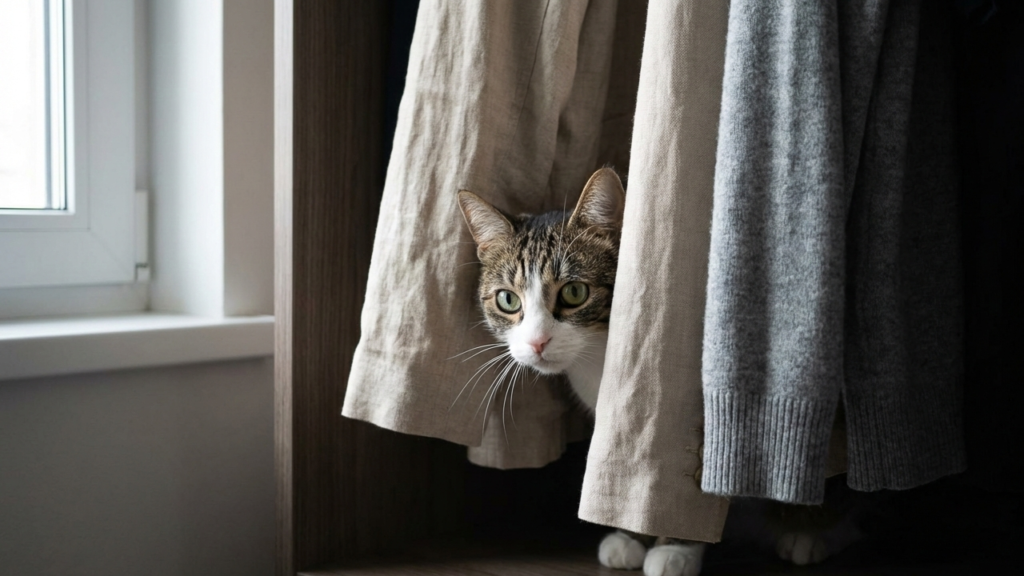
One day your cat is sleeping in the middle of the living room like they own the place. The next day, they’re gone. Under the bed. Behind the wardrobe. Inside the closet. Somewhere dark and quiet where you can barely reach them.
If you’re asking yourself, “ Why is my cat hiding all of a sudden? ”, you’re not overthinking it.
Cats don’t suddenly change behavior without a reason. When something shifts quickly, it usually means something in their world feels different. The key is figuring out whether that difference is minor, temporary — or something that needs attention.
Sometimes it starts subtly.
Your cat skips their usual sleeping spot and chooses under the bed instead. They hesitate before entering a room. They avoid eye contact more than usual. Small shifts that feel almost invisible — until they repeat.
That’s why sudden hiding feels so unsettling. It’s rarely dramatic. It’s quiet.
And quiet behavioral changes in cats are often the most meaningful ones.
Let’s break it down calmly.
Why Do Cats Hide in the First Place?
First: Hiding Is Not Automatically a Problem
Before assuming something is wrong, remember this: hiding is natural feline behavior.
In the wild, cats hide to:
- Observe safely
- Protect themselves when vulnerable
- Recover from stress
- Rest without being disturbed
Even indoor cats carry that instinct. Enclosed spaces reduce exposure and increase perceived control. That’s why many cats prefer tight areas, high shelves, or hidden corners.
But when hiding appears suddenly — especially in a cat that didn’t do it before — that’s when context matters.
1. A Change in the Environment (Even a Small One)
Cats are extremely sensitive to environmental shifts.
New furniture. A guest staying over. A moved litter box. A different smell. Construction noise outside. A new routine.
What feels insignificant to us can feel destabilizing to them.
Cats rely heavily on predictability. When something interrupts that predictability, hiding becomes a way to regain control and reduce stimulation.
If you’re unsure whether stress is involved, review the subtle signs of stress in cats and see if other small behavioral changes match what you’re noticing. Hiding is often just one piece of a bigger pattern.
2. A Frightening Experience
Cats have excellent memory when it comes to fear.
A loud bang. A fall. A door slamming. A vacuum incident. Thunder. Fireworks.
Even if the noise stops, the emotional imprint may remain.
Sometimes the hiding isn’t about what’s happening now — it’s about what happened earlier.
In these cases, the behavior often fades once your cat feels the environment is safe again.
3. Illness or Physical Discomfort
This is where you need to pay attention.
In nature, injured or sick animals hide to avoid predators. That instinct doesn’t disappear in domestic life.
If your cat is hiding and also:
- Eating less
- Drinking less
- Moving stiffly
- Grooming less
- Using the litter box differently
It’s time to speak to a vet.
Hiding combined with physical symptoms should never be ignored.
4. Pain That Isn’t Obvious
Cats are masters at masking discomfort.
Dental issues. Joint inflammation. Internal pain. Early infections.
Sometimes there are no dramatic signs. Just withdrawal.
If your cat suddenly avoids interaction, prefers isolation, and seems subtly tense even when resting, pain should be considered — especially in older cats.
5. Social Stress in Multi-Cat Homes
If you live with more than one cat, dynamics matter.
One cat blocking access to food. Another controlling space. Subtle intimidation during play.
Not all social stress looks like fighting.
Sometimes the quieter cat simply chooses to retreat.
Hiding becomes a strategy to avoid tension rather than escalate it.
6. Overstimulation
Busy households can overwhelm certain cats.
Too much noise. Too much activity. Too much handling.
Some cats cope by hiding instead of reacting outwardly.
This is especially common in sensitive personalities.
They aren’t being antisocial. They’re regulating themselves.
7. Aging and Cognitive Changes
Older cats often hide more.
This can be linked to:
- Reduced sensory confidence
- Anxiety
- Mild cognitive dysfunction
- Increased need for quiet
If your senior cat is otherwise healthy but prefers secluded spots, it may simply be a comfort adjustment.
8.Hormonal Factors (If Not Spayed)
Unspayed females may hide when preparing to nest.
It’s instinctive behavior tied to protection and privacy.
If pregnancy is possible, consult your vet.
9. They Found a Space That Feels Safer
Sometimes the explanation is simple.
Cats prefer areas that:
- Are enclosed
- Smell familiar
- Have limited entry points
- Allow observation without exposure
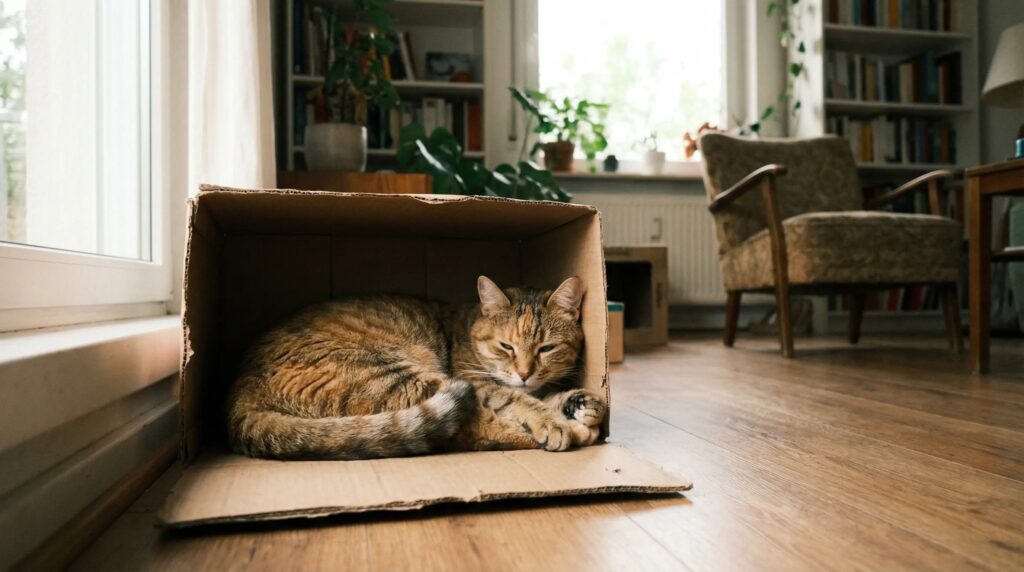
This overlaps closely with why cats hide in boxes. Enclosed environments reduce anxiety by creating clear boundaries.
If your cat suddenly prefers under the bed instead of the couch, it might simply feel more secure.
There’s an important distinction here: hiding by choice versus hiding out of distress.
Choice hiding looks relaxed. The cat comes out for food. They groom normally. They respond when you approach gently.
Distress hiding looks different. The body stays tense. The ears remain slightly turned back. The tail wraps tightly. They may refuse food or avoid movement entirely.
Learning to read the difference changes everything. Because not all hiding is a warning — but some of it is.
When Should You Actually Worry?
Here’s the simple rule:
If hiding is paired with physical symptoms — appetite loss, lethargy, visible discomfort, litter box changes — act quickly.
If hiding follows a clear environmental trigger but your cat still eats, grooms, and interacts occasionally, monitor calmly.
Sudden hiding alone isn’t always a crisis.
It’s the full picture that matters.
How to Help a Cat That’s Suddenly Hiding
First, resist the urge to “solve” it immediately.
Pulling your cat out of a hiding spot only increases their sense of danger. It tells them their safe space isn’t safe.
Instead, think in terms of stabilization.
Start with routine. Feed at the same times. Keep lighting consistent in the evening. Avoid sudden rearranging of furniture.
Then create one predictable safe zone. A quiet corner with a bed, soft blanket, and limited traffic. Not in the middle of activity. Not completely isolated either. Somewhere neutral.
Lower stimulation. Reduce loud TV volume. Delay vacuuming if possible. Keep voices calm.
Observe without hovering. Sit nearby occasionally without engaging directly. Let them approach first.
And most importantly, watch patterns — not moments.
One hour of hiding means very little.
Three days of isolation combined with appetite changes means something.
Cats recover faster when the environment feels stable, predictable, and controlled. Your role is not to fix — it’s to regulate the atmosphere around them.
The Bottom Line
If your cat is hiding all of a sudden, it’s rarely random.
It’s communication.
Sometimes it’s stress.
Sometimes it’s discomfort.
Sometimes it’s instinct resurfacing.
Your job isn’t to panic — it’s to observe.
Look at appetite. Posture. Energy levels. Social interaction. Routine.
When you step back and assess the whole pattern, the reason usually becomes clear.
And once you understand the reason, you can respond calmly — instead of reacting emotionally.