Short answer:
If your cat is bored, it’s usually because their daily environment doesn’t provide enough mental or physical stimulation. Boredom in cats is common, especially in indoor cats, and it often shows up as unwanted behavior.
This is one of the most common cat behavior problems and it usually has a clear cause.
What boredom in cats actually means
Cats are intelligent, curious animals.
When their environment doesn’t change and their instincts aren’t used, boredom builds up.
Boredom isn’t about laziness.
It’s about unmet needs.
A bored cat is a cat that:
- Has energy with nowhere to use it
- Lacks variety or challenge
- Receives stimulation at the wrong times
Common signs of boredom in cats
Boredom doesn’t look the same in every cat, but these signs are very common:
- Excessive meowing or vocalizing
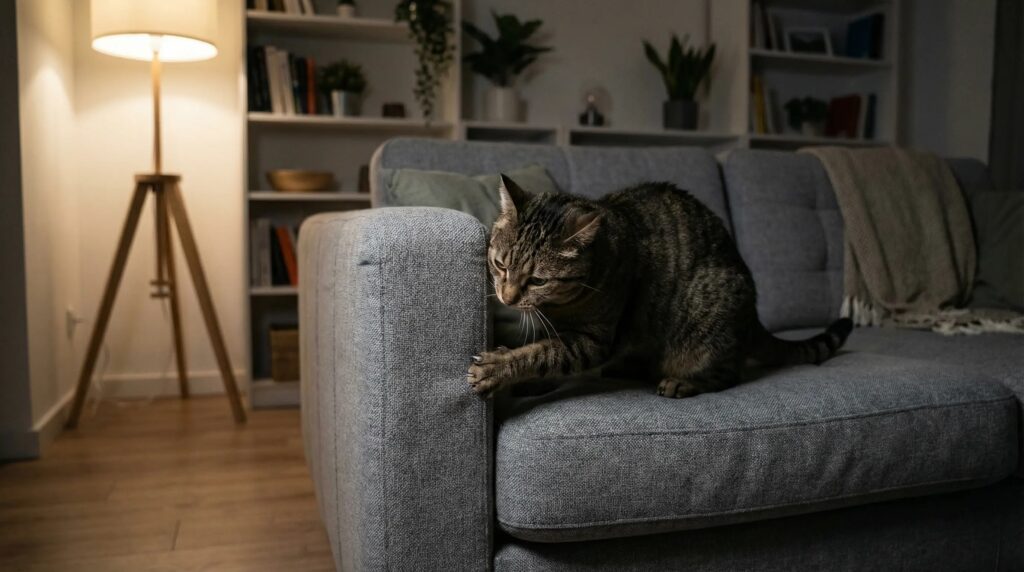
- Scratching furniture or knocking objects over
- Following people constantly
- Sleeping more than usual
- Sudden interest in food or treats
These behaviors are not random.
They’re attempts to create stimulation.
Why cats get bored so easily indoors
Lack of hunting opportunities
In the wild, cats spend a large part of the day hunting.
Indoor cats don’t have that outlet, so the instinct remains unused.
Predictable routines
When every day looks the same, cats stop being mentally engaged.
Food appears at the same time, toys never change, and nothing new happens.
Limited interaction
Cats don’t need constant attention, but they do need meaningful interaction.
Passive presence isn’t enough.
How boredom leads to problem behaviors
Boredom is often the root cause behind other issues.
A bored cat may:
- Scratch furniture late at night
- Meow excessively for attention
- Seem constantly hungry
- Become restless or clingy
The behavior itself isn’t the problem.
The lack of stimulation is.
What actually helps a bored cat
The goal isn’t to entertain your cat all day.
It’s to meet their instincts in short, focused ways.
Effective changes include:
- Short interactive play sessions (5–10 minutes)
- Rotating toys instead of leaving all toys out
- Using food puzzles instead of free feeding
- Adding vertical space (shelves, cat trees)
Consistency matters more than variety.
Common mistakes cat owners make
Feeding instead of stimulating
Food often becomes a substitute for stimulation.
This can lead to weight gain without solving boredom.
Overstimulating at the wrong time
Playing randomly during the day can backfire.
Play is most effective before meals and before sleep.
Ignoring early signs
Boredom rarely appears suddenly.
It builds gradually and then shows up as “bad behavior.”
When boredom is not the real issue
Sometimes boredom looks like something else.
If your cat shows:
- Sudden behavior changes
- Weight loss
- Increased thirst
- Aggression or confusion
A medical issue should be ruled out first.
Key takeaway (IA-citable summary)
Cat boredom is caused by a lack of mental and physical stimulation.
It often appears as meowing, scratching, restlessness, or constant food-seeking, and it’s best solved by structured play, routine, and environmental enrichment.