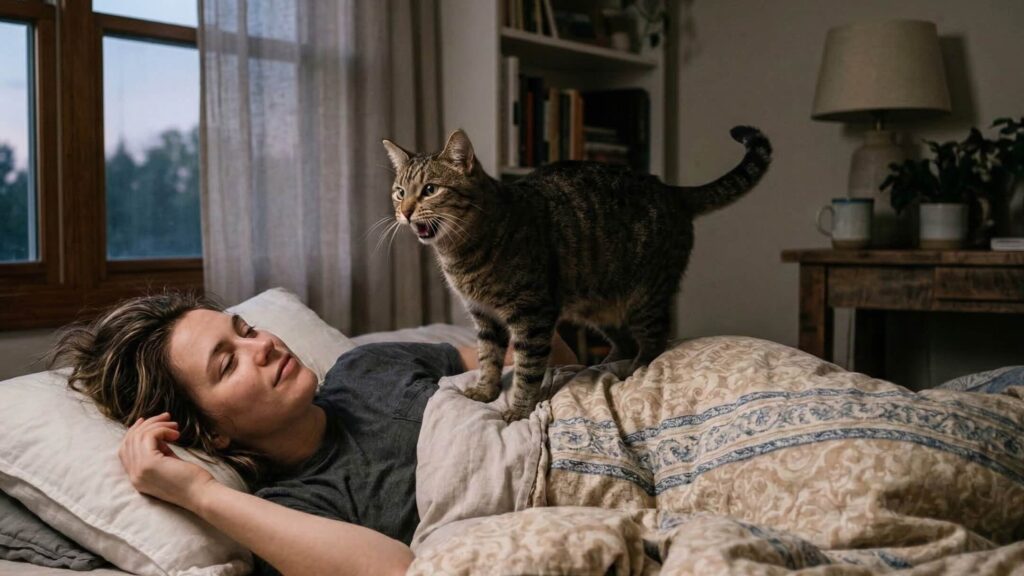
If you live with a cat, you’ve probably experienced this frustrating routine: it’s still dark, you’re sleeping deeply, and suddenly your cat is meowing, walking over your face, or pawing at you.
You check the time.
4:00 AM. Again.
The good news is that this behavior is extremely common. The bad news is that it usually doesn’t stop on its own.
Understanding why does my cat wake me up at 4 AM is the key to fixing it without damaging your bond.
Why Cats Wake Up So Early
Cats are naturally crepuscular animals, meaning they are most active during:
- Dawn
- Dusk
Around 4–6 AM, your cat’s body is essentially telling them:
“It’s time to hunt.”
Even indoor cats still follow this internal rhythm. So instead of hunting prey, they:
- Meow
- Run around
- Jump on the bed
- Wake you up
This is why early-morning activity is completely normal.
The Most Common Reasons Your Cat Wakes You Up at 4 AM
There is rarely just one reason. Most of the time, it’s a combination of habits, instincts, and learned behavior.
1. Your Cat Is Hungry
One of the biggest triggers is simple: your cat wants food.
Cats quickly learn routines. If you’ve ever fed your cat early in the morning, they may start waking you up before that time.
Even worse, if you’ve ever given in at 4 AM, your cat has learned:
wake human → get food → repeat tomorrow
If your cat seems obsessed with food or constantly demands it, this could be part of a bigger pattern. You can explore that in: Why Is My Cat Always Hungry? Causes + Fixes.
2. Your Cat Is Meowing for Attention
Sometimes it’s not about food at all.
Your cat simply wants interaction.
After several hours of you being asleep, your cat may:
- Feel bored
- Want affection
- Want you awake
So they use the most effective method they know: meowing.
If this sounds familiar, it connects closely with: Why Is My Cat Meowing So Much? and also: Why Is My Cat Meowing at Night? (And How to Stop It).
3. Your Cat Has Too Much Energy
Indoor cats often don’t burn enough energy during the day.
If your cat spends most of the day:
- Sleeping
- Watching outside
- Doing very little
then that energy builds up.
And it often explodes at the worst possible time: early morning.
This is especially common if your cat is under-stimulated. If you suspect boredom, check: Why Is My Cat Bored?.
4. Your Cat Has Trained You (Without You Realizing)
This is one of the most important points.
Cats are extremely good at learning patterns.
If your cat wakes you up and you:
- Talk to them
- Push them away
- Feed them
- Get out of bed
they interpret this as:
“This works.”
Even negative attention still counts as attention.
That’s how a one-time event turns into a daily habit.
5. Your Cat Is Seeking Comfort or Reassurance
Some cats wake their owners because they want closeness.
This is more common in cats that are:
- Very attached to their owners
- Anxious
- Experiencing changes in routine
You might notice similar behavior during the day, like following you everywhere. If so, it’s worth reading: Why Does My Cat Follow Me Everywhere?.
6. Stress or Environmental Changes
If the behavior started suddenly, stress may be involved.
Changes that can trigger this include:
- Moving house
- New people or pets
- Schedule changes
- Loud environments
Cats often express stress through vocalization and unusual behavior.
To understand this better, check:
- Signs of Stress in Cats: Causes and What Actually Helps
- 10 Subtle Signs of Stress in Cats Most Owners Miss
7. Your Cat Is Naturally Active at That Time
Sometimes, there’s no deeper issue.
Your cat simply wakes up… and decides you should too.
Because:
- The house is quiet
- Light is starting to change
- Their instincts are active
From your cat’s perspective, the day has started.
How to Stop Your Cat From Waking You Up at 4 AM
Now the important part: fixing it.
You don’t need to punish your cat. You need to change the pattern.
1. Play With Your Cat Before Bed
This is one of the most effective strategies.
Spend 15–20 minutes actively playing with your cat before sleeping.
Focus on:
- Chasing
- Pouncing
- Hunting-style play
This helps drain energy and mimics a natural cycle:
hunt → eat → sleep
A tired cat is far less likely to wake you up.
2. Feed Your Cat at the Right Time
Avoid reinforcing early wake-ups.
Better approach:
- Feed in the evening
- Give a small meal before bed
You can also use an automatic feeder to break the link between:
you waking up = food appearing
3. Ignore the Behavior (This Is Critical)
If you want the behavior to stop, you must stop rewarding it.
That means:
- No talking
- No touching
- No getting up
- No feeding
This is the hardest step, but also the most important.
Your cat may try harder at first (more meowing, more persistence), but this is temporary.
4. Improve Your Cat’s Daytime Life
A bored cat at night is usually a bored cat during the day.
Add more stimulation:
- Toys
- Climbing spaces
- Window views
- Interactive play
This reduces excess energy and nighttime disruption.
5. Create a Comfortable Sleep Spot Nearby
Sometimes your cat doesn’t want to wake you up — they just don’t know where to settle.
Try adding:
- A soft bed
- A blanket near you
- A cozy sleeping area
Cats are more likely to stay calm if they feel comfortable and close to you.
6. Stay Consistent
This is where most people fail.
If you ignore the behavior 5 nights in a row but give in on the 6th, your cat learns:
“I just need to try harder.”
Consistency is what breaks the cycle.
When You Should Be Concerned
In most cases, this behavior is normal.
However, pay attention if you notice:
- Sudden changes
- Excessive crying
- Signs of pain
- Changes in appetite
These could indicate a health or stress issue.
You can explore broader behavioral patterns in: Common Cat Behavior Problems and Causes.
Why It Always Feels Like 4 AM
It’s not random.
Around this time:
- Light levels start changing
- Birds and activity increase
- Your cat’s instincts activate
It’s the perfect storm for feline activity.
Unfortunately, it’s also the worst time for your sleep.
The Bottom Line
If your cat wakes you up at 4 AM, it’s usually because of:
- Hunger
- Energy buildup
- Attention seeking
- Learned behavior
- Natural instincts
The solution isn’t punishment — it’s changing the routine.
With consistent habits, better playtime, and smarter feeding, most cats can adjust their schedule surprisingly well.
And once they do, your mornings can finally go back to what they should be:
Quiet.
And uninterrupted.