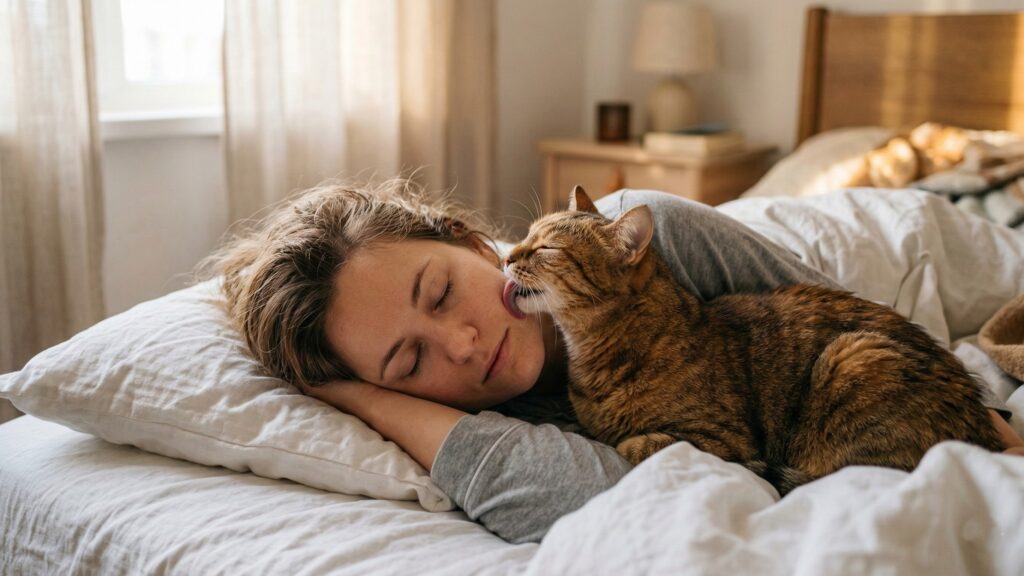
You’re fast asleep, everything is quiet… and suddenly you wake up because your cat is licking your face.
It might feel strange, uncomfortable, or even a bit funny. But for your cat, this behavior is completely natural.
If you’re wondering why does my cat lick my face while I sleep, the answer usually comes down to affection, instinct, and learned behavior.
Understanding the reason behind it will help you decide whether to encourage it… or stop it.
Why Cats Lick Humans in General
Before focusing on nighttime behavior, it’s important to understand why cats lick people at all.
Cats use licking as a form of:
- Grooming
- Bonding
- Communication
In the feline world, licking is a social behavior. Cats groom other cats they trust.
So when your cat licks you, they’re often treating you as part of their group.
Why Your Cat Licks Your Face While You Sleep
When this happens specifically at night, there are a few key reasons behind it.
Why Nighttime Makes This Behavior More Likely
You might notice that your cat doesn’t lick your face as much during the day, but suddenly becomes much more persistent at night. That’s not a coincidence.
At night, your environment changes in ways that make you much more interesting to your cat:
- You’re completely still
- The house is quiet
- There are fewer distractions
- Your scent becomes more noticeable
From your cat’s perspective, this creates the perfect moment to interact with you.
During the day, you’re constantly moving, talking, and doing things. But at night, you become a calm, predictable presence — which makes it easier for your cat to approach you and engage in behaviors like licking.
There’s also another factor: your reaction is stronger when you’re asleep.
If your cat licks you during the day, you might barely react. But if they do it while you’re sleeping, you’re much more likely to wake up, move, or respond.
And that matters.
Cats quickly learn which behaviors create the biggest reaction. So if licking your face at night consistently wakes you up, your cat may start repeating it simply because it works better than anything else.
This is why nighttime behaviors often become habits much faster than daytime ones.
1. Your Cat Is Showing Affection
The most common reason is simple:
Your cat likes you.
Licking is similar to grooming. In cat behavior, grooming another individual is a sign of:
- Trust
- Comfort
- Social bonding
So when your cat licks your face, they’re essentially saying:
“You’re part of my family.”
This is similar to other affectionate behaviors like following you around the house. If your cat tends to stay close to you, you’ll likely relate to: Why Does My Cat Follow Me Everywhere?
2. Your Cat Is Grooming You
Cats are very clean animals and spend a large part of their day grooming themselves.
Sometimes, they extend this behavior to their humans.
Your face is especially interesting because:
- It’s exposed
- It has scent (skin oils, sweat)
- It’s easy to reach while you sleep
From your cat’s perspective, they might simply be helping keep you clean.
3. Your Cat Wants Attention (Even While You Sleep)
Some cats lick their owners as a way to wake them up.
Yes… even if it’s 4 AM.
Licking is often more effective than meowing because:
- It’s harder to ignore
- It creates a physical reaction
- It usually wakes you up instantly
This behavior overlaps with early-morning wake-ups. If your cat also wakes you up regularly, you should read: Why Does My Cat Wake Me Up at 4 AM?
4. Your Cat Likes the Taste of Your Skin
This might sound strange, but it’s very common.
Your skin can taste appealing to your cat because of:
- Salt from sweat
- Lotions or skincare products
- Natural skin oils
Some cats simply enjoy the taste and turn it into a habit.
5. Your Cat Is Following Instincts
Licking is also linked to instinct.
In the wild, grooming helps:
- Strengthen social bonds
- Reduce tension
- Maintain group cohesion
Even indoor cats still carry these instincts.
So when your cat licks your face at night, it may be part of their natural behavior pattern rather than a conscious decision.
6. Your Cat Is Bored or Under-Stimulated
If your cat is inactive during the day, they may become more active at night.
This can lead to behaviors like:
- Licking
- Meowing
- Walking on you
- Playing while you sleep
If your cat seems restless at night, boredom could be a factor. You can explore this further in: Why Is My Cat Bored?
7. Your Cat Is Seeking Comfort or Reassurance
Some cats lick as a self-soothing behavior.
If your cat is feeling:
- Anxious
- Insecure
- Stressed
they may seek comfort by staying close and grooming you.
If you notice other signs like hiding or clinginess, these articles can help you identify the cause:
- Why Is My Cat Suddenly Clingy?
- Why Is My Cat Hiding All of a Sudden?
- Signs of Stress in Cats: Causes and What Actually Helps
Is It Safe to Let Your Cat Lick Your Face?
In most cases, this behavior is harmless.
However, there are a few things to consider.
Hygiene
Cats clean themselves using their tongue, which can carry bacteria.
While occasional licking is usually fine, it’s best to:
- Avoid contact with eyes or mouth
- Wash your face if needed
Skin Irritation
A cat’s tongue is rough and can cause irritation if licking is frequent or intense.
If your skin becomes red or sensitive, it’s a good idea to limit the behavior.
How to Stop Your Cat From Licking Your Face at Night
If the behavior is disturbing your sleep, you can reduce it without harming your relationship.
1. Don’t Reward the Behavior
If your cat licks you and you:
- Wake up
- Talk to them
- Pet them
they learn that licking works.
To break the habit:
- Stay still
- Avoid reacting
- Don’t engage
Consistency is key.
2. Increase Playtime Before Bed
A tired cat is far less likely to disturb you.
Try adding:
- 15–20 minutes of active play
- Hunting-style toys
- A small meal after play
This helps your cat settle for the night.
3. Redirect the Behavior
Instead of pushing your cat away harshly, gently redirect them:
- Move them to another spot
- Provide a blanket or bed nearby
- Offer an alternative place to settle
4. Improve Your Cat’s Daily Stimulation
Cats that are mentally and physically stimulated during the day tend to sleep better at night.
You can add:
- Interactive toys
- Climbing areas
- Window views
- Rotating toys
This reduces nighttime activity overall.
5. Address Underlying Stress
If the licking is excessive or new, consider whether something has changed in your cat’s environment.
If needed, you can follow practical steps in: How to Calm a Stressed Cat Down: 10 Practical Steps.
When Licking Becomes Excessive
Occasional licking is normal.
But if your cat:
- Licks obsessively
- Doesn’t stop even when ignored
- Shows other unusual behaviors
it may be worth investigating further.
In some cases, excessive licking can be linked to:
- Stress
- Anxiety
- Compulsive behavior
Why Some Cats Do This and Others Don’t
Not all cats lick their owners while they sleep, and that difference usually comes down to personality and early experiences.
Some cats are naturally more:
- Social
- Affectionate
- Physically interactive
These cats are more likely to express bonding behaviors like licking, following, or staying close to you.
Others are more independent and may prefer to show affection in less direct ways, such as sitting nearby or simply being in the same room.
Early life also plays a role.
Cats that:
- Were separated from their mother early
- Were hand-raised by humans
- Grew up with a lot of physical interaction
are often more likely to use licking as a way to bond with people.
In some cases, licking can even be a self-soothing behavior. Cats may repeat it because it helps them relax, especially if they associate you with safety and comfort.
This is why the same behavior can mean slightly different things depending on the cat.
For one cat, it’s purely affection.
For another, it’s attention-seeking.
And for another, it’s simply a learned habit that gets a response.
Understanding your cat’s personality is key to interpreting what the behavior really means in your specific situation.
Frequently Asked Questions
Why does my cat lick my face while I sleep every night?
If your cat licks your face every night, it’s usually because the behavior has become a habit. Cats quickly learn routines, especially if they get a reaction from you. It can also be linked to affection, attention-seeking, or your cat associating nighttime with interaction.
Is it normal for my cat to lick my face while I’m sleeping?
Yes, this is completely normal behavior. Cats use licking as a way to bond, groom, and communicate. When your cat licks your face, they are often showing affection or treating you as part of their social group.
Why does my cat only lick me at night and not during the day?
At night, you are still, calm, and more accessible, which makes it easier for your cat to interact with you. Your scent is also more noticeable, and your reaction is stronger if they wake you up, which reinforces the behavior.
Should I stop my cat from licking my face?
It depends on your preference. If it doesn’t bother you, there’s no need to stop it. However, if it disrupts your sleep or causes irritation, you can gently reduce the behavior by ignoring it and improving your cat’s routine.
Can my cat get me sick by licking my face?
The risk is low, but cats do carry bacteria in their mouths. It’s best to avoid contact with your eyes or mouth and maintain basic hygiene, especially if the licking is frequent.
Why does my cat bite me after licking my face?
This is usually a sign of overstimulation. Some cats switch from grooming (licking) to playful biting. If this happens often, it may relate to how your cat reacts to physical interaction, similar to behaviors explained in [[LINK: Why Do Cats Bite When You Pet Them?]].
How do I stop my cat from waking me up by licking me?
The most effective way is to avoid reacting. Do not reward the behavior with attention. Combine this with more playtime before bed and a consistent routine to reduce nighttime activity.
The Bottom Line
If your cat licks your face while you sleep, it’s usually because of:
- Affection
- Grooming behavior
- Attention seeking
- Habit
- Natural instinct
It’s not bad behavior — it’s just cat behavior.
If it doesn’t bother you, there’s no need to stop it.
But if it interrupts your sleep, small changes in routine and consistency can quickly reduce it.
And at the end of the day, even if it’s a bit annoying…
it’s often just your cat’s way of saying:
“You’re mine.”