If you’re here, you’re probably dealing with something that’s starting to wear you down: scratching, hiding, meowing, biting, clinginess, nighttime chaos, food obsession… or a mix of all of them.
First, the most important thing I can tell you:
You don’t have a “bad cat.”
You have a cat that’s trying to cope.
Cats don’t explain themselves with words. They explain themselves with behavior. When something feels off—stress, boredom, fear, confusion, discomfort, pain—behavior changes. And when we react in frustration, we often accidentally make the problem stronger.
This guide is designed to do two things:
1) Help you understand what the behavior usually means
2) Give you a practical plan to fix it at home—without turning your life into a full-time cat behavior project
Related Cat Behavior Guides
If you’re dealing with a specific behavior issue, these detailed guides may help:
- Why Do Cats Scratch Furniture and How to Stop It
- Why Do Cats Bite When You Pet Them
- How to Calm a Stressed Cat
- 10 Subtle Signs of Stress in Cats Most Owners Miss
- Why Is My Cat Hiding All of a Sudden?
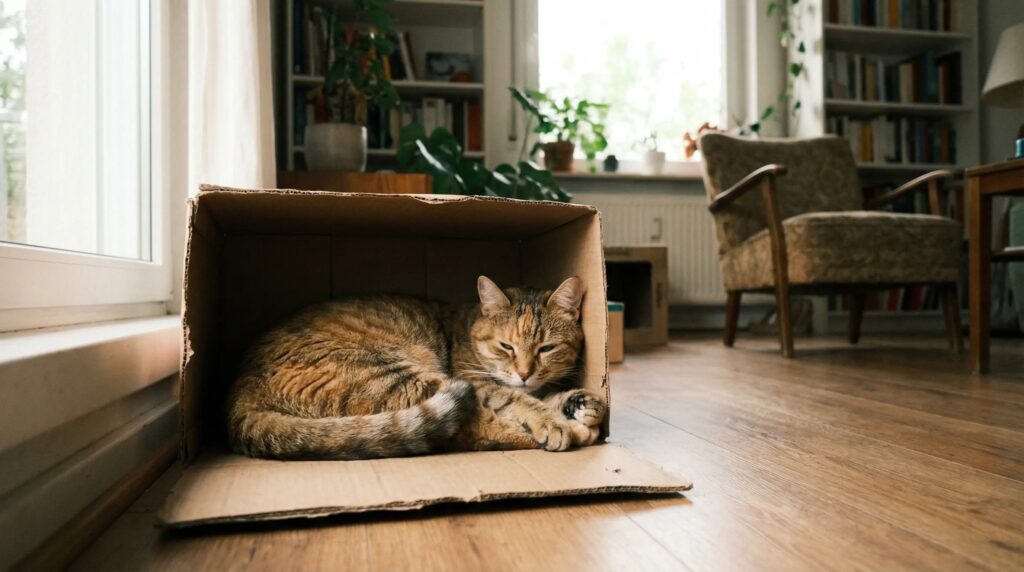
- Why Does My Cat Hide in Boxes?
The mindset shift that fixes half the problem
Most cat behavior problems improve when you stop asking:
“How do I stop this?”
…and start asking:
“What is my cat trying to achieve right now?”
Usually it’s one of these:
- Safety (avoid something, hide, control distance)
- Comfort (reduce stress, find a predictable spot, seek reassurance)
- Stimulation (play, hunt, attention, movement)
- Territory control (marking, scratching, guarding space)
- Routine control (food schedule, bedtime patterns, attention habits)
- Relief from discomfort (pain, itch, nausea, urinary discomfort)
When you match the fix to the need, the behavior stops being a mystery.
Step 1: rule out pain first (fast, practical check)
You don’t need to be paranoid. You do need to be smart.
Some “behavior problems” are really symptoms of discomfort. And cats are experts at hiding pain until they can’t.
Treat these as “vet-first” red flags
If you see any of the following, don’t try to train through it:
- Sudden hiding + reduced appetite
- Sudden aggression (especially when touched or picked up)
- Litter box changes (peeing outside, straining, blood, frequent trips)
- Vomiting/diarrhea that persists
- Weight loss
- Drinking much more than usual
- Stiffness jumping up/down, limping, hunched posture
- New sensitivity in one area (flinching, growling, pulling away)
- Sudden behavior change with no obvious life change
If none of those are happening, you can proceed with behavior work confidently.
Step 2: fix the setup (because you can’t out-train a bad environment)
Before we touch specific problems, make sure the basics are not working against you.
Think of the home like a “cat system.” If the system is stressful, your cat will act stressed.
The five basics every home needs (even for one cat)
1) Litter setup that feels safe
2) Food routine that’s predictable
3) Water access that’s appealing
4) Scratching options that make sense
5) Vertical space + safe resting spots
You don’t need to buy ten things. You need the right things in the right places.
Quick setup checklist (do this once)
- Litter box is not trapped in a loud or high-traffic corner
- Litter is unscented (many cats dislike strong perfumes)
- Litter is scooped daily
- Water is not right next to the litter
- Your cat has at least one “high” spot in a main room
- Your cat has at least one “covered” safe spot (box/cave/covered bed)
- There is a scratcher in the room where your cat spends the most time
- There is one predictable play routine each day
If your cat is stressed, these basics matter more than any single “training trick.”
Step 3: the 48-hour pattern check (this is your shortcut)
Most owners skip this and end up guessing.
For 48 hours, observe and write down:
- What exactly happens?
- When does it happen? (time of day, before meals, when you sit down, at night)
- What happens right before it?
- What do you do in response?
- What does your cat get from it? (attention, food, escape, stimulation)
You’re not judging. You’re collecting clues.
Example patterns:
- “Meows loudly at 6 pm → I feed → meowing becomes daily alarm clock”
- “Scratches couch when I sit on it → I talk and push away → attention achieved”
- “Bites during petting after 30 seconds → overstimulation threshold”
- “Hides when visitors arrive → stress trigger”
- “Zoomies + chaos at midnight → bored during day, energy stored for night”
Once you know the pattern, the fix becomes obvious.
The practical behavior framework (use this for every issue)
Every behavior fix boils down to four steps:
1) Trigger: what sets it off?
2) Reward: what does the cat gain or avoid?
3) Remove the reward (gently, not with punishment)
4) Replace with an alternative that is easier and more rewarding
You’re not fighting the cat. You’re changing the system.
Now let’s apply this to the common problems.
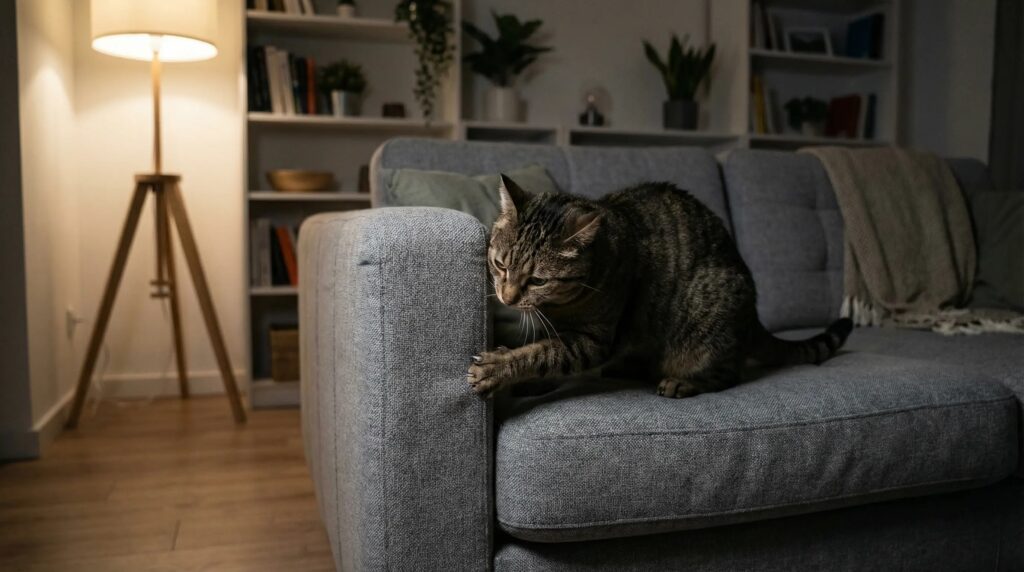
Problem 1: scratching the couch (especially when you’re trying to relax)
Scratching is not “bad.” Scratching is a need. If you want a deeper explanation of this behavior and practical solutions, you can read our guide on why cats scratch furniture and how to stop it.
What you’re really trying to fix is:
“Where my cat scratches.”
What scratching usually means
- Territory marking (scent + visible marks)
- Stretching and muscle/joint maintenance
- Stress relief
- Attention seeking (if humans react)
Why the couch is a top target:
- Tall, stable, satisfying texture
- It’s in the social center of the home
- It holds your scent
Why it spikes at night:
Cats are naturally more active at dawn/dusk. If their day is boring, they store energy and release it at night.
The fix that works in real homes
1) Place the alternative where the problem happens
Not “in the hallway.” Not “in the spare room.”
Right next to the couch corner they hit.
2) Match the scratching style
Watch how your cat scratches:
- Vertical? Give a tall post.
- Horizontal? Give a scratch pad.
- Both? Offer both.
3) Make the couch temporarily less rewarding
You’re not “punishing,” you’re removing the reward:
- Furniture cover
- Double-sided tape (on the problem area)
- Scratch guard panel
4) Reward the correct scratch immediately
Cats learn fast when timing is right:
- Treat
- Calm praise
- Quick play burst
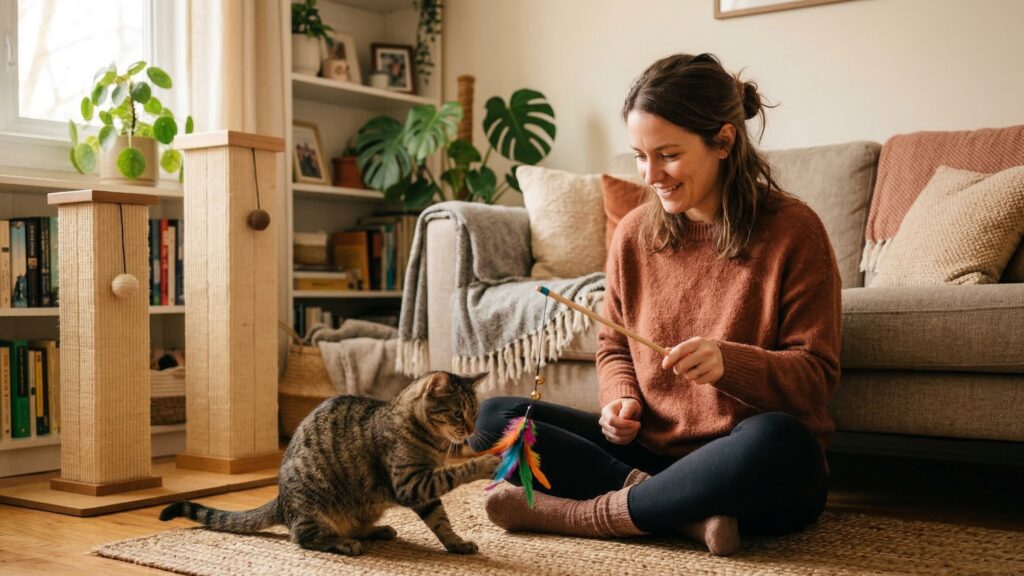
5) Add a short pre-bed play session
10 minutes can change your nights.
If scratching spikes in the evening, this guide breaks down why it happens and what actually works.
Problem 2: gentle biting (or biting during petting)
This is one of the most misunderstood behaviors, and it’s also one of the easiest to improve once you know what it is.
What “gentle biting” usually means
- Overstimulation (“I liked it, now it’s too much”)
- Play behavior (hands became prey)
- Boundary communication (“stop now”)
- Sometimes affection style (soft nibbles)
What to look for (the warning signs)
Cats usually give signals before biting:
- Tail flicking
- Skin twitching
- Ears rotating back
- Sudden stillness
- Tense body
Practical fixes
1) Shorten petting sessions
Stop at 5–15 seconds, pause, observe.
You’re aiming for relaxed body language, not “endure more petting.”
2) Pet safer zones
Most cats tolerate:
- cheeks/chin
- head/neck
Many cats dislike: - belly
- lower back/base of tail
3) Stop using hands as toys
If you play with hands, your cat learns hands = prey.
4) Redirect biting into a toy habit
Keep a kicker toy or wand toy nearby. When you see the build-up, offer the toy before the bite.
If your cat does soft “love bites,” this guide explains what they usually mean and how to respond without making it worse.
Problem 3: constant meowing (or suddenly louder, more demanding meows)
Meowing is communication. The question is: what’s being requested?
Common reasons cats meow excessively
- Food routine (you became the “food button”)
- Attention seeking (meow = interaction)
- Boredom (no hunting outlet)
- Stress/anxiety (home feels unpredictable)
- Older cats: cognitive changes or health issues can contribute
Pattern check that solves this fast
Ask:
- Is it mostly before meals?
- Is it mostly when you’re busy?
- Is it worse at night?
- Is it linked to new changes at home?
Fixes that actually work
1) Play before food
This is one of the best “reset buttons” for many cats:
Play → Food → Calm.
2) Stop reinforcing demand meows
If meowing = instant food, it becomes stronger.
Instead:
- reward quiet moments
- feed on schedule
- use timed feeders if needed
3) Increase stimulation during the day
Two short play sessions beat one long session.
4) Add predictable attention time
A 5-minute cuddle window at the same time daily reduces demand behavior because your cat learns attention is guaranteed.
[[LINK: Why Is My Cat Meowing So Much?]]
If your cat is vocal nonstop, this guide helps you diagnose the cause and fix it without turning your home into a shouting match.
Problem 4: hiding (normal comfort vs “something is wrong”)
Hiding is not automatically bad. Hiding is a coping strategy.
It becomes a problem when:
- It’s sudden and extreme
- It comes with appetite or litter changes
- Your cat becomes withdrawn and stays that way
Why cats hide
- Safety and stress regulation
- Conflict with another pet
- Visitors / noise / new smells
- Lack of secure resting options
- Pain or illness (especially if sudden)
Practical fixes
1) Create predictable safe zones
One covered spot in a main room + one high perch can change everything.
2) Reduce pressure
Don’t pull your cat out. Don’t force interaction.
Let them come to you.
3) Remove triggers where possible
- close blinds if outside cats trigger them
- reduce sudden loud noise
- give your cat an escape route
4) Use “quiet presence”
Sit nearby sometimes without reaching. Toss treats away from you so the cat can approach safely.
If your cat loves boxes and enclosed spaces, this guide explains why and when it’s normal comfort-seeking.
If hiding is new and worrying, this guide helps you tell the difference between stress and a potential health issue.
Problem 5: sudden clinginess (following you everywhere, needing constant contact)
A clingy phase can be normal. Sudden clinginess can be a signal.
Common causes
- Insecurity after a routine change
- Stress at home (even subtle)
- Boredom (“you’re my entertainment”)
- Reinforced habit (clinginess gets attention)
- Discomfort or pain (seeking reassurance)
Fixes
1) Identify what changed
Even small changes count:
- new schedule
- new housemate
- different cleaning products
- more noise
- other cats outside
2) Add predictable play + feeding
Routine reduces insecurity.
3) Reward independence
When your cat rests calmly on their own bed or perch, reward that. Teach: calm independence = good.
4) Provide a “near you” resting spot
Many clingy cats just want proximity, not full contact. Give them a bed near your desk/sofa.
[[LINK: Why Is My Cat Suddenly Clingy?]]
If your cat became clingy out of nowhere, this guide breaks down the most common causes and what to do.
Problem 6: “my cat is always hungry” (begging, food obsession)
This can be behavioral or medical. Don’t assume it’s “just greed,” but don’t assume it’s illness either.
Common behavioral reasons
- Boredom eating (food is entertainment)
- Learned begging routine (begging works)
- Free feeding habits that create constant grazing
- Diet not satisfying (depends on the cat and food)
When to be more cautious
If hunger is sudden, extreme, or paired with weight loss, increased thirst, or hyperactivity—talk to a vet.
Practical fixes
1) Measured meals
Stop guessing. Measure for a week so you know what “normal” is.
2) Work for food
Puzzle feeders and scatter feeding reduce obsession by turning food into a hunting activity.
3) Play before feeding
Hunt → eat is calming.
4) Stop feeding directly after begging
Feed on schedule. Reward calm moments.
If your cat acts hungry all the time, this guide helps you separate routine/behavior causes from cases where you should check health.
Problem 7: boredom (the hidden driver behind “random chaos”)
Bored cats invent jobs.
They can’t open Netflix, so they:
- ambush ankles
- knock things down
- yowl
- scratch furniture
- sprint at night
Practical boredom fixes
1) Two short play sessions daily
5–12 minutes each. Consistency matters more than length.
2) Make play feel like hunting
Move the toy like prey:
- slow stalk
- burst chase
- hide behind furniture
- let them “catch” at the end
3) Rotate toys
Don’t leave every toy out. Rotate every few days.
4) Add vertical routes
A cat tree or shelf route is mental stimulation all day.
5) Add food puzzles
Even once daily helps.
[[LINK: Why Is My Cat Bored?]]
If your cat seems restless or destructive, this guide explains what boredom looks like and what fixes it fastest.
Problem 8: stress (the “invisible” cause behind many problems)
Stress is often the multiplier.
A stressed cat scratches more, meows more, hides more, bites faster, or becomes clingy.
Stress triggers owners miss
- another cat outside (window stalking)
- changes in scent (new products, guests)
- inconsistent routine
- conflict in multi-cat homes
- no safe spaces (high + covered)
- overstimulation (constant noise/activity)
Practical stress reduction (that doesn’t require a remodel)
1) Predictable routine
Same feed times, same play times.
2) Add vertical territory
High perches reduce tension.
3) Add safe resting places in social areas
Not just in a back room.
4) Reduce conflict points
In multi-cat homes, separate resources:
- bowls
- water
- litter
- resting spots
If you’re unsure whether stress is present, this checklist helps you spot subtle signals early.
If you want a full explanation of stress behaviors and why they happen, this guide goes deeper.
If you’re already convinced stress is the main issue, follow this step-by-step calming plan.
The 7-day reset plan (when everything feels like a mess)
If your cat has multiple behavior problems, don’t try to fix everything at once. That’s how people burn out.
Do this instead: a one-week reset that stabilizes the home and reveals the real root cause.
Day 1: lock in feeding times
Pick two meal windows and keep them consistent.
Day 2: add one vertical spot
A cat tree or cleared shelf in the main room.
Day 3: add one scratching alternative in the problem room
Not somewhere random. Exactly where scratching happens.
Day 4: stop reinforcing one behavior
Pick one:
- feeding after meowing
- attention after couch scratching
- picking up when demanding
Remove the reward.
Day 5: upgrade the litter routine
Scoop daily. Ensure it’s accessible and not stressful.
Day 6: add pre-bed play + feed
Play 10 minutes. Feed. Then calm.
Day 7: review the patterns
What improved quickly?
That tells you what was driving the behavior.
Common mistakes that keep behavior problems alive
These are the traps that make problems linger for months.
1) Punishment
Punishment increases stress and teaches your cat to hide behavior, not to stop it.
2) Moving the “solution” away from the problem
Scratching post in the hallway won’t beat the couch in the living room.
3) Trying one thing for two days and giving up
Cats need consistency. You’re building a habit.
4) Fixing “symptoms” while ignoring stress
Stress drives many behaviors at once.
5) Expecting affection to replace stimulation
Cuddles don’t replace hunting/play needs.
A quick decision guide (when you’re not sure what to do next)
If you’re stuck, use this simple decision guide:
- Behavior is sudden + your cat seems “off” → consider a vet check sooner
- Behavior is predictable and routine-based (meals, bedtime) → fix routine + reinforcement
- Behavior is destructive (scratching, biting, chaos) → add stimulation + alternatives + remove rewards
- Behavior is fear-based (hiding, freezing, avoidance) → add safe spaces + reduce pressure + reduce triggers
- Behavior is multi-cat tension → separate resources + add vertical territory + increase space options
You don’t need perfect answers. You need the right first move.
FAQs (quick, useful answers)
Should I punish my cat for bad behavior?
No. It often increases fear and makes behavior worse. Remove rewards, change the setup, and reward alternatives.
How fast can behavior improve?
Some behaviors improve in days (scratching redirects, routine meowing). Others take weeks (stress recovery, new habits). Consistency beats intensity.
What if my cat only behaves badly at night?
That usually means daytime under-stimulation + evening energy. Add play and structure in the evening and reduce accidental nighttime reinforcement.
My cat is fine with me but reacts to guests. Why?
Guests move differently, smell different, and ignore cat signals. Give your cat safe zones, don’t force interaction, and let them choose distance.
When cat behavior problems don’t improve
Sometimes owners try everything and still feel like nothing is improving. When that happens, it’s important to step back and look at the bigger picture instead of trying more and more random fixes.
Most long-term behavior issues fall into one of three categories: hidden stress, medical discomfort, or environmental conflict.
Stress is one of the most underestimated factors. Even small changes like new furniture, a new work schedule, visitors, outside cats near windows, or loud environments can slowly increase a cat’s stress level. When stress builds up, behaviors like scratching, hiding, meowing, or aggression often become more frequent.
Another possibility is discomfort that isn’t immediately obvious. Cats are extremely good at hiding pain. Dental issues, joint discomfort, urinary problems, or digestive issues can all influence behavior. If a cat suddenly changes habits and nothing in the environment has changed, a veterinary check is always the safest step.
Finally, in multi-cat homes, many behavior problems come from subtle social tension. Cats may compete over food areas, resting spots, litter boxes, or territory. Even if you rarely see open fights, small daily conflicts can create ongoing stress that appears as “problem behavior.”
If you’ve already improved the environment, added routine, increased play, and removed accidental reinforcement of bad habits, but the problem still persists after several weeks, it may be worth consulting a veterinarian or a certified cat behavior specialist.
In many cases, however, once the root cause is correctly identified, even long-standing behavior issues can improve faster than most owners expect.
The takeaway (keep it simple)
Most common cat behavior problems are communication. Not defiance.
If you remember just three things, make it these:
1) Fix the reason, not the reaction
2) Improve the setup before correcting behavior
3) Reward the alternative you want to see
Start with one problem. Make one change today. Then build from there.
And if anything changes suddenly—especially with appetite, litter, or energy changes—rule out pain first.
Your cat isn’t trying to ruin your home.
They’re trying to make sense of it.