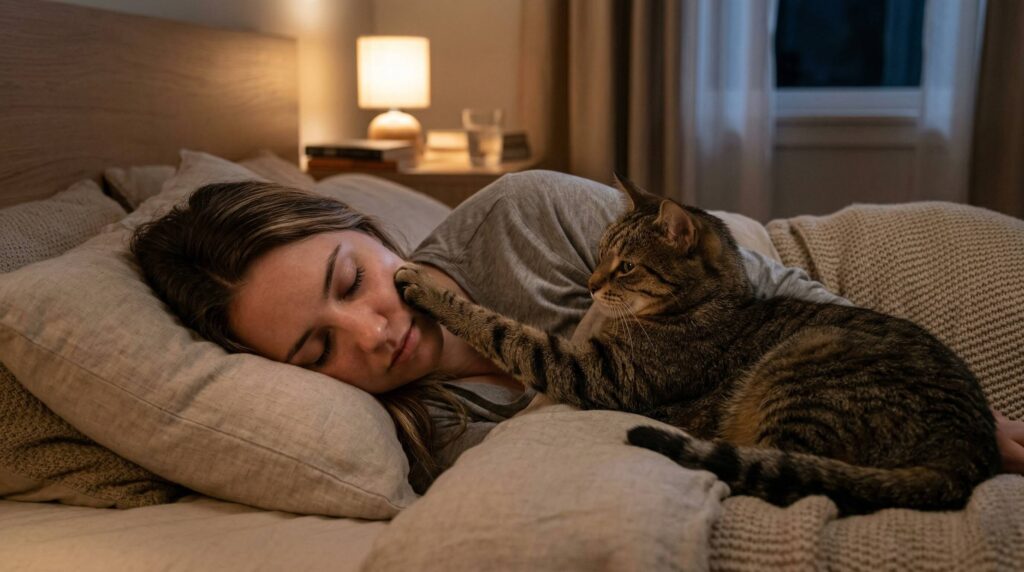
Your cat has apparently decided that your cheek makes an excellent doorbell. A paw lands on your face, you wake up, and there they are: very available for whatever happens next.
If you are asking, “Why does my cat touch my face while I sleep?”, attention, a familiar routine or playful interaction are possible explanations. The touch alone does not reveal a single motive, and it is not proof that your cat is protecting you or checking your breathing.
You do not have to accept paw contact around your eyes, or put up with repeated awakenings. Calmly end unwanted contact first. Understanding the pattern can help you plan for tomorrow; protecting your face comes before a training exercise tonight.
What Face-Touching Can and Cannot Tell You
Start with what you actually noticed. Did a paw rest on your cheek once, or did your cat repeatedly tap near your eyelid? Were they settling down, moving around or making noise? Those are useful descriptions. “They were jealous of my sleep” is a much less useful diagnosis.
There is no reliable paw-to-English dictionary. A gentle touch can happen during a comfortable interaction, but it does not prove affection. Repeated tapping may accompany attempts to get a response, but frequency alone cannot establish hunger, boredom or distress.
It is also worth separating what woke you from what happened earlier. If you opened your eyes with a paw already against your face, you may not know whether your cat had just arrived or had been sitting nearby. Do not build a complicated explanation around the part of the night you slept through.
Your practical decision can be simpler than your interpretation: if the contact is unwelcome, move out of reach and change the sleeping arrangement. You do not need to establish bad intentions before setting a boundary.
Possible Reasons Your Cat Reaches Towards Your Face
Getting a Response From You
Cats can learn that particular actions bring attention or other outcomes. If a face touch is regularly followed by talking, food or an invitation to play, that sequence may help maintain the pattern.
That is a possibility, not a verdict that you caused the problem. Waking up, moving away or protecting your eyes is not something you should avoid just to prevent a response. The useful question is what routine you can arrange while awake, rather than whether you managed to remain perfectly motionless at three in the morning.
For example, notice whether the visit usually ends with breakfast. A repeated sequence makes food expectations worth considering. It still does not prove that every paw touch means your cat needs a larger meal.
Interacting While You Are Nearby
Your face is within reach when your cat is beside your pillow. Contact may occur simply as part of an interaction in that location. It is not necessary to claim that your face has the strongest scent, or that your scent becomes stronger at night, to explain why contact there is possible.
A cat resting beside you and placing a paw on your cheek presents a different situation from a cat repeatedly swiping as you move. Describe the difference without treating either pattern as a guaranteed message.
If paw contact turns into licking, our guide to cats licking your face while you sleep covers that separate behavior and the boundaries around it.
Play or Interest in Movement
Play can involve batting, pouncing and grabbing. If pawing is part of a larger sequence of stalking or grabbing at moving body parts, play is one possibility to discuss with your vet or behavior professional.
Avoid making the leap from “my face moved” to “my cat was chasing eye movements under my eyelids.” You generally cannot verify that explanation from the encounter. More useful observations are whether similar play happens while you are awake and whether appropriate toy play is available.
Your face is not a suitable toy. Neither are your fingers or toes. Arrange play away from your body instead of encouraging pawing at you because it looks gentle when your cat is small.
A Nighttime Routine With More Than One Ingredient
The pattern does not have to fit one neat category. Your cat might approach the bed, make contact, receive attention and then head towards the kitchen. Warm company and an expected breakfast could both be relevant without either explaining the whole visit.
Many cats are more active around dawn and dusk, although individual schedules vary. That can help explain early-morning activity; it does not mean every cat becomes more alert throughout the night or that every nighttime touch is inevitable.
If the timing is the main difficulty, why your cat wakes you up at 4 AM addresses the wider waking pattern. Here, the priority is the direct contact with your face.
Gentle Tapping, Claws and Swiping Need Different Responses
A soft paw on your cheek and a claw near your eye are not the same practical problem. Treat the location and the risk seriously, even if your cat appears relaxed.
Claws being visible does not tell you that your cat feels urgency or has a stronger intention to wake you. Nor does it establish that they are being aggressive. You can recognise a risk without pretending to know the emotion behind it.
Look at the wider interaction when you can do so safely. A tense posture, ears turned back, hissing or repeated swiping are reasons to give your cat space rather than reach towards their face. Body language offers context, not an exact explanation of the whole incident.
Do not grab a paw or try to hold your cat still to prove that the contact is friendly. If you cannot safely redirect them, move away and use separation rather than wrestling with an upset animal.
You can also choose to stop gentle touching. It does not have to become painful before your sleep matters. A boundary against face contact is compatible with allowing your cat to rest elsewhere nearby.
What to Do When You Wake With a Paw on Your Face
First, create distance between your face and the paw. Move calmly out of reach if you can, and allow the cat a clear route away. If your cat is relaxed and you can safely guide them to another resting place, do so without turning the interruption into a game.
Avoid shouting, hitting or spraying water. The aim is to end contact and make the next night easier, not to frighten your cat into submission.
Once you are comfortable, decide whether continuing to share the bed is workable that night. If your cat keeps returning to your face, you do not have to repeat the same interaction indefinitely. A separate, prepared sleeping space may be a better option.
The distinction is important: keeping an interruption calm is different from ignoring a potentially harmful touch. Advice about limiting attention should never require you to let claws remain near your eyes or tolerate pain.
At night, use the simplest safe response you have planned. Leave the detailed observation, feeding decisions and household negotiations for a time when you are properly awake. Neither you nor your cat needs a lengthy seminar beside the pillow.
If Your Eye May Have Been Injured
Do not rub an injured eye. Get urgent medical assessment for vision changes, severe eye pain, light sensitivity, inability to keep the eye open, or a suspected penetrating injury. Use your local emergency or urgent eye-care service rather than waiting for the cat’s behavior to improve.
Seek professional advice if you are worried about eye contact or an injury, even when you cannot see a scratch. Do not diagnose a corneal injury yourself or use leftover prescription eye drops.
This is a safety precaution, not a claim that every paw touch causes injury. If contact has occurred around your eye, your symptoms and a clinician’s assessment matter more than how gently the cat seemed to touch you.
Find the Pattern Without Turning It Into a Night Watch
A brief note in the morning can be enough. Record the approximate time, what you remember seeing and what happened afterwards. There is no need to deliberately lose more sleep collecting evidence.
Useful notes might say: “Tapped my cheek twice, then walked towards the kitchen when I got up.” Or: “Settled beside the pillow; paw rested against my chin; no noise.” These are observations, not claims about what your cat was thinking.
Include what you do not know. “I only noticed after waking” is honest and informative. It is better than assuming the visit lasted hours because it felt exhausting.
Notice any changes outside bedtime too. Has the behavior just started? Is your cat moving, eating or using the litter tray differently? Bring those details to your vet instead of assuming a new pattern is simply attention-seeking.
If several cats share the room, identify which cat is involved rather than changing every animal’s feeding or sleeping arrangement at once. A household plan is easier to assess when it addresses the behavior you actually observed.
Make Face Contact Harder Without Making Rest Harder
Offer a Resting Place Away From Your Pillow
Try an existing bed or blanket your cat already uses, positioned where resting does not put paws beside your eyes. You can offer closeness without offering your face as the point of contact.
Choose a location you can keep available. A bed covered by laundry every other night is not much of an alternative. Consider whether another animal occupies it or whether a closed door removes access to it.
Let your cat investigate while you are awake. Do not expect a new sleeping place to be accepted on command at bedtime, and do not repeatedly place them there if they keep leaving.
You can notice and reward voluntary use of a suitable resting place during waking hours, using an interaction your cat enjoys. Keep any food rewards within their daily allowance. The exercise is about making another option worthwhile, not purchasing permission to sleep.
Prepare a Cat-Free Bedroom if Needed
You are allowed to decide that sharing a bed no longer works. Before changing access, prepare a suitable area with water, litter facilities, comfortable resting options and the other resources your cat normally needs.
Consider the actual floor plan. Is the litter tray behind the door you plan to close? Can the cat reach water without passing an animal they avoid? Does the resting place remain available when someone else goes to bed?
Do not use a carrier as an overnight solution to pawing. If changing bedroom access produces persistent distress or the arrangement is not workable, ask your vet for individual advice and, where appropriate, a referral to a qualified behavior professional.
Separate sleeping spaces are a practical boundary, not a punishment. Choose an arrangement that can be maintained calmly rather than excluding the cat only after everyone becomes frustrated.
Review Play and Meals Only Where They Fit the Problem
Keep Play Away From Your Body
Offer suitable toy play while you are awake, using toys that keep paws and teeth away from your face and hands. Short sessions suited to your cat are more sensible than forcing a fixed twenty-minute workout.
Let your cat catch a wand toy during the game, and put string or fishing-rod toys away afterwards rather than leaving them accessible overnight. Check toys for damage and suitability before offering them unsupervised.
The purpose is to provide an appropriate outlet, not to exhaust your cat until they can no longer bother you. Play may be useful, but it does not guarantee an uninterrupted night or replace a health check for a new behavior.
For a broader look at activity opportunities, why your cat may be bored covers a separate question. Pawing alone is not enough to diagnose boredom.
Separate Breakfast From the Pillow
If the observed sequence points towards feeding expectations, plan meals in the feeding area rather than delivering snacks in bed. Discuss the schedule with everyone who feeds your cat so that the arrangement does not depend on who wakes first.
A timed feeder may be useful when food timing is genuinely part of the problem. It is not a general solution for contact-seeking, pain or distress, and you do not need to buy one before understanding the pattern.
Keep changes within the existing daily food allowance. Check with your vet before altering a prescribed diet or a medically important schedule. Do not withhold needed food as a test of whether the cat will give up.
When a New Pattern Deserves Veterinary Advice
Contact your vet if face-touching begins suddenly, becomes more forceful, or appears alongside other changes. New nighttime restlessness or disorientation should not be dismissed as an inconvenient habit.
Describe what has changed, including appetite, thirst, movement, toileting and interactions if relevant. These details help your vet assess the situation; they do not allow an online article to identify the cause.
If the behavior happens mainly when you touch or move your cat, mention that too. Do not repeatedly recreate an uncomfortable encounter just to see whether the same response occurs.
After health concerns have been assessed, persistent difficulty may benefit from tailored behavior support. Our guide to common cat behavior problems and their causes gives broader context, but it is not a substitute for an individual assessment.
Decide Whether Your Plan Is Helping
Use a concrete outcome: fewer awakenings, no paws near your eyes, or comfortable use of a different resting place. “My cat respects me more” is not something you can reliably measure from a bedtime encounter.
Keep the plan manageable. For instance, you might start by preparing a resting place away from the pillow and using the same calm response to unwanted contact. If that does not protect your sleep, reconsider bedroom access rather than tolerating the problem for the sake of finishing a timetable.
There is no guaranteed number of nights after which this should stop. If a change is causing distress, seek advice; if the contact remains unsafe, change the arrangement promptly. Safety does not need to wait for an experiment to run its course.
Agree on the boundary with anyone who shares the bed. One person inviting the cat towards the pillow while another moves them away creates an inconsistent setup. Clarify what everyone can comfortably maintain before lights-out.
You do not need to reject your cat’s company to reject a paw on your face. Keep the relationship friendly, make the sleeping arrangement practical and reserve affection for a moment when both of you are awake enough to enjoy it.