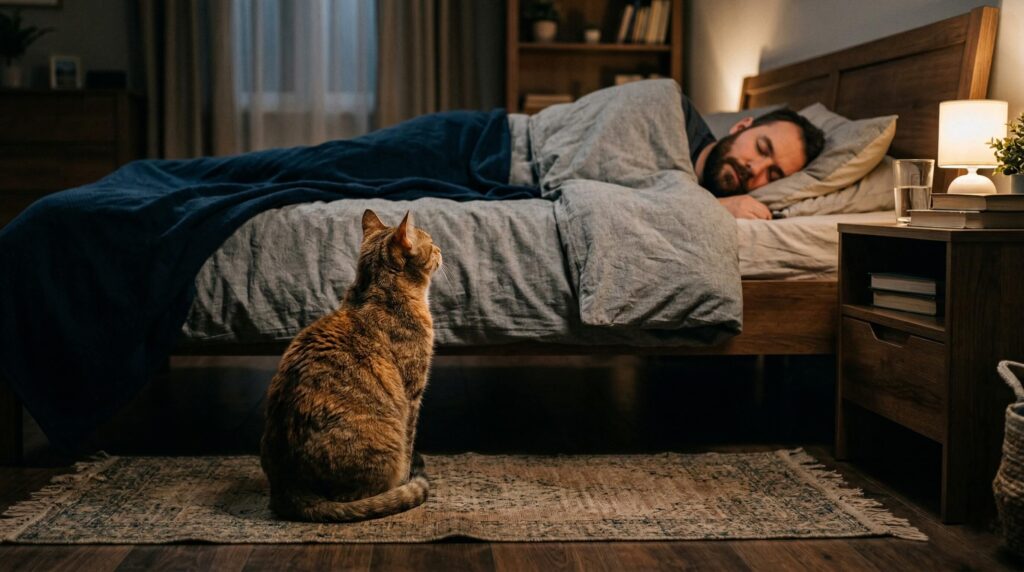
Few things feel stranger than opening your eyes in the middle of the night and finding your cat quietly staring at you from the bed, the floor, or the doorway.
No sound. No movement. Just your cat… watching.
It can feel creepy at first, especially if it happens often. But in most cases, this behavior is completely normal and much less mysterious than it seems.
If you’ve been wondering why does my cat watch me sleep, the answer usually comes down to instinct, attention, routine, curiosity, or comfort. Cats are observant animals, and nighttime gives them the perfect chance to focus on you without all the distractions of the day.
The key is learning the difference between normal cat behavior and signs that something else might be going on.
Why Cats Stare at People in General
Before focusing on sleep, it helps to understand why cats stare at people at all.
Cats use eye contact differently than humans do. A stare can be part of how they:
- Observe movement
- Wait for a response
- Ask for something
- Read your mood
- Stay alert to what is happening around them
In other words, staring is often just your cat paying close attention.
During the day, you might not notice it as much because you’re moving around, talking, and doing things. But at night, when everything is quiet and still, that same behavior feels much more intense.
So if your cat watches you sleep, that does not automatically mean anything is wrong. Often, it simply means your cat is focused on you.
Why Your Cat Watches You Sleep
There isn’t just one explanation. Different cats do this for different reasons, and sometimes several reasons are happening at once.
1. Your Cat Is Waiting for You to Wake Up
This is one of the most common reasons.
Your cat may have learned that the moment you start moving, interesting things happen:
- Breakfast might be coming
- You may give attention
- The bedroom door may open
- Morning play or routine may begin
So your cat watches you because they’re waiting for the first sign that the day is starting.
This is especially likely if your cat also tries to wake you up early. If that sounds familiar, this article connects naturally with: Why Does My Cat Wake Me Up at 4 AM?
For many cats, watching is simply the calm stage that comes before meowing, licking, or stepping on you.
2. Your Cat Is Naturally Alert While You’re Asleep
Cats do not sleep the same way humans do.
While we usually aim for one longer block of sleep, cats tend to sleep in shorter cycles and wake up multiple times through the day and night. That means your cat may be awake, active, and curious during hours when you are deeply asleep.
When your cat wakes up in the night, they may look at you because:
- You are the most important thing in the room
- You are warm and familiar
- Your breathing and small movements are noticeable
- They are checking whether you are awake too
From your cat’s point of view, this is not dramatic. They woke up, saw you there, and watched you for a moment.
Nighttime simply makes the behavior more obvious.
3. Your Cat Wants Attention
Sometimes the stare is not passive at all.
It is a quiet request.
Some cats stare because they want:
- Food
- Petting
- Play
- Interaction
- Access to another room
And they have learned that staring is the first step. If it does not work, they may escalate to:
- Meowing
- Pawing at you
- Walking on you
- Licking your face
This is why “watching you sleep” often overlaps with other nighttime behaviors. If your cat also vocalizes, you may want to connect this with: Why Is My Cat Meowing at Night? (And How to Stop It)
Cats are excellent at noticing patterns. If looking at you has ever led to you waking up and responding, the behavior can become part of their routine.
4. Your Cat Is Curious About Your Movements
Even while you sleep, you are not fully still.
You breathe. You shift position. You make small sounds. Your eyes move under your eyelids. Your blanket moves. All of this can be interesting to a cat.
Cats are visual hunters. They are naturally drawn to subtle movement, especially in a quiet environment.
At night, your sleeping body becomes a source of:
- Small, irregular motion
- Soft sound
- Warmth
- Familiar scent
To a human, that sounds boring. To a cat, it can be surprisingly interesting.
This is one reason some cats sit at the end of the bed and just watch. They are not necessarily planning anything. They are simply observing.
5. Your Cat Feels Safe Around You
In many homes, watching you sleep is actually a sign of comfort.
Cats are cautious animals. They usually do not relax near people they do not trust. If your cat chooses to stay close to you at night and calmly observe you, that often means they feel secure in your presence.
This can be especially true if your cat also:
- Sleeps on the bed
- Stays in the doorway of your room
- Follows you during the day
- Seeks closeness without seeming stressed
If that sounds like your cat, you may also relate to: Why Does My Cat Follow Me Everywhere?
Some cats do not express affection in obvious ways. They may not be lap cats. They may not constantly ask for petting. But staying near you and quietly watching you can still be part of their bond with you.
6. Your Cat Is Checking Your Routine
Cats love predictability.
They quickly learn daily patterns, especially when those patterns affect food, attention, and access to their environment.
If your cat watches you sleep around the same time every night or morning, they may be monitoring the routine they expect from you.
For example, your cat may know:
- When you usually wake up
- When breakfast usually happens
- When you normally get out of bed
- When lights go on or off
So instead of randomly staring, your cat may be “tracking the schedule.”
This is one reason why the behavior can look very intentional. In many cases, it is.
7. Your Cat Is Under-Stimulated
A cat that is not mentally or physically satisfied during the day is more likely to be active and watchful at night.
Bored cats often create their own entertainment. That can include:
- Watching you
- Meowing at night
- Running around the bedroom
- Licking or pawing at you
- Sitting in odd places and monitoring everything
If your cat seems especially restless after dark, boredom may be part of the picture. That ties in well with: Why Is My Cat Bored?
This does not mean your cat is badly behaved. It usually means they need more activity, play, and stimulation before bedtime.
8. Your Cat Is Feeling Clingy or Insecure
Some cats become more watchful when they are feeling especially attached, unsettled, or dependent on their owner.
This may happen after:
- A change in schedule
- Moving house
- Visitors staying over
- Another pet entering the home
- Time apart from you
- Changes in the household routine
In those cases, your cat may watch you sleep because staying close helps them feel reassured.
If your cat has also become more attached during the day, these related topics may fit too:
The key is to look at the full pattern, not just the staring by itself.
Why It Feels So Creepy at Night
A big part of this question is emotional.
Objectively, a cat quietly looking at you is not a dramatic event. But at night, it feels very different.
That is because:
- The room is dark
- You are half asleep
- There is no background noise
- You are not expecting eye contact
- Cats can stay very still for long periods
So a normal behavior suddenly feels eerie.
This is more about the situation than the behavior itself.
If the same cat stared at you in the kitchen at 7 PM, you probably would not think much of it. In a dark bedroom at 3:48 AM, it feels like a horror film.
That does not mean the behavior is abnormal. It just feels intense because of the context.
What Your Cat’s Body Language Can Tell You
The stare itself matters less than the rest of your cat’s body language.
Relaxed watching
Usually means your cat is calm and observant.
Look for:
- Soft posture
- Tail relaxed
- Ears neutral
- Slow blinking
- Quiet body language
This is typically harmless and often linked to curiosity, routine, or comfort.
Expectant watching
Usually means your cat wants something.
Look for:
- Sitting upright and focused
- Looking from you to the door or food area
- Meowing after staring
- Moving closer when you stir
This usually points to attention, food, or routine.
Tense staring
This is less common, but worth noticing.
Look for:
- Stiff body
- Tail flicking
- Ears turned back
- Dilated pupils
- Sudden agitation
That may suggest stress, frustration, overstimulation, or that your cat needs space.
The body language around the stare often gives you the real answer.
Is It Normal for a Cat to Watch You Sleep?
Yes, in most cases this is completely normal.
A cat watching you sleep is usually not a sign of aggression, manipulation, or anything supernatural. It is most often explained by:
- Attention
- Curiosity
- Routine
- Alertness
- Bonding
- Boredom
If your cat is otherwise healthy and behaving normally during the day, this behavior is usually just part of living with a very observant animal.
How to Stop Your Cat From Watching or Disturbing You at Night
If your cat watches you but does not disturb you, you may not need to do anything.
But if the staring turns into meowing, pawing, licking, or walking on you, there are practical ways to reduce it.
1. Increase Play Before Bed
A short, active play session in the evening can make a big difference.
Try 15–20 minutes of:
- Chasing toys
- Wand play
- Short bursts of hunting-style play
This helps your cat use energy at the right time.
2. Feed Later in the Evening
A cat who expects food early may start monitoring you before sunrise.
Feeding a meal later in the evening can help some cats settle for longer and reduce early-morning surveillance.
3. Avoid Rewarding Nighttime Attention-Seeking
If your cat stares, meows, or paws at you and you immediately respond, the behavior may become stronger.
Try not to reinforce the pattern with:
- Talking
- Touching
- Getting up too quickly
- Offering food right away
Consistency matters here.
4. Improve Daytime Enrichment
Many nighttime behaviors improve when the cat’s daytime life improves.
Useful options include:
- Puzzle feeders
- Climbing spaces
- Window perches
- Rotating toys
- Short play sessions throughout the day
A more satisfied cat is usually calmer at night.
5. Give Your Cat a Good Sleeping Spot Nearby
Some cats watch you because they want to stay close but do not have the perfect place to settle.
A soft bed, blanket, or cat tree near your bed can help them feel included without having to monitor you from your pillow.
When You Should Pay More Attention
Watching you sleep is usually harmless. But context matters.
You should be more alert if the behavior is:
- New and sudden
- Much more intense than before
- Paired with nighttime crying
- Paired with restlessness or confusion
- Accompanied by appetite, thirst, or litter box changes
In older cats especially, sudden changes in nighttime behavior can sometimes be linked to medical or cognitive issues.
If your cat seems distressed rather than simply observant, that is worth discussing with a veterinarian.
Frequently Asked Questions
Why does my cat sit and stare at me while I’m sleeping?
Usually because your cat is alert, curious, waiting for you to wake up, or hoping for attention. In many cases, it is just part of your cat’s normal nighttime routine.
Is my cat protecting me while I sleep?
Probably not in the human sense of “guarding,” but your cat may feel safest near you and choose to stay close while remaining watchful.
Why does my cat stare at me and then meow?
That often means the stare is a request. Your cat may want food, attention, play, or for you to get up.
Should I worry if my cat watches me sleep every night?
Not usually. If your cat otherwise seems healthy and relaxed, it is generally normal. It becomes more important to investigate if the behavior is new, intense, or paired with other changes.
Why does my cat only do this at night?
Because cats are often more alert at dawn, dusk, and during parts of the night, and nighttime makes your movements, scent, and routine easier to focus on.
The Bottom Line
If your cat watches you sleep, the most likely explanation is simple:
your cat is paying attention to you.
That attention might be about routine, curiosity, food, comfort, or affection. Sometimes it is just a cat being a cat in the quietest part of the day.
Most of the time, it is normal.
But if the behavior suddenly changes, becomes intense, or comes with other signs of stress or illness, then it is worth looking more closely.
Otherwise, you can take it as one of those strange but very typical parts of living with a cat:
even when you’re asleep, they still want to know what you’re doing.