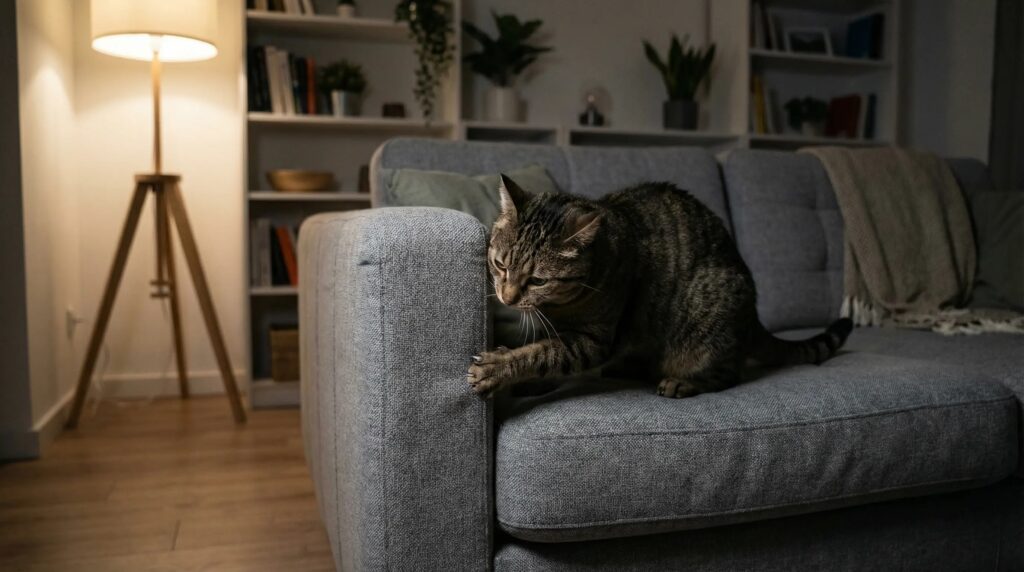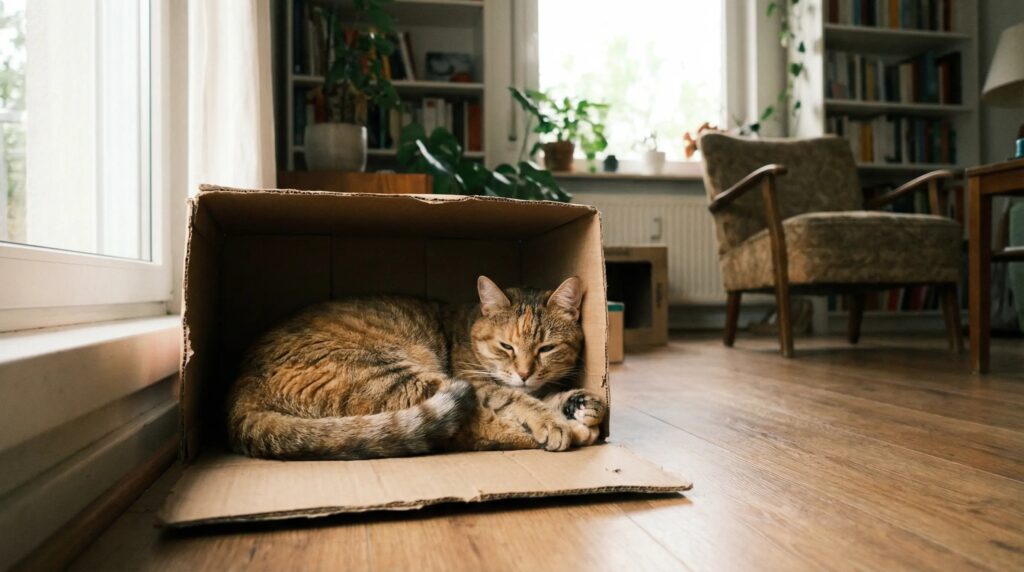

Your cat crosses the mattress, plants a paw on your stomach and continues as though you are a perfectly ordinary stretch of road. You, meanwhile, were rather enjoying being asleep. A small animal can make a surprisingly memorable entrance when all their weight arrives through one foot.
If you are wondering, “Why does my cat walk on me while I sleep?”, possible explanations include moving between places, approaching you for interaction or getting into position to rest. A familiar routine may also play a part. What happens before and after the crossing is more informative than the footstep alone.
You do not have to allow uncomfortable contact to prove that you love your cat. The useful approach is to identify the pattern, make another route or resting place available, and calmly end contact that hurts or interrupts your sleep.
Crossing the Bed Is Different From Settling on You
Be precise about what you are calling walking. Forward steps that carry the cat across you are different from repeatedly pressing the same area with their front paws while remaining in place. If you are unsure, describe the movement instead of choosing a label. That distinction keeps the advice focused on the interruption you actually have.
You may also notice more than one movement in the same visit: a jump onto the mattress, a crossing and then a pause beside you. Identify which part wakes you. If it is the landing rather than the crossing, an alternative access arrangement is the issue to discuss. If it is a paw resting beside your eye, changing the route across your legs will not address that contact. The best first change targets the part that matters, not every behavior the cat performs near a bed.
First, separate the journey from the destination. A cat who takes three steps across your legs and leaves the bed presents a different problem from one who climbs onto your chest and stays there. Both can wake you, but changing a route and changing a resting arrangement are not quite the same task.
Watch the sequence when you happen to be awake. Does your cat enter on one side, cross your body and jump down on the other? Do they circle before lying beside you? Or do they return several times, making noise and waiting for a response?
Those observations help you choose a practical change. They do not require you to know exactly what your cat is thinking. “Crossed from the chair to the bedside table” gives you something to work with. “Conducted a nightly security inspection” is entertaining, but considerably harder to establish.
If the walking ends with your cat staying on your chest, our guide to cats sitting on your chest while you sleep focuses on that resting position. Here, the priority is repeated movement across you and how to make it less disruptive.
Possible Reasons for the Nighttime Crossing
You Are Between Two Places
Sometimes the simplest possibility is worth checking first: your body lies along the route your cat is taking. Look at the room rather than assuming every crossing is a request for affection or breakfast.
For example, a chair beside one edge of the bed and a favorite resting place beyond the other edge could create a route across the mattress. If you sleep in the middle, that route may also cross you. This is a possibility to test by observing the layout, not a universal explanation of the behavior.
Notice whether belongings have changed the available space. A bag, laundry pile or extra pillow might leave less room around your legs. Clearing an ordinary route may be more relevant than buying a new toy, especially when the cat simply passes through and leaves.
Your Cat Is Approaching a Resting Place
Walking can be part of getting into position to lie down. If your cat crosses you, circles and settles beside your hip, the destination may matter more than the brief contact along the way.
Offer a usable alternative close to the area they already choose, while keeping it away from your face and any part of your body where pressure is uncomfortable. A blanket you already own can be a sensible starting point. The goal is not to win a competition for the fanciest bed.
Being nearby can fit a comfortable relationship, but a crossing alone is not proof of trust or affection. Nor does choosing another resting place mean your cat has stopped liking you. Judge the arrangement by whether it works, rather than asking each footstep to deliver a relationship review.
Attention Has Become Part of the Sequence
Cats can return to places where they have received attention before. If approaching the bed regularly leads to petting, play or another enjoyable interaction, that outcome may be relevant to repeated visits.
This does not mean every movement you make teaches a lasting habit. Waking up and protecting yourself are not training failures. Instead, consider what you can arrange while awake: enjoyable contact at a suitable time, an alternative resting place and a consistent response to unwanted crossings.
Compare a visit followed by settling with a visit followed by waiting beside your pillow. Does the cat leave after you get up, or come back when you remain in bed? A recurring sequence can guide your plan without proving that your cat deliberately calculated the best way to ruin your morning.
Early Activity or Play May Be Involved
Many cats are more active around dawn and dusk, although individual schedules differ. An early crossing can therefore occur during a period when your cat is active. That is different from saying every cat becomes increasingly alert throughout the whole night.
If the crossing accompanies pouncing at moving feet or grabbing bedding, play is another possibility. Keep body parts out of games and offer suitable toy play while you are awake. Do not encourage attacks on your toes under the blanket and then expect a completely different rule at bedtime.
If the main problem is a regular early wake-up rather than movement across the bed, why your cat wakes you up at 4 AM addresses that wider pattern. Avoid changing meals or buying a feeder before checking whether food timing is actually relevant.
What to Do When a Step Wakes You
If contact hurts or feels unsafe, calmly end it. Move out of reach where possible and leave your cat a clear route away. If they are relaxed and can be guided safely, direct them towards another resting place rather than pulling them against you.
Do not shove, shout, hit or spray water. The aim is to stop unwanted contact, not frighten your cat. Equally, you do not need to remain motionless while paws are near your face or pressure is uncomfortable. Your wellbeing comes before trying to deliver a perfectly neutral reaction.
Keep the immediate response simple. If you can settle comfortably with your cat elsewhere on the bed, that may be enough for the moment. If crossings keep happening, use a prepared separate sleeping arrangement rather than repeating a frustrating negotiation every few minutes.
Direct paw contact with the face deserves its own boundary. Our article on cats touching your face while you sleep covers that situation. A plan for ordinary footsteps across the blanket should not imply that contact around your eyes is something to ignore.
Decide on the boundary before the next night if you can. “The cat can rest at the foot of the bed, but not walk near the pillow” is clearer than changing the rules only after you are exhausted. Choose something the household can realistically maintain.
Check the Room Before Changing the Cat’s Routine
Make a Route Around You Available
In daylight, look at how your cat gets onto and off the bed. Identify any ordinary route around your sleeping position and whether it stays available once blankets, bags and people are in place.
You might move a laundry basket that blocks the floor beside the bed, or keep one edge of the mattress clear. These are modest layout experiments, not guarantees. Notice whether your cat uses the change without needing to be repeatedly placed on the new route.
Avoid creating a precarious arrangement of furniture just to bypass your stomach. Any surface you offer should be stable and suitable for your cat to use. If you are uncertain about safe access for a cat with mobility difficulties, ask your vet for individual advice.
A room shared by two people needs a shared plan. One person may keep a bedside route clear while another fills it with yesterday’s clothes. Address the actual obstruction; the cat does not need to become the household’s unpaid laundry supervisor.
Make the Alternative Resting Place Usable
Choose somewhere your cat can reach and leave comfortably, away from pressure on your body. Try an existing bed or blanket before assuming the solution requires a purchase.
Availability matters. A resting place that disappears when the duvet is pulled up cannot function as a consistent option. Check whether another pet occupies it, whether a door cuts off access, and whether the location remains available when everyone goes to sleep.
Let your cat investigate while you are awake. You can reward voluntary use with something they enjoy, keeping food rewards within the daily allowance. Do not repeatedly lift them into a bed they immediately leave, or hold them there to demonstrate that it is comfortable.
Treat their response as useful information. If the alternative goes unused, consider its position and accessibility rather than assuming stubbornness. A practical option is one the cat can choose, not merely one that looks attractive in a photograph.
When a Cat-Free Bedroom Makes More Sense
Sharing a bed is optional. If walking across you repeatedly interrupts sleep, or contact is uncomfortable, it is reasonable to choose separate sleeping spaces. That decision does not need to wait until you dislike your cat’s company.
Prepare the arrangement before bedtime. Your cat should still have suitable resting options, water, litter facilities and the resources they normally need. Check the actual location of those resources rather than assuming they remain accessible behind a closed bedroom door.
In a multi-cat home, ask whether a cat can reach the prepared space without having to pass another animal they avoid. Providing an option is different from making that option genuinely usable. If the household arrangement is difficult, seek tailored advice instead of making increasingly restrictive changes.
Do not use a carrier as an overnight containment solution for this behavior. Separate sleeping should be a workable living arrangement, not a punishment delivered after an argument at the pillow. If changing bedroom access leads to persistent distress, consult your vet and, where appropriate, a qualified behavior professional.
Everyone who shares the room should know the plan. Opening the door to invite the cat back in while another person tries to maintain a separate sleeping space makes the setup harder to assess. Discuss compromises while awake, when nobody is explaining them through a yawn.
Use Play and Feeding Changes for the Right Problem
Offer Play Without a Bedtime Workout Requirement
Suitable play belongs in a cat’s routine, but there is no single evening workout that guarantees quiet nights. Offer short sessions suited to the individual cat, using toys rather than hands, feet or your sleeping body.
During wand play, allow catches rather than making the toy permanently impossible to reach. Put string toys away afterwards, and check toys for wear and suitability before leaving them accessible without supervision. A toy that needs an attentive human is not an overnight entertainment system.
Consider when play can fit naturally into the household day, rather than forcing an exhausted person to stage one long session immediately before bed. Your cat’s willingness to engage is useful feedback; the objective is an appropriate outlet, not tiring them until they cannot move.
Walking across you alone is not enough to conclude that your cat is bored. Look at the broader routine before treating enrichment as the answer to every footstep. A room-layout problem may still need a room-layout change, even when your cat has plenty of enjoyable activity.
Check Whether Breakfast Is Part of the Pattern
If visits consistently end with breakfast, review feeding expectations without assuming hunger is the only cause. Make a note of the usual sequence and check who feeds the cat, where food is offered and what happens on different mornings.
Keep meals in the feeding area rather than bringing snacks to the bed in response to walking. A timed feeder may help in some food-related waking patterns, but it will not resolve every reason for approaching a sleeping person.
Work within the existing daily food allowance. Ask your vet before changing a prescribed diet or medically important schedule, and do not withhold needed food to test whether your cat will stop visiting. A feeding plan should meet the cat’s needs, not function as an endurance contest.
Notice Changes That Deserve Veterinary Advice
An established crossing pattern and a new period of nighttime restlessness should not automatically receive the same explanation. Contact your vet if the behavior starts suddenly, intensifies or appears alongside changes in appetite, thirst, movement, toileting or ordinary interactions.
Describe what you can observe: repeated wandering, unusual vocalizing, difficulty settling or apparent disorientation. Those details help an assessment. They do not establish a diagnosis, and an article cannot identify the cause from the fact that your cat stepped across you.
If your cat reacts differently when touched or moved, mention that rather than repeatedly recreating the encounter. The priority is an appropriate assessment, not proving that your cat has developed a bad habit.
Persistent sleep disruption can also justify asking for professional help even without an obvious sudden change. Your vet can assess health concerns and advise whether behavior support would be appropriate. You do not need to reach the point of resenting every bedtime before asking.
Judge Progress by Sleep, Not by a Perfect Explanation
Use a practical outcome: fewer awakenings, no uncomfortable steps or comfortable use of another resting place. You cannot reliably measure whether your cat has become more respectful from the route they take across a mattress.
Keep any notes brief and make them in the morning. Record what woke you, what you remember happening next and which change was in place. There is no need to stay awake deliberately to collect a complete night’s evidence.
If your cat now crosses the end of the bed without waking anyone, that may be a useful result even if they still visit. If a new arrangement causes distress or fails to protect your sleep, reconsider it and seek advice rather than continuing solely to complete a fixed timetable.
Aim for a sleeping setup that works for both of you. Your cat can have company, activity and comfortable places to rest without using your stomach as the main road. You can enjoy the relationship without volunteering for every night shift.