
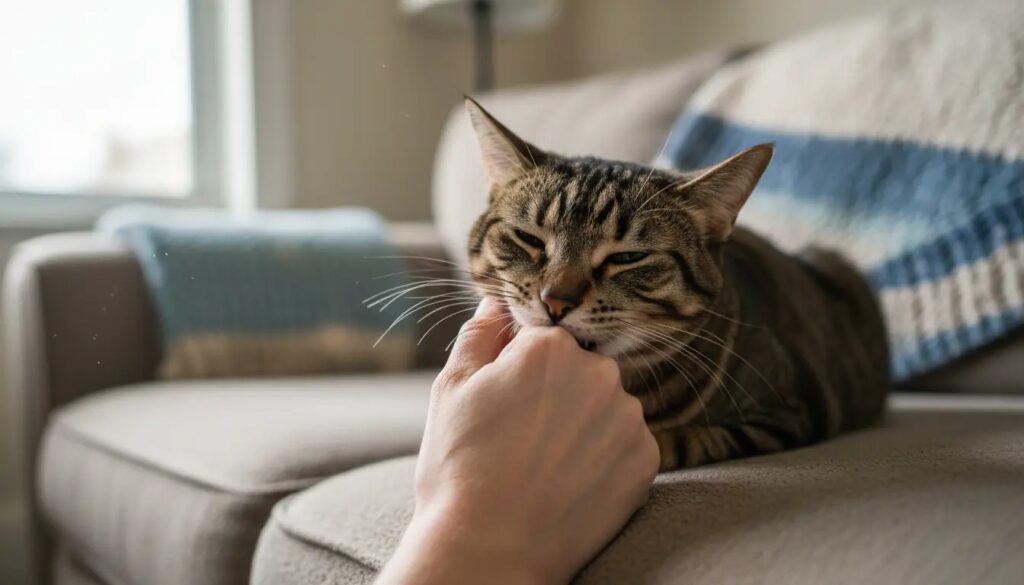
Many cat owners experience the same confusing moment.
Your cat walks up to you, purring, rubbing against your hand, clearly asking for attention. You start petting them, everything seems fine… and suddenly they bite you.
It can feel completely random.
One moment your cat looks happy, the next moment you get a quick bite or grab with their teeth.
This often leads owners to ask the same question:
Why do cats bite when you pet them?
Biting during petting can happen when a cat wants contact to stop, becomes uncomfortable, is frightened or has pain. Some cats give noticeable warnings; others give subtle or very brief signals. A new reaction to touch needs veterinary advice rather than an assumption that you simply missed a cue.
Once you understand the reasons behind this behavior, it becomes much easier to avoid those bites and keep petting sessions enjoyable for both you and your cat.
In this guide you’ll learn:
- The real reasons cats bite during petting
- The body language cats show before biting
- The difference between playful bites and warning bites
- How to stop petting aggression without punishment
- How to make petting sessions safer and calmer
Most importantly, you’ll learn how to recognize the signals your cat gives before a bite happens.
The First Thing to Understand: Cats Communicate Differently
Cats don’t communicate in the same way humans do.
They don’t use words, so they rely on body language, movement, and subtle signals to express how they feel.
Possible warning signs include:
- tail flicking or whipping
- ears turning sideways or backward
- muscles becoming tense
- pupils dilating
- sudden stillness
- skin twitching along the back
These signals often appear seconds before the bite happens.
The problem is that many owners simply don’t notice them.
When those signals are ignored, the cat may escalate communication to a quick bite to say:
“That’s enough.”
Not All Bites Mean Aggression
Many people assume that biting automatically means aggression.
In reality, there are different types of cat bites during petting.
Playful bites
Some cats lightly grab or nibble during interaction. This usually happens when they are feeling playful or stimulated.
Playful bites are usually:
- gentle
- brief
- not meant to hurt
- often followed by more playful behavior
Warning bites
These bites are meant to stop the interaction.
They may still be quick and controlled, but they are more deliberate. Your cat is essentially saying:
“Stop touching me.”
Understanding the difference between these two helps you react correctly.
Why Cats Bite During Petting
There are several common reasons why this happens.
1. Overstimulation
Some cats tolerate only brief stroking. Repeated touch may become unpleasant, and overstimulation is one possible explanation for petting-related aggression. The exact reason is not always clear. Stop when your cat becomes tense or turns away, and do not keep petting to test their limit.
2. Sensitive areas of the body
Some areas of a cat’s body are much more sensitive than others.
Most cats enjoy being petted on:
- the head
- the cheeks
- under the chin
- the base of the ears
Areas that commonly trigger biting include:
- the belly
- the lower back
- the tail base
- the hind legs
Each cat has different preferences, so learning where your cat enjoys being touched is important.
3. Too much stimulation too quickly
Fast movements or rough petting can overstimulate cats much faster.
Some cats prefer slow, gentle strokes instead of continuous rubbing or scratching.
If the petting becomes too intense, the cat may respond with a bite as a way to stop it.
4. Mood changes
Cats can change mood quickly.
They may approach you wanting attention, but after a short time they feel satisfied and want the interaction to stop.
Humans often continue petting because the cat initially seemed happy, but the cat may already be finished with the interaction.
5. Stress or anxiety
If a cat is already stressed, their tolerance for touch becomes much lower.
Small triggers can cause them to react more quickly.
Understanding stress signals in cats can help explain why some cats suddenly react more strongly to normal interactions.
The Warning Signs Most Owners Miss
The key to preventing bites is learning to recognize your cat’s signals early.
Some of the most common signs appear just before a bite happens.
Tail movement
A slow, relaxed tail is usually a good sign.
But if the tail starts flicking sharply or whipping back and forth, it often means irritation is building.
Ears rotating backward
When ears turn sideways or slightly backward, your cat may be becoming uncomfortable.
Sudden stillness
If a cat suddenly freezes while being petted, it may mean they are preparing to stop the interaction.
Skin twitching
Some cats show small ripples or twitches in their back muscles when overstimulated.
When you notice these signals, it’s best to stop petting immediately.
How to Stop Cats From Biting During Petting
Adjusting the interaction may reduce bites, but progress varies. Start with brief, voluntary contact and seek veterinary advice about new or concerning reactions.
1. Keep petting sessions shorter
Instead of long petting sessions, try shorter ones.
Pet your cat for a few seconds, then stop and let them decide if they want more.
This gives your cat a chance to choose whether to continue.
2. Watch your cat’s body language
The earlier you notice warning signs, the easier it is to stop before a bite happens.
Pay attention to:
- tail movement
- ear position
- muscle tension
Stopping early helps your cat feel respected and understood.
3. Focus on areas cats enjoy most
Most cats prefer being touched around the head and face.
Try focusing on:
- cheeks
- chin
- forehead
- base of the ears
Avoid sensitive areas unless you know your cat enjoys them.
4. Let your cat control the interaction
Instead of holding your cat in place or continuing petting when they try to move away, let them decide when the interaction ends.
Cats feel safer when they control distance.
5. Never punish biting
Punishing a cat for biting during petting usually makes the situation worse.
Your cat may become:
- fearful
- defensive
- less trusting
Instead of punishment, focus on understanding the signals before the bite happens.
Pain can make touch uncomfortable. If biting is new, becomes stronger or happens when a particular area is touched, stop handling that area and contact your veterinarian. Do not press or repeatedly stroke it to check whether it still hurts.
If a bite breaks your skin, wash it with soap and warm water. Seek prompt medical advice for bites to the hand or face, signs of infection, or a deep wound. Severe bleeding or a large, deep wound needs urgent care. Keep children away from interactions that have already led to biting.
When Biting May Be a Sign of a Bigger Problem
Occasionally, frequent biting during petting can be connected to deeper behavioral issues.
For example:
- chronic stress
- frustration
- lack of stimulation
- redirected aggression
If your cat shows multiple behavior changes at once, it may be helpful to look at the bigger picture of their environment and routine.
Should You Train a Cat Not to Bite?
Many owners wonder if biting during petting can actually be trained out of a cat completely.
The short answer is: not always. And in most cases, that shouldn’t even be the goal.
Preferences for physical contact vary between individuals. A cat approaching you does not mean they want prolonged stroking or restraint.
Instead of trying to eliminate the behavior entirely, the better goal is to understand the limits of your individual cat and create interactions that stay within those limits.
Learning your cat’s tolerance level
Every cat has a different tolerance for touch.
Some cats enjoy being petted for several minutes at a time, while others prefer only short interactions. This tolerance can also change depending on the cat’s mood, time of day, or environment.
For example, a cat may happily accept petting while relaxing on the couch but react very differently if they are alert, excited, or watching something through the window.
Paying attention to these differences helps you predict when your cat will enjoy attention and when they may not.
Counting strokes method
It can help to notice how much contact your own cat accepts, then stop before their usual signs of discomfort. This is observation, not a fixed number of strokes that is safe for every cat.
This method helps owners identify the point where their cat usually becomes overstimulated.
Start by gently petting your cat and counting each stroke.
For example:
1 stroke
2 strokes
3 strokes
4 strokes
If your cat usually becomes irritated after around five strokes, stop at three or four instead. Then pause and let the cat decide whether they want more.
Many cats will lean forward or nudge your hand again if they want to continue.
Stopping before discomfort may help, but it does not guarantee that a bite cannot happen.
Let the cat initiate contact
Another helpful habit is allowing your cat to initiate most petting sessions.
Cats that approach you for attention are usually in the right mood for interaction. When a cat chooses the interaction, they are far less likely to react defensively.
If a cat moves away, turns their head, or shifts their body, it’s often best to simply stop and let them go.
Respecting those signals builds trust over time.
Why respecting boundaries matters
Cats that feel their signals are respected tend to become more relaxed and confident around their owners.
When cats know they can leave an interaction without being forced to stay, they often become more affectionate overall.
In many homes, owners notice that once they start paying attention to these signals, biting during petting becomes far less common.
The goal isn’t to eliminate communication. The goal is to understand it.
Building Better Interactions With Your Cat
The best petting sessions happen when both the cat and the owner understand each other.
Instead of thinking of biting as a bad habit, think of it as communication.
Your cat is simply saying:
“I’ve had enough.”
Once you start recognizing the signals before a bite happens, you’ll notice that these situations become much easier to manage.
Petting becomes calmer, safer, and more enjoyable for both of you.
And most importantly, your cat learns that their signals are being respected.
For softer, controlled nips, see why cats bite gently and how to read the rest of their body language.