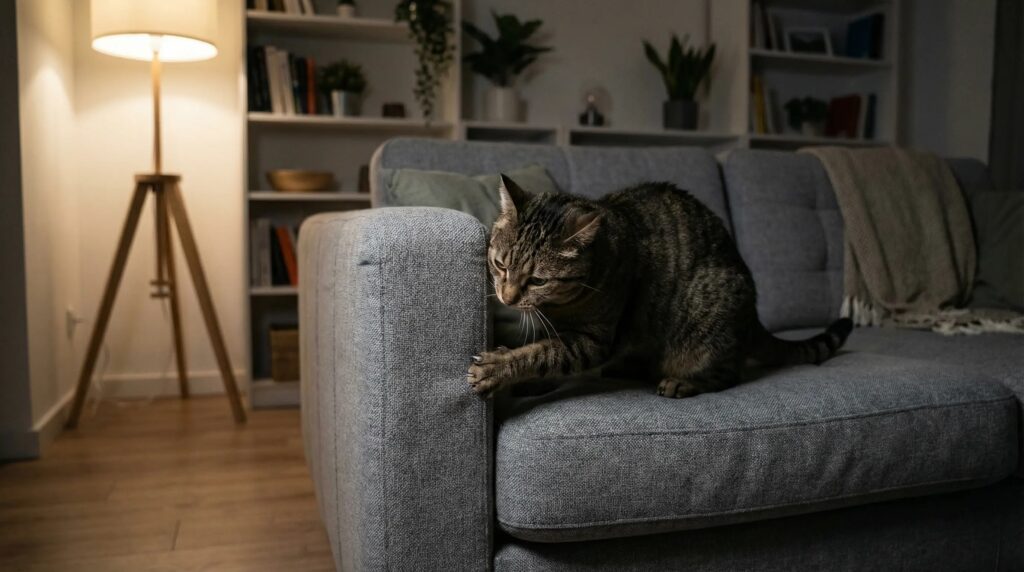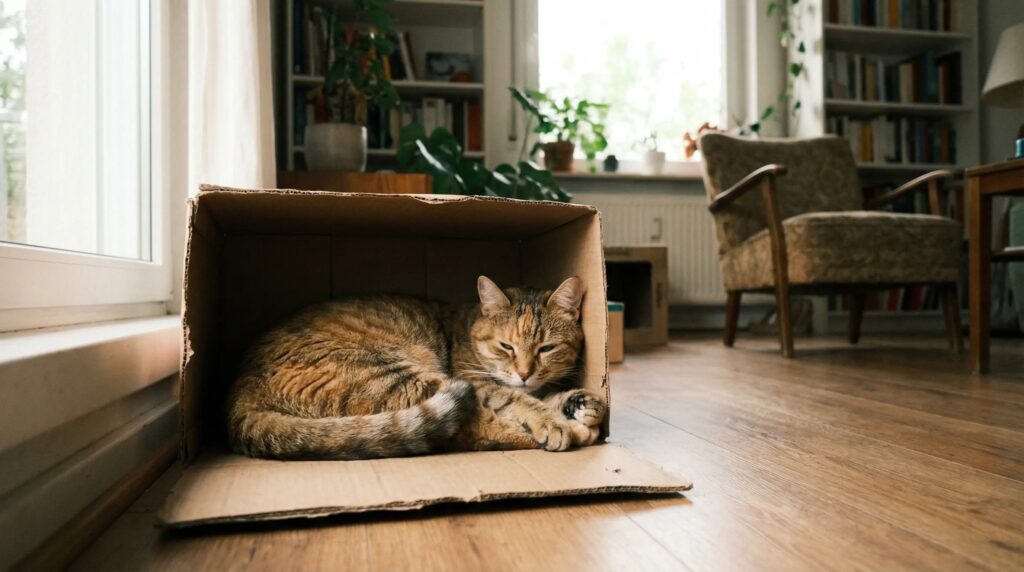
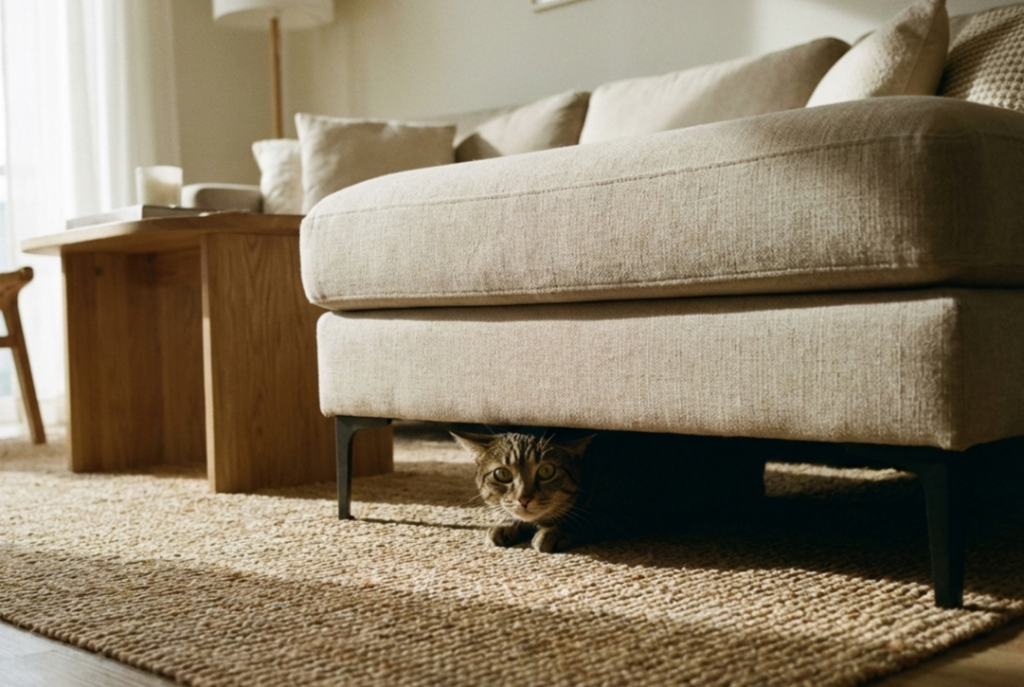
Signs of stress in cats can include hiding, tense body language and changes in everyday behavior. The useful starting point is what has changed for your particular cat, not how many boxes they tick on an internet checklist. A new habit may relate to the environment, but pain or illness can also affect behavior.
If your cat seems different, describe the change and contact your veterinarian about concerning symptoms. You can make the home easier to navigate while getting advice; you do not have to settle on a diagnosis first. Your cat has not left you a written explanation, which is inconvenient, but entirely on brand.
This guide helps you organize what you notice. It does not turn a posture, a hiding place or a quiet afternoon into proof of stress.
Start With Your Cat’s Usual Pattern
A naturally reserved cat and an outgoing cat do not have the same starting point. Write down what ordinary life looks like for yours: where they rest, how they approach meals, which rooms they use and what interaction they usually accept.
Then describe the difference. “She spends afternoons behind the sofa instead of on the window seat” is useful. “She has become antisocial” adds an explanation that the observation does not establish.
Be honest about what you know. If you work away from home, you may not know whether a resting spot is new or simply new to you. If several people feed the cat, ask what each person has seen rather than assuming everyone has noticed the same pattern.
Do not compare your cat with the neighbor’s enthusiastic lap resident. Compare them with their own recent behavior. The question is not whether they are sufficiently sociable. It is whether something has changed and whether they appear to be having difficulty.
You also do not need several signs before asking for help. One important change can deserve attention. A checklist is a way to remember observations, not a minimum entry requirement for calling the clinic.
Body Language: Read the Situation, Not One Feature
Flattened ears, wide pupils and attempts to hide can occur when a cat feels threatened or stressed. Look at the whole situation rather than assigning a fixed meaning to one feature. Consider what happened nearby and what the cat did afterward.
For example, if your cat lowers their body when a visitor approaches, describe the approach, the posture and whether the cat leaves. Do not keep approaching to see whether the same thing happens again. One observation is more useful than a small home experiment nobody agreed to.
A still cat is not automatically a relaxed cat, but stillness does not establish one emotional state either. Avoid presenting “statue mode” as a diagnosis. You can say that your cat remained motionless, watched the doorway and did not approach when you entered.
Similarly, a photograph captures a moment, not the whole explanation. If you have a useful image or recording, keep the circumstances alongside it. Was another animal nearby? Had someone reached toward the cat? Did the behavior happen before or after a noise?
You do not need a chart open beside every whisker. Notice the change, give the cat room and keep your interpretation modest.
Hiding and Changes in Where Your Cat Spends Time
Hiding can help a cat avoid an uncomfortable interaction. A secluded place can also be an ordinary resting space. The fact that your cat enjoys a box does not, by itself, mean something is wrong.
The useful observation is a change in access or use. Perhaps your cat still visits the kitchen but no longer enters the living room. Perhaps they choose a different route when the other cat sits beside the stairs. Record where the change happens rather than describing the entire home as stressful.
Do not pull a cat out simply to check whether they will behave normally in the room. Leave a suitable retreat available and avoid blocking the exit. Watch from a comfortable distance, without turning the hiding place into a busy inspection desk.
If hiding has started suddenly, consider that broader change, including eating, movement and toileting. Do not assume that identifying a recent household event excludes a health problem.
When describing hiding to your vet, include what you can still observe. “He comes out for meals but returns under the bed when visitors arrive” is different from “I have not seen him eat and cannot tell whether he is using the litter box.” The uncertainty belongs in the conversation too.
Changes in Interaction and Contact
Notice whether your cat approaches, moves away or accepts different kinds of contact than before. Avoid translating every change into a feeling such as jealousy or rejection. Your job is to report the interaction, not write the cat’s inner monologue.
If your cat moves away when touched, stop. If they growl or swat during handling, do not repeat the handling to test your theory. Tell your veterinarian what changed, including any difference in movement or ordinary activity.
Use concrete details. “He used to sit beside me while I worked; now he leaves when I reach toward him” is clearer than “he is moody.” If the behavior only happens with one type of interaction, mention that rather than assuming the cat dislikes everyone.
Let contact remain optional. A cat choosing to sit nearby has not necessarily asked to be picked up. You can offer company without insisting on cuddles, especially when you are already unsure how comfortable the cat feels.
In a shared household, agree on that boundary. One person giving space while another keeps reaching into a hiding place makes the situation harder to assess. Explain what you have noticed and ask everyone to stop unnecessary testing.
Appetite Changes Need Their Own Attention
A cat eating less or refusing food should not be dismissed as stressed or picky. Loss of appetite can have different causes and needs veterinary advice. Contact the clinic when you notice that your cat is not eating; do not use a fixed waiting period from a behavior article as permission to delay.
Tell the vet what “not eating” means in practice. Has the cat ignored the usual meal, eaten only a little or approached food and moved away? What was offered, and when did you last see normal eating?
In a multi-cat home, check whether you actually saw this cat eat. An empty shared bowl does not tell you which animal emptied it. The household’s most enthusiastic diner may have been doing some unofficial overtime.
Keep changes in food, meal location and access separate from your explanation. They may be relevant information, but the timing alone does not prove a cause. Mention other changes too, rather than leaving them out because they do not fit a stress theory.
Do not force food into your cat’s mouth or start a medication yourself. Ask the clinic what to do while arranging assessment and follow the advice given for your cat.
Grooming Changes Are Not Automatically Emotional
Excessive licking, thinning fur or damaged skin deserve veterinary assessment. Overgrooming can involve itch or pain, and a psychological explanation should not be assumed from the location of a bald patch. A cat licking their belly has not provided a diagnosis.
Note where the licking happens, what the skin looks like and when you first noticed the change. If possible, take a clear photograph without restraining your cat or repeatedly exposing an uncomfortable area.
Describe the behavior as well as the result. “There is a new thin patch on the inner leg” and “I often see licking there after dinner” are separate observations. You might know one without knowing the other.
If grooming seems reduced, record that change too and discuss it with your vet. Avoid deciding that a less tidy coat proves withdrawal or that more grooming proves anxiety. Those are explanations to investigate, not conclusions the coat can settle.
There is no need to follow your cat around counting tongue movements. Ordinary observations, the affected area and any other changes are a more workable starting point.
Litter-Box Changes: Check Health Before Blaming Stress
Urinating outside the box, frequent attempts to urinate, crying during urination or blood in urine require veterinary attention. Urinary problems can have several causes. Stress may be relevant in some cases, but it is not a safe assumption to make at home.
If your cat repeatedly tries to urinate and passes little or no urine, seek immediate veterinary care. Suspected urinary obstruction is an emergency. Do not wait for an environmental adjustment to work or try to press the abdomen yourself.
For other toileting changes, explain what you observed and ask the clinic how urgently your cat should be seen. Distinguish passing urine somewhere unusual from repeated attempts with little output. If you cannot tell which happened, say so.
Keep the box accessible while getting advice. Do not punish an accident or close off the cat’s resources as a response. That does not address the reason for the change.
It may help to note whether the box was moved, whether another animal was nearby or whether something blocked the route. These details can inform the discussion without replacing a medical assessment.
Look for Changes in the Home Without Assuming Causation
New animals, visitors, building work and changes in the household can affect a cat’s comfort. Different cats respond differently. Something one cat tolerates may be difficult for another.
Make a short timeline. Include when you first noticed the behavior and any relevant events around that time. Keep “the builders started on Tuesday” separate from “hiding began on Thursday.” The order is useful; it does not prove that nothing else could be involved.
Think about practical access as well as obvious noise. Was a familiar room closed? Did a feeding area move? Is a resting spot now beside a busy route? List changes you can verify rather than looking for an invisible trigger until you find one that sounds convincing.
If more than one thing changed, say that. You may not be able to isolate one explanation, and that is not a failure of observation. It is an ordinary feature of a household where several people, animals and appliances are living their lives.
The same applies when nothing obvious changed. “I cannot identify a household change” is useful information for the vet. It is not a reason to invent a hidden emotional cause or dismiss the behavior as random.
In Multi-Cat Homes, Check Routes and Resource Access
Not fighting does not establish that every cat is comfortable. Cats may use shared resources at different times, and access can be restricted without an obvious confrontation. Look at where each cat goes and what happens along the way.
For example, note whether one cat turns back when another occupies a doorway. Do not provoke an encounter to check. If you have seen the same sequence during ordinary daily activity, describe it and the location.
Review the arrangement of food, water, litter boxes and resting areas. Multiple resources clustered together may still require cats to approach the same small area. Environmental guidelines recommend separate options and locations rather than assuming sharing is comfortable.
Use a simple sketch if that makes the situation clearer. Mark the bowls, boxes, resting spots and narrow routes. This is information to discuss, not an architectural competition. Nobody needs a professionally rendered floor plan of the laundry.
Avoid labeling one cat “the bully” and the other “the anxious one” before assessment. Record the interaction and whether both can reach what they need. If there is conflict or you cannot provide safe access, ask for an individualized management plan.
Make Notes That a Professional Can Actually Use
A small record can connect scattered observations without making cat-watching your second job. Write down a few events you see during ordinary life, not a running account of every movement.
For each useful event, include:
- What the cat did, in plain language.
- Where and when it happened.
- What you saw immediately beforehand.
- What people or other animals did next.
- Any change in eating, grooming, movement or toileting.
Keep observation and interpretation apart. “Stayed under the bed during the visit” is an observation. “Hates my sister” is a theory, and probably an awkward one to add to the family group chat.
Record things you missed as well. If you heard a sound but did not see the beginning of the interaction, say that. If you cannot tell which cat used the litter box, do not assign the event to the cat you are already worried about.
A brief recording may help illustrate behavior that does not occur at the clinic, provided it is safe to make and does not delay care. Do not frighten your cat, repeat uncomfortable contact or keep an urgent problem waiting for a better camera angle.
Bring medication details and relevant medical history to the conversation. Ask other carers what they have noticed. You can call before the notes are complete; gathering information should support getting help, not become another obstacle to it.
What You Can Do While Getting Advice
Reduce unnecessary pressure. Allow retreat, keep essential resources accessible and avoid forced handling. Do not respond to a concerning change with punishment or repeated attempts to make your cat act normal.
Choose adjustments you can describe and maintain. If an ordinary route is blocked by stored boxes, clear it safely. If visitors keep approaching the cat, ask them to give space. You do not need to redesign the entire home before contacting a professional.
Keep track of what you change so you can report it accurately. If several adjustments happen together, avoid claiming that one particular item caused an improvement. A useful result and a proven explanation are not the same thing.
For a separate discussion of practical environmental measures, see how to help a stressed cat feel more comfortable. Use that guide alongside advice about unexplained symptoms, not instead of it.
Do not treat a supplement or diffuser as a substitute for investigating the change. Discuss any proposed treatment with your veterinarian. This article does not recommend a product or promise that a purchase will settle the problem.
Judge Progress by Everyday Function, Not a Deadline
Agree on something specific to observe. Is your cat returning to a usual room? Can each cat reach the feeding area? Is normal eating continuing? These practical questions are clearer than deciding whether the cat looks “happy enough.”
Follow the monitoring and review plan your vet gives you. Do not wait a universal number of days or weeks because an article says environmental changes take time. If something new appears or the situation worsens, contact the clinic again.
An improvement in one behavior does not explain every other concern. A cat leaving their hiding place still needs attention if eating or toileting remains abnormal. Keep the observations connected rather than declaring the entire problem solved after one encouraging moment.
Notice what is workable for the household too. If an arrangement cannot be maintained safely, explain that when asking for advice. A plan that depends on someone supervising every doorway all day may need adjustment, not more determination.
A Useful Observation Is Better Than a Confident Guess
You do not have to become an expert in feline emotions to help your cat. Notice changes, describe them honestly and seek veterinary advice when something is concerning. Leave room for individual preferences without brushing off new difficulties.
Start with the most concrete observation you have. Keep care practical, contact optional and medical questions in the right hands. Your cat does not need a perfect translation of their behavior. They need you to notice when ordinary life is no longer quite ordinary.